
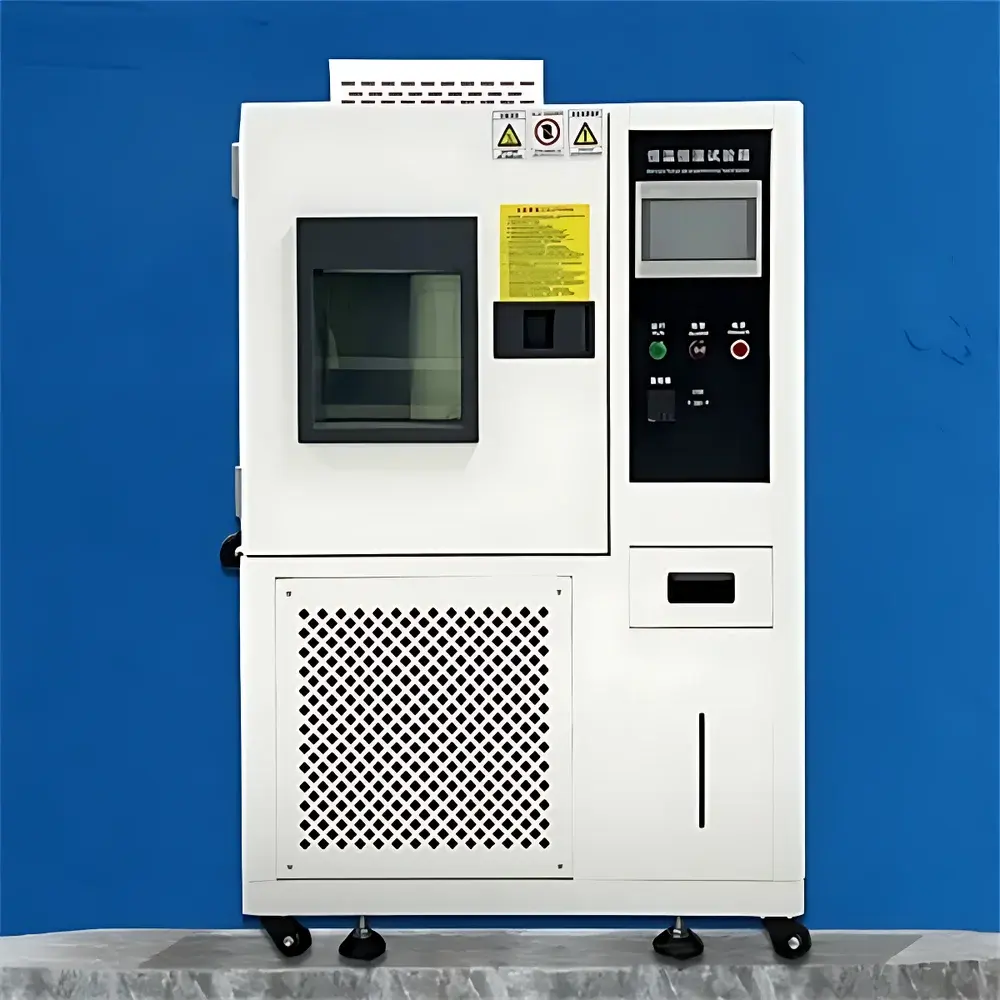
Jianhu JH-TS2 Two-Zone Thermal Shock Test Chamber
| Brand | Jianhu |
|---|---|
| Origin | Shanghai, China |
| Model | JH-TS2 |
| Temperature Range (High Zone) | +150°C to +200°C |
| Temperature Range (Low Zone) | -70°C to -40°C |
| Thermal Shock Range | -70°C ↔ +150°C |
| Temperature Stability | ±0.3°C |
| Ramp Rate (Heating) | ≥30°C/min (typical, 5–15°C/min avg. across full range) |
| Ramp Rate (Cooling) | ≥15°C/min (typical, 5–10°C/min avg. across full range) |
| Internal Volume Options | 50 L / 100 L / 200 L / 400 L |
| Uniformity (High/Low Zones) | ±0.5°C |
| Humidity Control Capability | Dew Point Controlled to ≤ –75°C at –70°C Setpoint |
| Compliance | GB/T 2423.1–2008 (Test A), GB/T 2423.2–2008 (Test B), GB/T 10592–2008, GJB 150.3–1986, GJB 360A–1996 Method 107 |
| Construction | Dual-chamber (hot/cold) with pneumatic transfer mechanism |
| Control System | 10.4″ TFT touchscreen HMI with real-time dew point monitoring, audit trail, and data logging |
Overview
The Jianhu JH-TS2 Two-Zone Thermal Shock Test Chamber is an engineered solution for accelerated reliability assessment of electronic components, semiconductor wafers, PCB assemblies, and advanced packaging materials under extreme transient thermal stress. Operating on the principle of rapid, repeatable thermal transition between physically isolated high-temperature and low-temperature chambers, the JH-TS2 eliminates thermal lag inherent in single-chamber designs and enables precise control of dwell time, transfer speed, and thermal gradient. Unlike conventional thermal shock systems, the JH-TS2 integrates a dew point–regulated humidity management architecture—critical for applications where condensation or frost formation at cryogenic setpoints (e.g., –70°C) must be suppressed to preserve measurement integrity and prevent device degradation. Its dual-zone configuration complies with internationally recognized test standards including IEC 60068-2-14, MIL-STD-810H Method 503.5, and ASTM D5229/D5229M for thermal cycling qualification.
Key Features
- Dual independent chamber design: Separated hot zone (up to +200°C) and cold zone (down to –70°C), each with dedicated heating/cooling circuits and PID-controlled temperature regulation.
- Frost-free operation at –70°C: Achieved via integrated desiccant rotor dehumidification system maintaining dew point ≤ –75°C—ensuring no surface condensation on sensitive semiconductor substrates during extended low-temperature exposure.
- Real-time dew point monitoring: Embedded chilled-mirror hygrometer continuously measures and displays actual dew point temperature alongside chamber setpoints; alarm thresholds configurable per test profile.
- Pneumatically actuated specimen transfer: High-speed lift-and-shift mechanism completes chamber-to-chamber transfer in <5 seconds with positional repeatability <±0.3 mm, minimizing thermal soak delay.
- Uniform airflow distribution: Honeycomb diffuser plates and optimized recirculation ductwork ensure spatial temperature uniformity ≤ ±0.5°C across active test volume (per GB/T 10592–2008).
- Compliance-ready control architecture: Firmware supports 21 CFR Part 11–compliant electronic signatures, user-level access control (admin/operator/viewer), and immutable audit trail logging of all parameter changes and alarm events.
Sample Compatibility & Compliance
The JH-TS2 accommodates standard JEDEC trays (up to 300 mm × 300 mm footprint), wafer cassettes (25–50 slot), and bare-die carriers without modification. Its internal chamber geometry supports both static mounting and dynamic loading configurations for automated test integration. All operational parameters—including ramp rates, dwell times, cycle counts, and dew point offsets—are programmable and traceable in accordance with GLP and GMP requirements. The system satisfies mandatory environmental test clauses in IPC-9701A (Performance Requirements for Lead-Free Solder Attachments), JEDEC JESD22-A104F (Temperature Cycling), and AEC-Q200 (Stress Tests for Passive Components). Calibration certificates are NIST-traceable and include as-found/as-left data for temperature sensors and dew point transducers.
Software & Data Management
Jianhu’s proprietary TS-Control Suite (v4.2+) provides full-cycle test orchestration via Ethernet-connected PC or embedded HMI. It supports multi-step profile scripting with conditional branching (e.g., “if dew point > –72°C, pause and activate desiccant regeneration”). Raw sensor data—including chamber air temperature, specimen surface temperature (via optional IR port), dew point, and transfer timing—is sampled at 1 Hz and exported in CSV or XML format compliant with ASTM E2911. Historical data is stored locally (16 GB SSD) with automatic backup to network shares. Audit logs record operator ID, timestamp, action type, and pre-/post-value for every parameter change—meeting FDA 21 CFR Part 11 requirements for electronic records and signatures when configured with PKI authentication.
Applications
- Semiconductor wafer-level reliability screening: Mitigating frost-induced electrical leakage and optical interference during –70°C thermal shock qualification per JEDEC JESD22-A106B.
- Advanced packaging validation: Assessing interfacial delamination in fan-out wafer-level packages (FOWLP) and 2.5D/3D IC stacks subjected to 1000+ thermal cycles.
- Aerospace electronics: Qualifying avionics modules per DO-160G Section 4.9 (Temperature Shock) with documented dew point control history.
- Automotive ADAS sensor modules: Verifying solder joint integrity and lens adhesion stability across –40°C ↔ +125°C transitions.
- Medical device sterilization validation support: Correlating thermal shock resistance with ethylene oxide (EtO) and gamma irradiation durability.
FAQ
What is the lowest achievable dew point at –70°C operating temperature?
The JH-TS2 maintains a sustained dew point of ≤ –75°C during continuous –70°C operation, verified by chilled-mirror hygrometry per ISO 4677.
Does the system support automated pass/fail evaluation based on thermal cycle deviation?
Yes—TS-Control Suite allows definition of tolerance bands for ramp rate, dwell time, and temperature deviation; violations trigger configurable alerts and auto-halt.
Is third-party calibration certification included with delivery?
Each unit ships with a factory calibration report traceable to NIST standards; optional UKAS-accredited calibration is available upon request.
Can the chamber accommodate custom fixtures for non-standard DUT geometries?
Standard mounting rails and T-slot panels support user-designed fixtures; mechanical interface drawings and load-bearing specifications are provided prior to installation.
How is compliance with 21 CFR Part 11 enforced in the software?
Electronic signatures require dual-factor authentication; all critical actions generate time-stamped, immutable audit entries with hash-verified integrity checks.



