
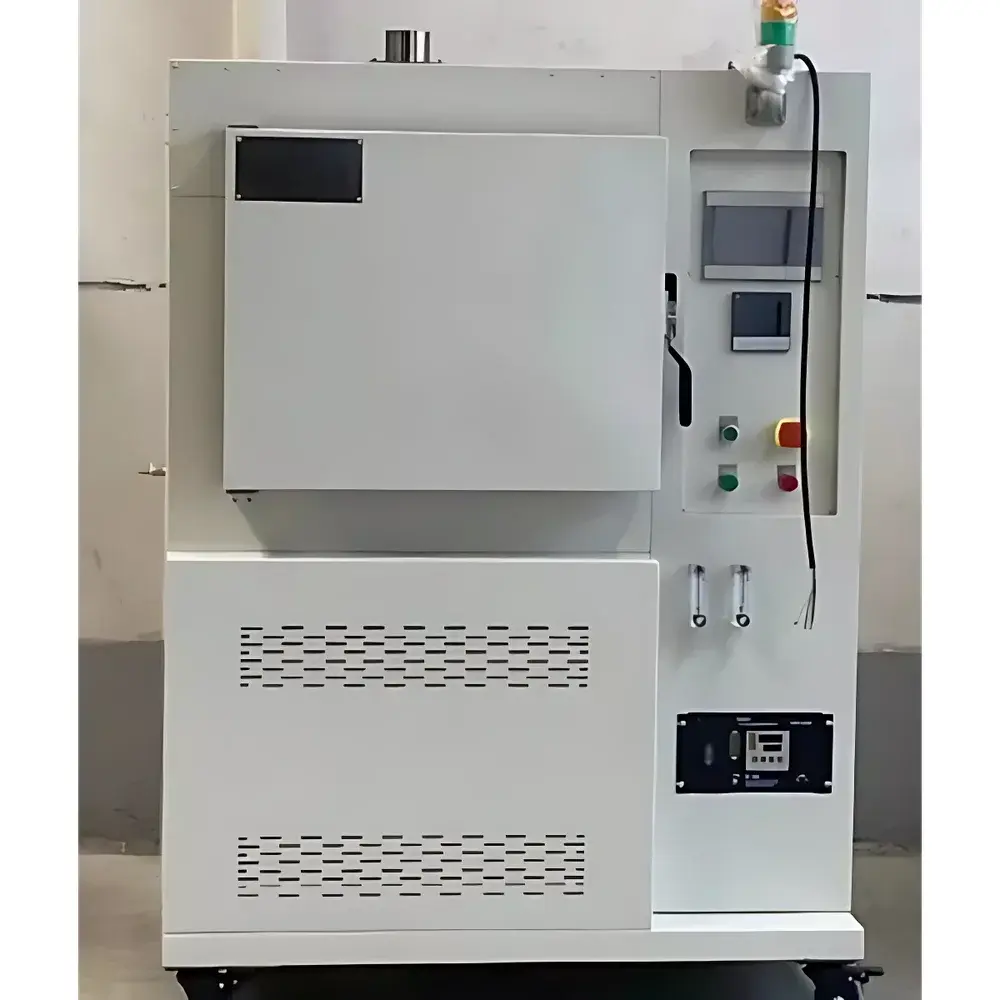
Jianhu PI-Series Oxygen-Free High-Purity Nitrogen Purged Oven
| Brand | Jianhu |
|---|---|
| Origin | Shanghai, China |
| Model | Jianhu PI-Series |
| Temperature Range | -70 °C to +150 °C |
| Refrigeration | Compressor-based |
| Explosion-Proof Design | Yes |
| Temperature Fluctuation | ±0.5 °C |
| Temperature Uniformity | ±2.0 °C |
| Temperature Deviation | ±2.0 °C |
| Heating Rate | ≤60 min (from 25 °C to 150 °C) |
| Cooling Rate | ≤45–80 min (depending on configuration) |
| Chamber Dimensions | Customizable standard and extended volume options |
| Atmosphere Control | High-purity nitrogen (≥99.999% N₂), continuous purge with pressure-regulated flow and O₂ monitoring |
Overview
The Jianhu PI-Series Oxygen-Free High-Purity Nitrogen Purged Oven is an engineered environmental test chamber specifically designed for thermal processing of oxygen-sensitive advanced materials—particularly polyimide (PI) films, precursors, adhesives, and composites—under strictly controlled inert atmospheres. Unlike conventional high-temperature ovens, this system integrates dual-zone thermal management (refrigeration + heating), explosion-proof mechanical architecture, and real-time nitrogen purity assurance to eliminate oxidative degradation during critical thermal stabilization, imidization, or post-cure stages. Its operational principle relies on dynamic inert gas displacement: high-purity nitrogen (≥99.999%) is continuously introduced at regulated flow and overpressure to displace ambient air, suppress residual O₂ concentration below 10 ppm (verified via integrated electrochemical O₂ sensor), and maintain a stable, non-reactive thermal environment across the full temperature range (−70 °C to +150 °C). This capability is essential for preserving stoichiometric integrity in PI synthesis, preventing carbonyl formation, discoloration, and premature chain scission—factors directly linked to dielectric loss, tensile strength decay, and long-term thermal aging performance.
Key Features
- Explosion-proof certified construction (IEC 60079-0 / GB 3836.1), including intrinsically safe electrical interfaces, reinforced stainless-steel chamber walls, and pressure-relief venting compliant with ASME BPVC Section VIII
- Dual-mode thermal control: cascade refrigeration system (R404A/R23) coupled with PID-controlled resistive heating elements enables precise ramp-hold-cool profiles with ≤0.5 °C fluctuation and ±2.0 °C uniformity across working volume
- Integrated nitrogen management subsystem: mass-flow controller (MFC), back-pressure regulator, O₂ analyser (0–100 ppm range, ±0.1 ppm resolution), and automatic purge sequence logic to ensure <10 ppm residual O₂ prior to and during thermal exposure
- Modular chamber design with customizable internal dimensions (standard volumes from 50 L to 1000 L); all wetted surfaces electropolished 316L stainless steel; double-gasketed door with helium-leak-tested seal integrity (≤1×10⁻⁹ mbar·L/s)
- Compliant thermal profiling: meets ASTM D3418 (Tg determination), ISO 2133 (heat resistance of plastics), and USP (sterile barrier validation support) requirements when operated under documented IQ/OQ protocols
Sample Compatibility & Compliance
The PI-Series oven accommodates a broad spectrum of thermally labile and oxidation-prone specimens: polyimide precursor films (e.g., PMDA-ODA, BPDA-PDA), flexible printed circuit (FPC) laminates, carbon fiber prepregs, lithium-ion battery electrode coatings, and ceramic green tapes. Chamber geometry supports horizontal tray loading, vertical rack configurations, and custom fixture mounting—all without impeding nitrogen laminar flow or thermal homogeneity. System compliance extends to GLP/GMP-aligned operation: audit-trail-enabled data logging (21 CFR Part 11–compliant optional firmware), electronic signature support, and calibration traceability to NIM (National Institute of Metrology, China) or NIST-equivalent standards. It is routinely deployed in laboratories adhering to ISO/IEC 17025 accreditation for material qualification testing.
Software & Data Management
Equipped with Jianhu’s JH-TCMS v4.2 (Thermal Control & Monitoring System), the oven provides synchronized multi-parameter acquisition: chamber temperature (dual RTD redundancy), nitrogen inlet pressure/flow rate, internal O₂ concentration, door status, and safety interlock states. All data are timestamped, encrypted, and stored locally on industrial-grade SSD with optional cloud backup (AWS IoT Core integration). The interface supports user-defined test recipes—including multi-step ramps, dwell periods, and conditional triggers (e.g., “hold if O₂ > 5 ppm”)—and exports CSV/PDF reports compliant with laboratory information management systems (LIMS). Calibration records, maintenance logs, and operator activity are retained for ≥15 years per internal retention policy.
Applications
- Imidization curing of polyimide varnishes and films under O₂-free conditions to achieve full cyclization without yellowing or weight loss
- Thermal aging studies per ASTM D3045 for evaluating long-term stability of aerospace-grade PI composites at elevated temperatures
- Pre-drying and degassing of moisture-sensitive battery cathode slurries prior to coating and calendaring
- Controlled pyrolysis of polymer-derived ceramics (PDCs) where carbon retention and phase purity depend on strict oxygen exclusion
- Accelerated life testing of encapsulants and underfills used in high-reliability optoelectronic packaging
FAQ
What nitrogen purity level is required for optimal polyimide processing?
High-purity nitrogen ≥99.999% (5N) is recommended; the system includes real-time O₂ monitoring to verify and maintain <10 ppm residual oxygen throughout the thermal cycle.
Can the chamber be validated for GMP-compliant thermal processes?
Yes—when configured with IQ/OQ documentation packages, 21 CFR Part 11 software options, and third-party calibration certificates, it supports GMP process validation for medical device or pharmaceutical excipient drying applications.
Is rapid cooling possible without condensation or thermal shock?
The cascade refrigeration system enables controlled cooling rates down to −40 °C/min while maintaining chamber pressure stability and preventing dew-point-related condensation on samples.
How is leak integrity verified during qualification?
Helium mass spectrometry leak testing is performed per ISO 10648-2 at 1.5× maximum operating pressure, with acceptance criteria ≤1×10⁻⁹ mbar·L/s for all sealed interfaces.
Does the system support automated recipe execution for unattended overnight runs?
Yes—JH-TCMS supports fully autonomous multi-stage thermal programs with email/SMS alerts for anomalies, door opening, or O₂ excursion events.



