
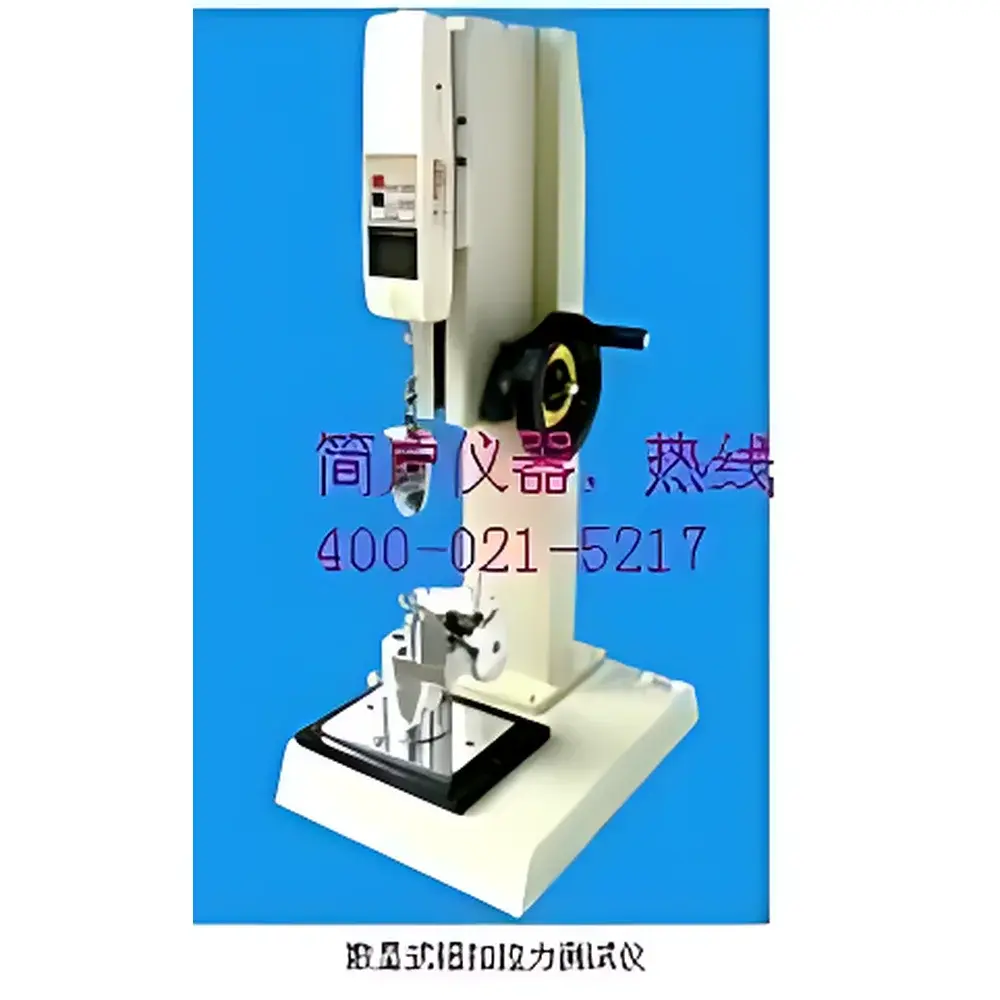
JH Q Series Button Pull Tester
| Origin | Shanghai |
|---|---|
| Manufacturer Type | Distributor |
| Origin Category | Domestic (China) |
| Model | JH Q Series |
| Pricing | Upon Request |
| Maximum Load Capacity | 300 N |
| Effective Stroke | 180 mm |
| Dimensions (L×W×H) | 260 mm × 360 mm × 700 mm |
| Net Weight | ~20 kg |
| Digital Force Gauge | Optional Accessory |
| Analog (Dial) Force Gauge | Compatible |
| Dedicated Button Fixtures | Included |
Overview
The JH Q Series Button Pull Tester is a precision-engineered mechanical testing instrument designed specifically for quantifying the tensile retention strength of sewn-on buttons, snap fasteners, and other garment-mounted decorative or functional closures. It operates on the principle of controlled uniaxial vertical tensile loading applied directly to the button surface while the fabric substrate remains fixed—simulating real-world stress conditions encountered during wear, laundering, or accidental snagging. This device complies with core mechanical test paradigms defined in international textile safety standards—including ASTM F963 (Toy Safety), ISO 13934-1 (Tensile Properties of Fabrics), and EN 14682 (Cords and Drawstrings on Children’s Clothing)—with particular emphasis on infant and toddler apparel compliance where button detachment poses a documented choking hazard. The tester’s rigid frame, calibrated load transmission path, and standardized fixture geometry ensure high reproducibility across sequential tests, making it suitable for both routine QC verification and pre-production validation in textile laboratories and garment manufacturing facilities.
Key Features
- Robust cast-iron base and upright column construction ensures minimal deflection under maximum 300 N load, preserving measurement fidelity.
- Adjustable vertical travel range of 180 mm accommodates diverse garment thicknesses and button mounting heights without reconfiguration.
- Modular fixture interface supports interchangeable button-specific jaws—including flat-faced, concave, and multi-pin configurations—for secure engagement of convex, shank, and sew-through button types.
- Compatible with both analog dial-type and digital push-pull force gauges (sold separately), enabling flexibility in data capture methodology—from visual readout to USB/RS-232 output for traceable electronic records.
- Ergonomic handwheel-driven loading mechanism provides smooth, manually controlled force application—eliminating inertial overshoot and enabling precise identification of peak detachment force.
- Compliance-ready design includes engraved reference marks for consistent sample positioning and integrated leveling feet for stable operation on standard laboratory benches.
Sample Compatibility & Compliance
The JH Q Series accepts fabric specimens mounted with commercially available buttons (shank, flat, snap, and decorative variants) secured via lockstitch sewing per ISO 13937-2 requirements. Testing protocols align with regulatory thresholds: buttons ≥6 mm in diameter must withstand ≥90 N axial pull force; those ≤6 mm require ≥50 N resistance before separation. These criteria are codified in GB/T 31900–2015 (Chinese National Standard for Children’s Apparel Safety) and referenced in EU RAPEX notifications concerning button-related recalls. While the instrument itself does not carry CE or UKCA marking, its mechanical architecture and dimensional repeatability support audit readiness for ISO/IEC 17025-accredited laboratories performing GLP-compliant textile safety assessments. Users are responsible for implementing site-specific risk assessments per ISO 45001, including eye protection during high-force trials and securing fabric clamps prior to actuation.
Software & Data Management
As a manually operated mechanical tester, the JH Q Series does not include embedded firmware or proprietary software. However, when paired with optional digital force gauges (e.g., IMADA DS2, Mark-10 M5-50), it integrates seamlessly with vendor-supplied PC applications supporting real-time graphing, statistical analysis (mean, SD, CV%), and export to CSV/PDF formats. Such configurations meet documentation requirements for FDA 21 CFR Part 11–aligned environments when combined with user-defined electronic signatures and audit trail logging. Raw analog readings from dial gauges may be transcribed into LIMS or Excel-based QA databases using standardized templates aligned with ISO 9001 clause 8.5.2 (Identification and Traceability).
Applications
- Pre-shipment verification of button adhesion strength in OEM garment supply chains serving North American and EU markets.
- Root cause analysis of seam failure modes during product development—distinguishing between thread breakage, fabric tear, and button deformation.
- Comparative benchmarking of fastener performance across supplier tiers or material substitutions (e.g., plastic vs. horn vs. metal buttons).
- Internal training for sewing technicians on stitch density, thread tension, and needle selection impact on retention integrity.
- Supporting technical documentation packages submitted to third-party certification bodies such as SGS, Bureau Veritas, or Intertek for CPSIA or OEKO-TEX® Standard 100 compliance.
FAQ
Is the JH Q Series compliant with ASTM F963 Section 4.5 for toy button retention?
Yes—the mechanical configuration and force application geometry satisfy the physical test setup requirements outlined in ASTM F963-23 Clause 4.5.2. Final pass/fail determination depends on correct specimen preparation per Clause 7.3.3.
Can this tester be used for non-textile applications, such as plastic housing clips?
While mechanically capable of applying up to 300 N, the dedicated fixtures and alignment constraints are optimized for fabric-mounted buttons. Non-textile use requires custom fixturing and independent validation of measurement uncertainty.
Does the unit include calibration certification?
No—calibration certificates must be obtained separately from an ISO/IEC 17025-accredited metrology provider using traceable deadweight standards. Annual recalibration is recommended per ISO 9001 Clause 7.1.5.2.
What maintenance is required for long-term accuracy?
Monthly inspection of screw-threaded adjustment components, lubrication of the lead screw with light machine oil, and verification of gauge mounting torque per manufacturer specifications.
Is there a version with motorized actuation?
No—this series is exclusively manual. For automated rate-controlled testing (e.g., constant-rate-of-traverse per ISO 13934-1), consider electromechanical universal testers with dedicated textile software modules.



