
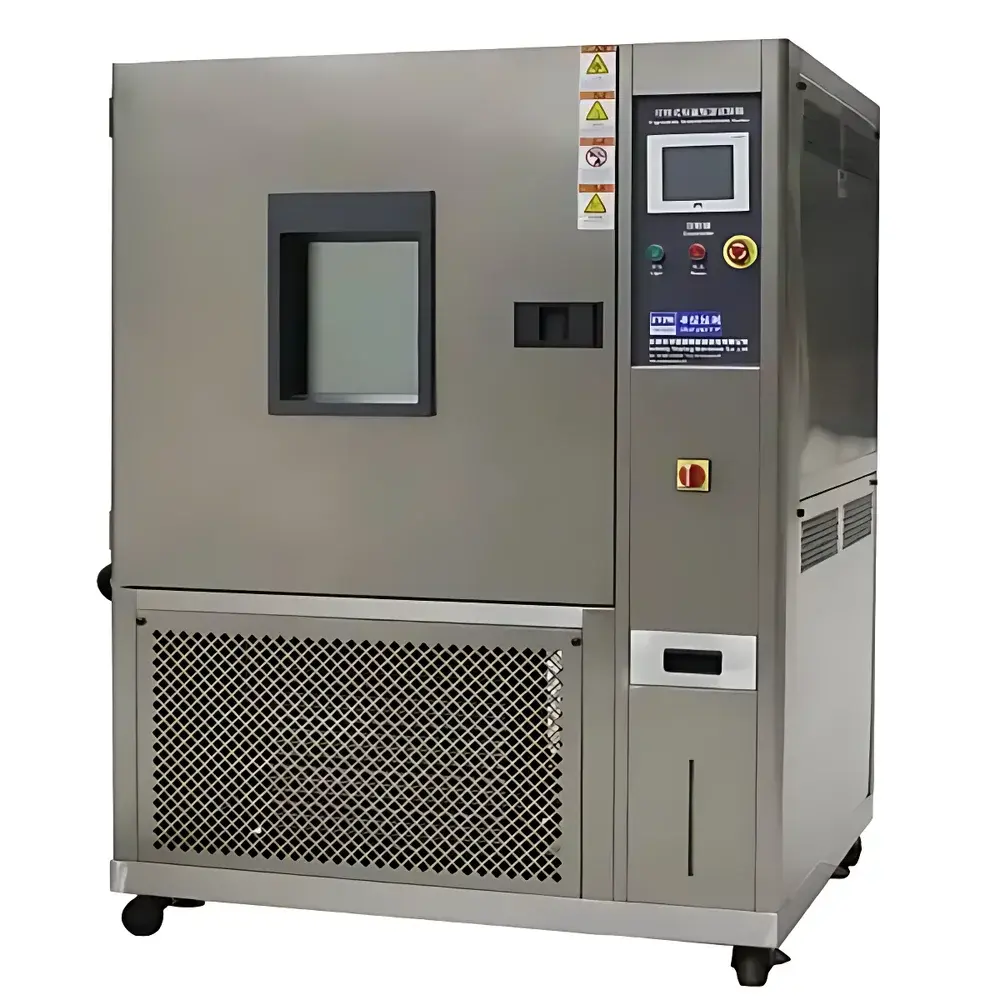
Jianhu BH-CT Battery Combustion Test Chamber for Lithium-ion Battery Fire Safety Evaluation
| Brand | Jianhu |
|---|---|
| Origin | Shanghai, China |
| Manufacturer Type | Authorized Distributor |
| Country of Manufacture | China |
| Model | BH-CT |
| Price Range | USD 900 – 9,000 |
Overview
The Jianhu BH-CT Battery Combustion Test Chamber is an engineered laboratory-scale fire test system designed to replicate and quantify thermal runaway propagation in lithium-ion battery cells, modules, and small packs under controlled, repeatable conditions. It operates on the principle of multi-modal thermal abuse simulation—integrating radiant heating, mechanical penetration (needle insertion), and electrical overcharge/overdischarge stimuli—to initiate and observe the full sequence of thermal runaway: from internal exothermic reactions and gas venting, through flame ignition and sustained combustion, to post-fire cooling and potential re-ignition. Unlike passive fire-resistance chambers, the BH-CT functions as an active research platform for fundamental fire physics, enabling high-fidelity measurement of heat release rate (HRR), total heat release (THR), mass loss rate (MLR), toxic gas evolution (CO, HF, VOCs), and flame dynamics via synchronized sensor arrays and high-speed imaging. Its design supports ASTM E1354 (Cone Calorimeter), UL 9540A, GB/T 36276, and ISO 1716-compliant test protocols, serving as a critical tool for validating battery safety strategies across R&D, quality assurance, and regulatory compliance workflows.
Key Features
- Multi-stimulus thermal abuse capability: integrated 3 kW radiant heating panel, programmable needle-penetration actuator (depth/speed adjustable), and DC power supply module for controlled overcharge (up to 5 V) and overdischarge (down to 0 V)
- Real-time multi-physical field monitoring: 16-channel thermocouple inputs (K-type, ±0.5 °C accuracy), pressure transducer (0–2 MPa), voltage/current logging (±0.1% FS), and optional FTIR or quadrupole mass spectrometer integration for evolved gas analysis
- Fire containment chamber: double-walled stainless steel construction with ceramic fiber insulation, rated for continuous operation up to 1000 °C; equipped with explosion-proof viewing window and emergency purge ventilation (N₂ or compressed air)
- Modular fire suppression interface: standardized flange ports and solenoid-controlled nozzles for quantitative delivery of extinguishing agents—including water mist, Novec 1230, aerosol, and dry chemical—enabling time-resolved efficacy assessment
- Compliance-ready data acquisition: timestamped, audit-trail-enabled logging compliant with FDA 21 CFR Part 11 requirements when paired with validated software; raw data export in CSV and HDF5 formats
Sample Compatibility & Compliance
The BH-CT accommodates cylindrical (18650, 21700, 32135), prismatic (up to 200 mm × 150 mm × 80 mm), and pouch cells (up to 250 mm × 180 mm × 15 mm). Modular fixtures allow testing of single cells, 2–12-cell modules, or mini battery packs (<5 kWh). The system meets structural and operational requirements referenced in UN Manual of Tests and Criteria Part III, subsection 38.3; IEC 62133-2; and GB 38031-2020. All electrical components conform to CE EN 61000-6-4 (EMC) and EN 61000-6-2 (immunity). Chamber exhaust pathways are compatible with standard fume hood ducting or external scrubber systems for hazardous gas abatement.
Software & Data Management
The BH-CT operates with Jianhu’s proprietary FireLog™ v3.2 control and analysis suite, running on Windows 10 IoT Enterprise. The software provides real-time visualization of all sensor channels, configurable trigger logic (e.g., “initiate suppression if surface temperature > 400 °C for >5 s”), and automated report generation per ISO/IEC 17025 templates. Data integrity is ensured via SHA-256 hashing of raw logs, electronic signatures for operator authentication, and immutable storage of calibration certificates and maintenance records. Optional integration with MATLAB® and Python-based analysis pipelines enables advanced statistical modeling of thermal propagation velocity, Arrhenius kinetic fitting of decomposition stages, and machine learning–assisted classification of failure modes.
Applications
- Electrode/electrolyte formulation screening: comparative evaluation of flame retardant additives, ceramic-coated separators, and solid-state electrolytes under identical thermal stress profiles
- BMS algorithm validation: ground-truth datasets for training early-warning models using voltage hysteresis, dV/dt inflection points, and localized temperature gradients
- Thermal barrier material testing: quantification of heat flux attenuation through aerogel blankets, intumescent coatings, and phase-change composites during cell-to-cell propagation
- Onboard fire suppression system development: benchmarking of agent delivery latency, minimum extinguishing concentration (MEC), and post-suppression hold time against re-ignition
- Regulatory submission support: generation of technical evidence required for UL 2580, GB/T 31467.3, and EU type-approval documentation under Regulation (EU) 2019/2144
FAQ
Does the BH-CT meet UL 9540A Section 7 requirements for module-level fire propagation testing?
Yes—the chamber volume (1.2 m³), thermal mass, and sensor density comply with the spatial and instrumentation specifications defined in UL 9540A Annex A for module-scale tests.
Can the system be integrated with an external cone calorimeter?
Yes—standardized 100 mm diameter exhaust port and pressure-matched flow interface enable direct coupling with ASTM E1354-compliant cone calorimeters.
Is remote operation supported for hazardous testing scenarios?
Yes—fully isolated Ethernet control, redundant emergency stop circuits, and IP65-rated local HMI allow unattended operation behind blast-resistant shielding.
What calibration standards are used for temperature and pressure sensors?
All thermocouples are traceable to NIST SRM 1750; pressure transducers are calibrated per ISO/IEC 17025 by an ILAC-accredited lab, with certificate included at shipment.
Does Jianhu provide application-specific test method development support?
Yes—Jianhu’s Application Engineering Team offers protocol co-development services, including custom fixture design, data interpretation workshops, and GLP-compliant SOP drafting for internal QA labs.



