
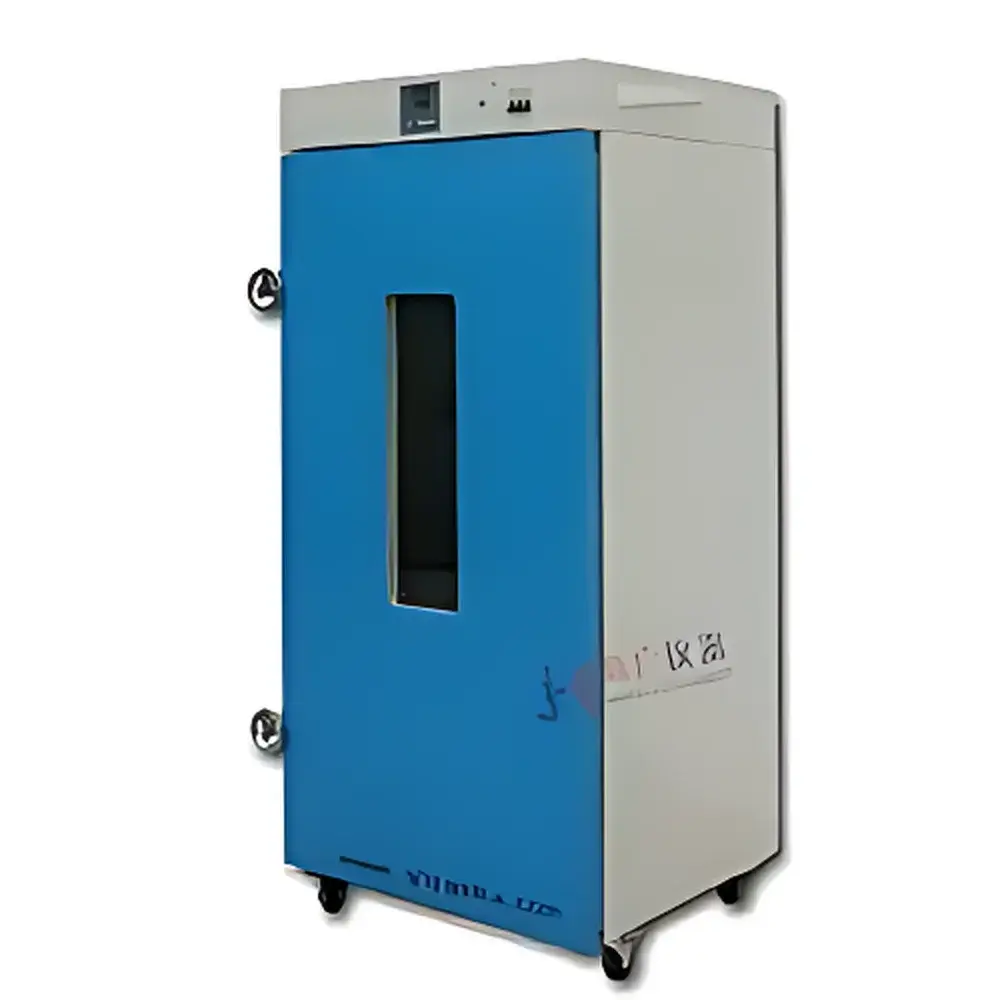
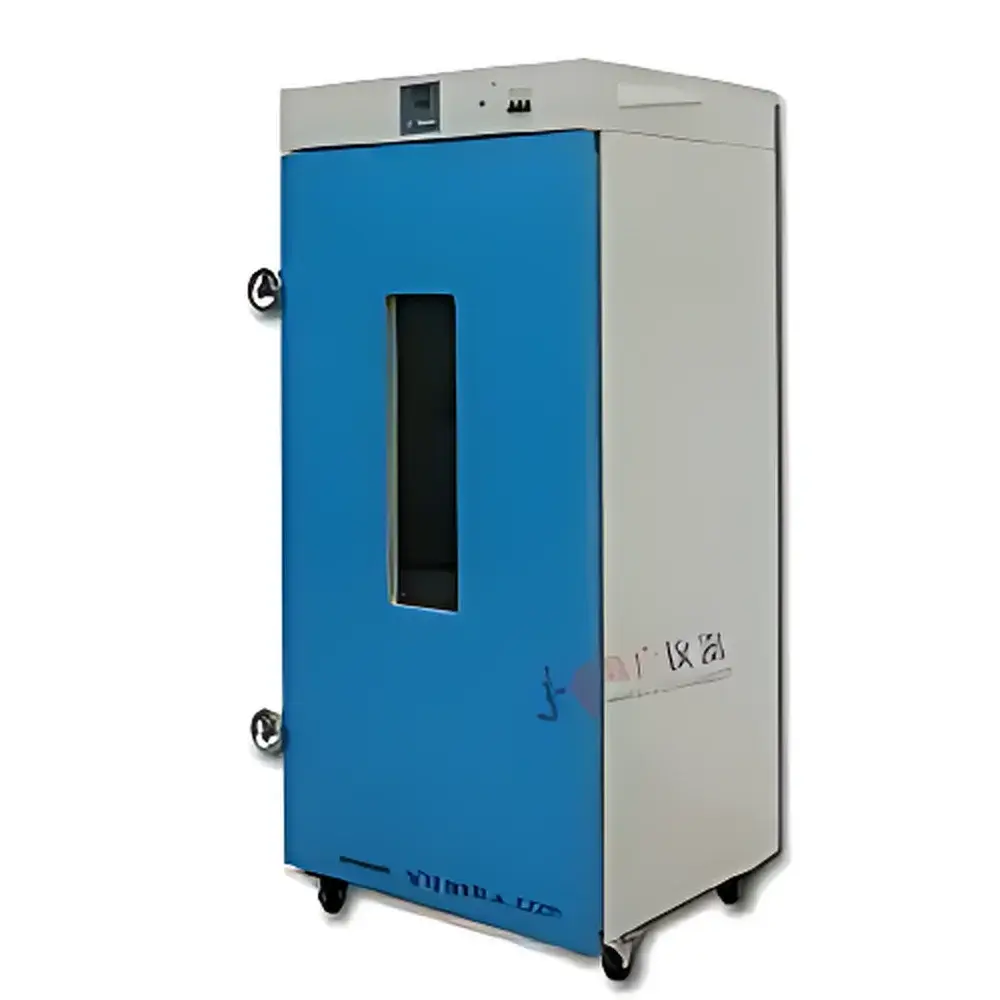
Jianhu ZSD-1150 Advanced Biochemical Incubator
| Brand | Jianhu |
|---|---|
| Origin | Shanghai, China |
| Model | ZSD-1150 |
| Chamber Volume | 150 L |
| Temperature Range | Ambient +5°C to 65°C |
| Temperature Uniformity | ±1.0–1.5°C |
| Temperature Accuracy | ±0.1–0.5°C |
| Power Supply | 220 V / 50 Hz |
| Max. Power Consumption | 800 W |
| Internal Dimensions (W×D×H) | 437 × 500 × 650 mm |
| External Dimensions (W×D×H) | 638 × 628 × 1282 mm |
| Shelving | 2 standard stainless steel electro-polished shelves (expandable to 3) |
| Interior Material | Mirror-finish stainless steel |
| Door | Tempered glass with sealed frame |
| Air Circulation | Micro-flow forced-air system with optimized duct geometry |
| Control System | Microprocessor-based environmental scanning controller with LED parameter display |
| Safety Features | Over-temperature audible/visual alarm, automatic heating cutoff, auto-restart after power recovery |
| Timer Range | 1 min – 99 h 59 min (continuous mode up to 500 h) |
| Compliance | Designed for GLP-compliant laboratory environments |
Overview
The Jianhu ZSD-1150 Advanced Biochemical Incubator is a microprocessor-controlled, forced-air incubation system engineered for precise, stable, and reproducible temperature maintenance in life science and quality control laboratories. Unlike basic warming cabinets or dry ovens, this unit operates on a convection-based thermal management principle—employing a low-turbulence air circulation architecture to minimize thermal gradients across the chamber volume. Its core function is to sustain biologically relevant temperature conditions (from ambient +5°C to 65°C) for extended periods, enabling consistent microbial growth, cell culture maintenance, enzyme activity studies, and strain preservation. The incubator is not designed for sterilization or moisture removal; it functions strictly as a non-humidified, temperature-regulated environment—making it suitable for applications where condensation control and material stability are critical, such as bacterial colony expansion, fungal cultivation, and long-term biological sample storage.
Key Features
- High-fidelity temperature regulation via responsive platinum resistance thermometers (PRTs) coupled with an environmental scanning microcontroller that continuously monitors and dynamically adjusts heater output.
- Dual-stage over-temperature protection: primary electronic cutoff at user-defined threshold and secondary hardware-based thermal fuse for fail-safe operation.
- Optimized airflow path with rear-mounted centrifugal fan and symmetrical baffle system ensures uniform heat distribution—validated at ±1.0–1.5°C across all shelf positions (per ISO 15189 Annex A.2 methodology).
- Chamber interior constructed from electropolished 304 stainless steel with seamless welds and rounded corners to support routine cleaning, reduce particle retention, and inhibit biofilm formation.
- Double-glazed tempered glass door with magnetic seal minimizes thermal leakage while enabling real-time visual monitoring without compromising chamber stability.
- Intuitive LED interface displays both setpoint and real-time chamber temperature, elapsed time, remaining timer duration, and system status codes—supporting immediate operational verification.
- Non-volatile memory retains user-defined parameters (setpoint, timer, alarm thresholds) during power interruption; automatic restart resumes incubation at pre-interruption conditions within ±0.3°C tolerance.
Sample Compatibility & Compliance
The ZSD-1150 accommodates standard microbiological and cell culture formats—including Petri dishes (up to 150 mm), multi-well plates, test tubes (13–18 mm OD), and Erlenmeyer flasks (up to 1 L). Its 150 L internal volume and adjustable shelving configuration (2 standard, expandable to 3) allow flexible load arrangement without compromising airflow integrity. The absence of humidity control makes it unsuitable for mammalian cell monolayer cultures requiring >95% RH—but ideal for aerobic bacterial propagation (e.g., E. coli, Bacillus subtilis), yeast fermentation trials, seed germination assays, and environmental isolate enrichment. The device complies with electrical safety standards IEC 61010-1 and EMC directive 2014/30/EU. While not certified to UL or CSA out-of-the-box, its design aligns with risk-based validation requirements under ISO/IEC 17025 and supports IQ/OQ documentation for GxP-regulated environments when integrated into lab-wide calibration and preventive maintenance programs.
Software & Data Management
The ZSD-1150 operates as a standalone instrument with embedded firmware—no external PC connection required for basic functionality. However, optional RS-232 or USB-to-serial interfaces enable integration with laboratory information management systems (LIMS) or custom SCADA platforms for remote parameter logging and alarm forwarding. When used with validated third-party data acquisition software, the unit supports electronic record generation compliant with FDA 21 CFR Part 11—including user authentication, audit trails, and immutable timestamped event logs (e.g., temperature excursions, door openings, power cycles). All displayed values are traceable to NIST-traceable references through annual calibration using Class AA PRTs per ASTM E74–22 guidelines.
Applications
- Microbial culture incubation in clinical diagnostics and pharmaceutical QC labs (e.g., USP <61> microbial limits testing, EP 2.6.12).
- Agricultural research: soil microbe enumeration, rhizobial nodulation assays, and plant pathogen isolation.
- Environmental monitoring: waterborne pathogen enrichment (e.g., Legionella culture per ISO 11731), sediment microbial activity profiling.
- Biochemical assay development requiring stable thermal conditions for enzyme kinetics or substrate degradation studies.
- Biobank infrastructure: short-to-medium term storage of reference strains under defined, documented temperature conditions.
FAQ
Is the ZSD-1150 suitable for CO₂-dependent cell culture?
No. This is a non-humidified, ambient-air incubator without gas blending or pH control capabilities.
Can the unit be calibrated internally by the user?
Yes—via offset adjustment mode using a certified reference thermometer; full metrological calibration requires external traceable equipment per ISO/IEC 17025.
What is the recommended maintenance interval?
Fan filter inspection every 3 months; chamber cleaning with 70% ethanol after each use cycle; annual thermistor verification and door gasket integrity check.
Does the incubator meet GLP requirements for regulated laboratories?
It provides foundational features (audit trail readiness, parameter memory, alarm logging) but requires site-specific validation documentation to fulfill GLP Annex 3 criteria.
Is the stainless steel interior passivated per ASTM A967?
Yes—electropolishing includes nitric acid passivation to enhance corrosion resistance and reduce metallic ion leaching in sensitive biological media.



