
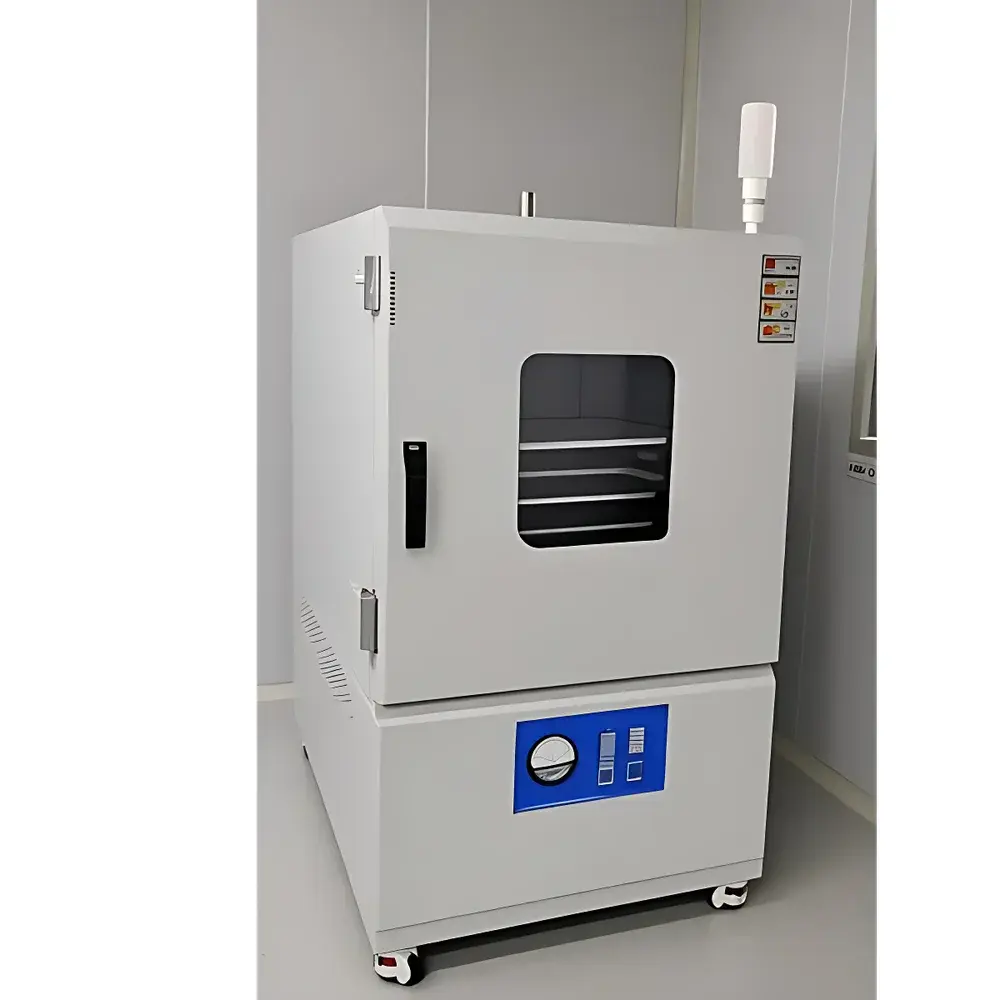
Jianhu JH-Series Polyimide Vacuum Oven with Dynamic Micro-Oxygen Control and High-Temperature Uniformity
| Brand | Jianhu |
|---|---|
| Origin | Shanghai, China |
| Manufacturer Type | OEM/ODM Manufacturer |
| Product Type | Vacuum-Enabled High-Temperature Aging Chamber |
| Temperature Range | 150–450 °C |
| Max Operating Temperature | 450 °C |
| Temperature Uniformity | ±1 °C (at 400 °C, 32-point mapping) |
| Temperature Stability | ±0.2–±0.5 °C |
| Temperature Deviation | ≤±2 °C |
| Heating Rate | Up to 20 °C/min |
| Cooling Rate | From 150 °C to –40 °C in ≤45 min |
| Oxygen Concentration Control | ≤5 ppm (real-time laser O₂ sensor, ±0.1 ppm accuracy) |
| Ultimate Vacuum | 5×10⁻⁴ Pa (turbomolecular + roots pump system) |
| Chamber Volume | Customizable from 30 L to >2 m³ |
| Compliance | SEMI S2/S8, ISO 9001, AS9100D, GLP/GMP-ready data logging |
Overview
The Jianhu JH-Series Polyimide Vacuum Oven is a precision-engineered thermal processing system designed specifically for the inert, high-temperature curing of polyimide (PI) films and advanced electronic materials. Unlike conventional air-circulating aging chambers, this system operates under dynamically controlled vacuum and ultra-low oxygen environments—leveraging Couette-flow nitrogen purging, multi-zone SiC heating elements, and real-time laser-based oxygen monitoring—to eliminate oxidative degradation during PI imidization. Its core architecture supports process-critical applications in semiconductor photolithography (e.g., PSPI and EUV-compatible resists), battery electrode binder crosslinking, and flexible display substrate annealing, where thermal uniformity, oxygen exclusion, and vacuum stability directly govern material stoichiometry, film density, and interfacial adhesion. The oven’s operational envelope spans 150–450 °C with validated uniformity of ±1 °C across full-load conditions at 400 °C—meeting the stringent spatial and temporal thermal constraints defined in ASTM D3418 and ISO 21371 for high-performance polymer thermal analysis.
Key Features
- Dynamic micro-oxygen control system: Integrated 256-channel laser diode oxygen sensor (detection limit 0.1 ppm) triggers automated high-purity N₂ (99.9995%) purge cycles when ambient O₂ exceeds 5 ppm; CFD-validated gas distribution ensures ≥98.7% oxygen homogeneity across chamber volume.
- Multi-zone high-temperature heating architecture: 32 independently regulated SiC heating zones with distributed K-type thermocouples enable adaptive thermal profiling; thermal response time <25 s, overshoot <0.5 °C during ramp-to-setpoint sequences.
- Intelligent vacuum compensation: Dual-stage pumping system (turbo-molecular + dry roots) maintains stable 5×10⁻⁴ Pa base pressure; closed-loop pressure regulation adjusts inert gas flow within ±5% setpoint deviation to counteract outgassing-induced fluctuations.
- GLP/GMP-compliant data integrity: Embedded 16-bit ADC with timestamped audit trail; raw sensor logs (O₂, T, P, power) stored locally and exportable in .csv/.tdms formats; optional FDA 21 CFR Part 11 compliance package available.
- Modular chamber design: Standardized flange interfaces (CF-100/CF-150) support rapid reconfiguration for wafer-level, pouch-cell, or roll-to-roll processing; internal dimensions scalable from 30 L benchtop units to 2.5 m³ production chambers.
Sample Compatibility & Compliance
The JH-Series accommodates rigid and flexible substrates up to 450 mm × 450 mm, including silicon wafers, lithium-ion battery electrode stacks, OLED backplanes, and aerospace-grade composite laminates. All internal surfaces are electropolished 316L stainless steel with low-outgassing gaskets (per ASTM E595). The system conforms to SEMI F47-0220 (voltage sag immunity), ISO 14644-1 Class 5 cleanroom compatibility (when equipped with HEPA-filtered N₂ supply), and IEC 61000-4-3 EMC standards. Process validation documentation—including IQ/OQ/PQ protocols, temperature mapping reports (per ISO/IEC 17025), and oxygen calibration certificates—is provided with each unit shipment.
Software & Data Management
Control is executed via Jianhu’s proprietary ThermaLink™ v4.2 platform, running on an industrial-grade embedded Linux controller with dual Ethernet ports (one for local HMI, one for plant SCADA integration). The interface supports recipe-driven operation with up to 99 programmable steps, conditional logic (e.g., “hold until O₂ < 3 ppm”), and real-time deviation alarms. All sensor data is logged at 1 Hz resolution with SHA-256 hash integrity verification. Export options include CSV, XML, and NI DIAdem-compatible TDMS files. Optional cloud gateway enables remote monitoring via TLS 1.3-secured MQTT endpoints, with role-based access control (RBAC) and configurable retention policies aligned with ISO/IEC 27001 requirements.
Applications
- Semiconductor front-end: PSPI and polybenzoxazole (PBO) cure for 28 nm node photomasks; reduction of line-edge roughness (LER) from 8 nm to 5 nm through sub-1 °C spatial uniformity.
- Lithium-ion battery manufacturing: Thermal stabilization of Ni-rich NMC cathodes and PI-based separators; achieves >99.2% capacity retention after 3000 cycles (per IEC 62660-2).
- Flexible electronics: Annealing of 12.5–30 µm PI substrates for foldable displays; enables >300,000 hinge cycles with thickness variation maintained within ±3 µm (measured by non-contact eddy-current profilometry).
- Aerospace composites: Out-of-autoclave (OOA) curing of BMI/PI hybrid laminates per MIL-STD-202G Method 210; eliminates void formation at fiber/matrix interfaces under sustained 420 °C vacuum.
FAQ
What vacuum level is required for PI imidization, and how does the JH-Series maintain it during extended holds?
The system sustains ≤5×10⁻⁴ Pa for >72 h continuous operation using active pressure compensation—monitoring conductance changes and modulating turbo pump speed and N₂ bleed flow in real time.
Can the oven be integrated into an existing factory automation system?
Yes—Modbus TCP, OPC UA, and SECS/GEM protocol stacks are standard; digital I/O terminals support hardware interlocks with lithography steppers or coating lines.
Is temperature mapping performed at installation, and is it traceable to national standards?
A full 32-point thermal uniformity map (per ASTM E2203) is conducted onsite using NIST-traceable calibrated thermocouples; final report includes uncertainty budget and GUM-compliant coverage factor (k=2).
How is oxygen sensor calibration verified between maintenance intervals?
The laser O₂ module includes dual-reference cells (zero gas and 5 ppm certified standard); automated self-diagnostic routines execute every 8 h and log drift metrics for predictive maintenance scheduling.
Does the system support qualification for medical device manufacturing under ISO 13485?
With optional Part 11 add-on and enhanced change-control workflow, the JH-Series meets design history file (DHF) and device master record (DMR) traceability requirements for Class III implantable electronics curing processes.



