
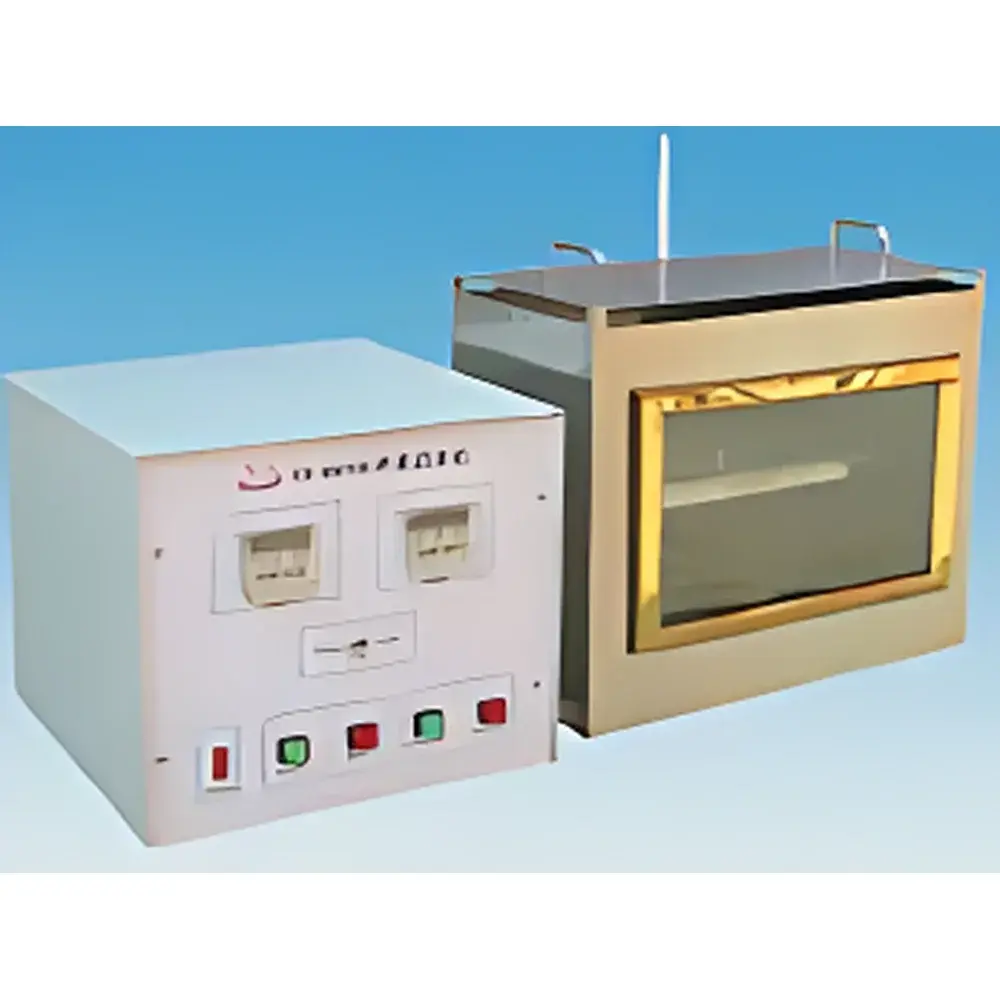
Jianhu H-8925 (8820G) Automotive Interior Materials Horizontal Burning Tester
| Brand | Jianhu |
|---|---|
| Origin | Shanghai, China |
| Model | H-8925 (8820G) |
| Combustion Time Range | 0–99.99 s/min/h |
| Burner Nozzle Inner Diameter | 9.5 mm |
| Nozzle Center Position | 19 mm below free end center of specimen |
| Metal Hood Dimensions | 385 × 204 × 360 mm |
| Control Box Dimensions | 305 × 320 × 285 mm |
| Comb Comb Length | ≥110 mm |
| Steel Ruler Accuracy | ±1 mm |
| Fuel | Liquefied Petroleum Gas (LPG), user-supplied |
| Power Supply | 220 V AC, 50 Hz |
| Compliant Standards | GB 8410–2006, TL 1010, GM 6090M, DIN 75200, GM 9070P |
Overview
The Jianhu H-8925 (8820G) Automotive Interior Materials Horizontal Burning Tester is a precision-engineered combustion test apparatus designed to evaluate the horizontal flame spread behavior of interior trim materials used in motor vehicles. It operates in strict accordance with standardized horizontal burning test protocols defined by major global automotive OEMs and regulatory bodies. The instrument employs a controlled open-flame ignition source—specifically a calibrated Bunsen-type burner fueled by liquefied petroleum gas (LPG)—to initiate combustion on horizontally mounted specimens under defined geometric and environmental conditions. Flame propagation distance and afterflame time are measured manually using a high-contrast steel ruler and digital timer, respectively, enabling quantitative assessment of material flammability performance. This methodology directly supports compliance verification for passenger vehicle safety requirements where suppression of fire initiation and lateral flame spread is critical to occupant egress and cabin integrity.
Key Features
- Modular construction integrating a dedicated control cabinet, insulated combustion chamber, precision-adjustable LPG burner assembly, high-voltage piezoelectric igniter, and standardized specimen holder with adjustable clamping mechanism
- Digitally programmable timer with resolution down to 0.01 second across selectable units (seconds, minutes, hours) for precise recording of afterflame and afterglow durations
- Geometrically validated metal hood enclosure (385 × 204 × 360 mm) ensuring consistent draft-free test environment per GB 8410–2006 and DIN 75200 specifications
- Calibrated 9.5 mm inner-diameter burner nozzle, positioned with ±0.5 mm tolerance at 19 mm below the lower edge of the specimen’s free end—critical for reproducible ignition geometry
- Included comb tool conforming to ISO 1716 and GM 6090M: stainless steel, ≥110 mm long, with 7–8 uniformly spaced, polished circular teeth per 25 mm segment for standardized surface preparation
- Integrated electromagnetic gas valve with fail-safe cutoff logic and manual override for operational safety and repeatability
- Compact control box (305 × 320 × 285 mm) housing isolated power regulation, signal conditioning circuitry, and interface terminals for external data logging or PLC integration
Sample Compatibility & Compliance
The H-8925 accommodates flat, rigid or semi-flexible polymeric sheets, foams, laminates, textiles, and composites commonly employed in automotive dashboards, door panels, headliners, seat covers, and pillar trims. Specimens are cut to 356 mm × 100 mm dimensions and conditioned per ASTM D618 or ISO 291 prior to testing. The system fully satisfies mandatory test requirements outlined in GB 8410–2006 (China), TL 1010 (Volkswagen Group), GM 6090M (General Motors), DIN 75200 (Germany), and GM 9070P (GM Global). While not inherently compliant with UL 94 HB or FMVSS 302 without configuration adjustments, its mechanical and dimensional fidelity allows direct correlation to those standards when operated within defined procedural boundaries. All hardware components—including burner alignment fixtures and specimen support rails—are manufactured to tolerances traceable to national metrology institutes.
Software & Data Management
The H-8925 operates as a standalone benchtop instrument with no embedded firmware or proprietary software. Timing and positional measurements are recorded manually using the integrated digital timer and certified steel ruler (±1 mm accuracy), aligning with GLP principles that emphasize operator-controlled, auditable data capture. For laboratories requiring electronic data acquisition, the timer output supports TTL-level pulse signaling compatible with third-party DAQ systems (e.g., National Instruments USB-6009) or industrial PLCs. All test parameters—including specimen identification, conditioning history, ambient temperature/humidity, flame application duration, and observed burn length—are documented in laboratory notebooks or LIMS-compatible spreadsheets. The absence of closed-source software ensures full transparency during FDA 21 CFR Part 11–aligned audits and eliminates validation overhead associated with electronic records.
Applications
- Pre-certification screening of prototype interior substrates and finished trim parts prior to OEM qualification submissions
- Root-cause analysis of flame-retardant additive efficacy in polypropylene, PVC, PU foam, and ABS-based formulations
- Batch-to-batch consistency monitoring in Tier-1 supplier quality control laboratories
- Technical support for material substitution studies under APQP Stage 3 validation protocols
- Training platform for fire safety engineers and laboratory technicians on standardized horizontal burning methodology
- Supporting documentation for IATF 16949 clause 8.5.1.1 (Control of production and service provision – special processes)
FAQ
Does the H-8925 support vertical burning tests?
No. This instrument is configured exclusively for horizontal orientation per GB 8410–2006 and related OEM standards. Vertical flame testing requires separate apparatus meeting UL 94 V-0/V-1/V-2 or FMVSS 302 geometries.
Is calibration certification included with shipment?
A factory-issued dimensional verification report is provided for the burner nozzle, metal hood, and ruler. Full ISO/IEC 17025 calibration services are available upon request through accredited third-party labs.
Can natural gas be substituted for LPG?
No. The burner design, pressure regulator, and flame dynamics are optimized for LPG (propane/butane mix). Natural gas operation would invalidate test results and violate standard-compliant procedures.
What maintenance intervals are recommended?
Burner nozzle inspection and cleaning every 50 test cycles; electromagnetic valve function check quarterly; steel ruler recalibration annually or per internal QA schedule.
Is operator training available?
Yes. Jianhu provides on-site or virtual SOP implementation workshops covering test setup, specimen mounting, timing protocol execution, result interpretation, and nonconformance reporting per AIAG CQI-9 guidelines.
Related Products



