
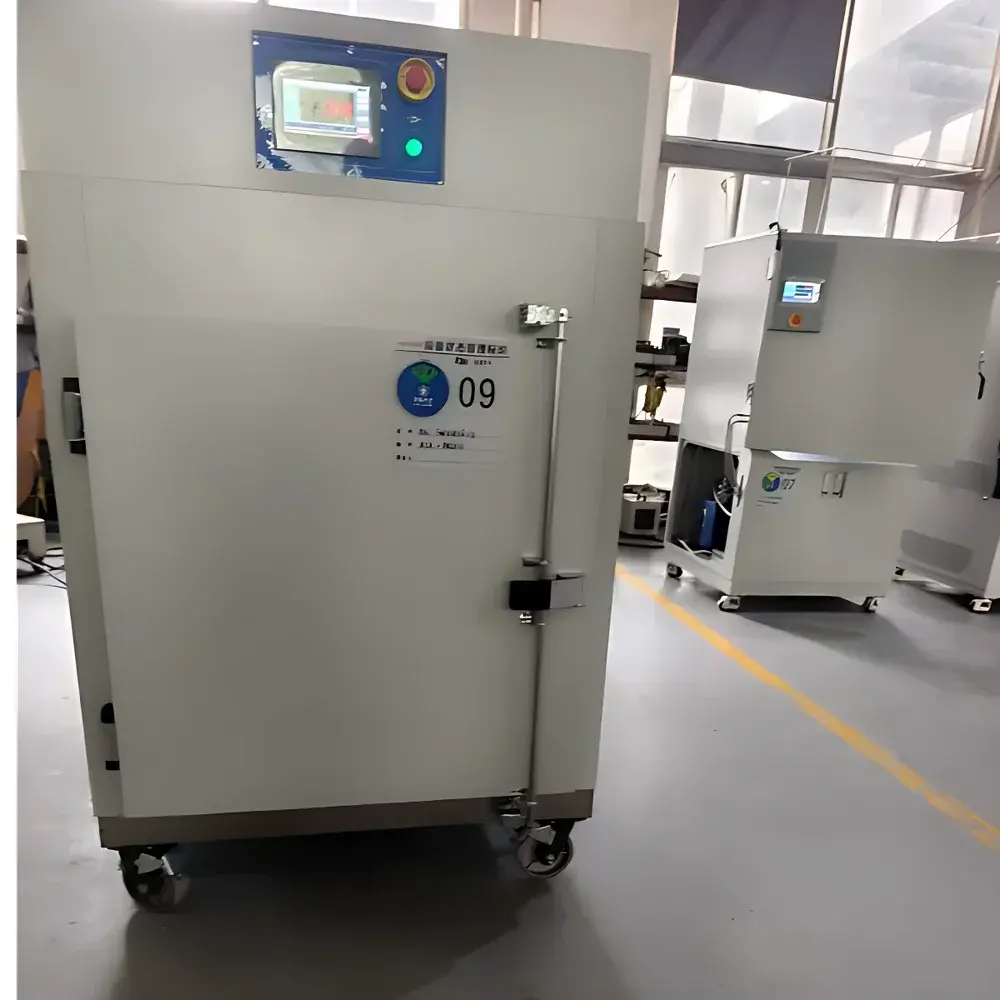
JH High-Temperature Environmental Test Chamber with Vacuum & Oxygen-Free Capability
| Brand | Jianhu |
|---|---|
| Origin | Shanghai, China |
| Manufacturer Type | Authorized Distributor |
| Product Category | Domestic |
| Model | JH High-Temperature Environmental Test Chamber |
| Price Range | USD 280 – 2,800 |
| Temperature Range | −70 °C to +150 °C |
| Refrigeration Method | Compressor-Based Cooling |
| Explosion-Proof Design | Yes |
| Temperature Fluctuation | ±0.5 °C |
| Temperature Uniformity | ±2.0 °C |
| Temperature Deviation | ±2.0 °C |
| Heating Rate | ≤60 min (from 25 °C to 150 °C) |
| Cooling Rate | ≤45 min / ≤60 min / ≤80 min (depending on configuration) |
| Interior Dimensions | Customizable |
Overview
The JH High-Temperature Environmental Test Chamber with Vacuum & Oxygen-Free Capability is an engineered solution for precision thermal simulation and inert-atmosphere material processing in industrial QA/QC, R&D laboratories, and reliability engineering environments. Designed around dual operational modes—forced-air convection high-temperature cycling and vacuum-sealed oxygen-free baking—the chamber supports thermally sensitive applications requiring strict atmospheric control and repeatable thermal profiles. Its core architecture integrates a compressor-based refrigeration system with a PID-controlled heating loop, enabling stable operation across a wide temperature range of −70 °C to +150 °C. The system adheres to fundamental principles of convective heat transfer and vacuum thermodynamics, ensuring traceable, reproducible environmental conditions suitable for accelerated aging, thermal stress screening, and pre-conditioning of electronic components, battery electrode materials, polymer composites, and pharmaceutical excipients.
Key Features
- High-precision temperature control via adaptive PID algorithm with Class A platinum RTD sensors, achieving ±0.5 °C fluctuation and ±2.0 °C uniformity across the working volume
- Forced-air circulation system with optimized duct geometry and variable-speed centrifugal blower, minimizing spatial thermal gradients to ≤±1.0 °C under steady-state conditions
- Vacuum-compatible chamber design rated for ≤10⁻² mbar base pressure, equipped with oil-free diaphragm pump interface and O₂-level monitoring ports (optional)
- Multi-segment programmable thermal profiling engine supporting up to 99 steps per cycle, with user-defined ramp rates (0.1–10 °C/min), dwell durations (1 min–999 h), and hold-to-stabilize logic
- Explosion-proof construction compliant with IEC 60079-0 and GB 3836.1 standards, including intrinsically safe wiring, flameproof enclosure, and over-temperature cut-off circuitry
- Modular interior dimensions—customizable from 50 L to 1000 L working volume—with stainless-steel 304 chamber walls and double-layer insulated door gasketing
Sample Compatibility & Compliance
The JH chamber accommodates diverse sample types—including PCB assemblies, lithium-ion cathode/anode wafers, aerospace-grade alloys, optical lens substrates, and sterile medical device packaging—without compromising thermal fidelity or atmospheric integrity. All configurations meet baseline requirements for ISO 17025-accredited laboratories conducting environmental qualification per MIL-STD-810H, IEC 60068-2-2 (heat), IEC 60068-2-14 (thermal shock), and ASTM D3418 (Tg determination). Optional upgrades include data logging validation packages aligned with FDA 21 CFR Part 11 for electronic records and signatures, as well as GLP/GMP-compliant audit trails for temperature deviation alerts, cycle start/stop timestamps, and operator authentication logs.
Software & Data Management
The embedded controller features a 7-inch capacitive touchscreen HMI with real-time graphical trend display, multi-curve overlay capability, and USB export of CSV-formatted test data (time, setpoint, actual chamber temp, vacuum level, fan speed). Remote supervision is supported via Ethernet (TCP/IP) or optional Wi-Fi module, enabling integration into centralized lab management systems using Modbus TCP or OPC UA protocols. Firmware includes built-in calibration verification routines traceable to NIST-certified reference standards, with automated recalibration prompts triggered by usage thresholds or time intervals. Audit-ready reports can be generated with digital signature fields, revision history, and electronic certificate of conformance (eCoC).
Applications
- Accelerated life testing of automotive ECUs under combined thermal cycling and humidity exposure (per AEC-Q200)
- Oxygen-free drying of LiCoO₂ and NMC cathode slurries to prevent transition-metal oxidation during electrode fabrication
- Thermal preconditioning of optical adhesives prior to UV curing, ensuring consistent refractive index stability
- Stress screening of MEMS accelerometers and gyroscopes across −55 °C to +125 °C operational envelopes
- Pre-bake treatment of semiconductor wafer carriers to eliminate outgassing contaminants before cleanroom loading
- Validation of packaging seal integrity for lyophilized biologics under low-humidity, elevated-temperature storage conditions
FAQ
What vacuum level can the chamber achieve, and is vacuum pumping included?
Standard configuration supports ≤10⁻² mbar with external vacuum pump connection; integrated oil-free diaphragm pumps are available as factory-installed options.
Does the system support ramp-soak-ramp (RSR) profiles required for JEDEC JESD22-A104 qualification?
Yes—profile editor supports unlimited RSR sequences with independent ramp rate control, soak stabilization criteria, and automatic transition logic.
Is third-party IQ/OQ/PQ documentation available for GxP-regulated labs?
Comprehensive validation protocol templates (IQ/OQ/PQ) are provided upon request, including test scripts, acceptance criteria, and blank execution records compliant with Annex 11 and EU GMP Annex 15.
Can the chamber operate continuously at 150 °C without derating?
Rated continuous operation at full temperature range; thermal insulation and cooling capacity are validated per IEC 60068-3-5 for sustained 168-hour exposure.
How is temperature uniformity verified during factory calibration?
Nine-point mapping per IEC 60068-3-5 using calibrated PT100 probes; final report includes spatial deviation matrix, uncertainty budget, and traceability statement to national metrology institute.



