
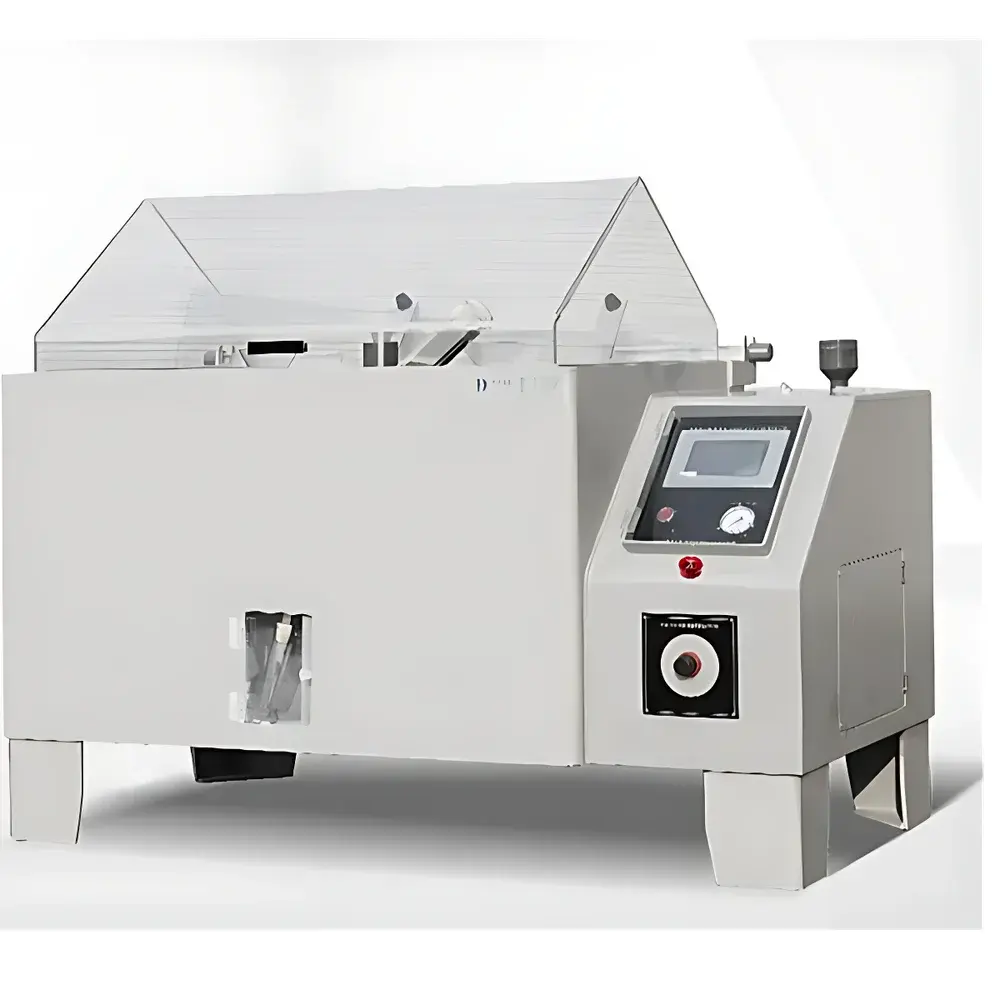
Jianhu Salt Spray Test Chamber DV-1000 Series
| Brand | Jianhu |
|---|---|
| Origin | Shanghai, China |
| Model | DV-1000 Series |
| Spray Method | Continuous Atomization |
| Fog Output | 1–2 mL / 80 cm²·hr |
| Nozzle Pressure | 0.7–1.0 kgf/cm² |
| Fog Removal | Pneumatic Air-Compression Exhaust |
| Salt Fog Deposition Rate | 1.0 ± 0.2 mL/80 cm²·hr (per ASTM B117) |
| Temperature Range | Ambient to 50.0 °C (±0.5 °C uniformity) |
| Chamber Volume | 90 L (standard) |
| Compliance | ASTM B117, ISO 9227, JIS Z2243, GB/T 2423.17 |
| Construction | PVC-coated steel interior, acid-resistant glass viewing window, corrosion-proof chamber seals |
| Power Supply | 220 VAC ±10%, 50 Hz, 2.5 kW |
Overview
The Jianhu Salt Spray Test Chamber DV-1000 Series is an ASTM B117-compliant environmental test system engineered for reproducible, long-duration accelerated corrosion testing of metallic and coated components. It operates on the principle of continuous nebulization of a standardized sodium chloride (NaCl) solution into a saturated, temperature-controlled test chamber—generating a dense, stable fog that accelerates electrochemical degradation mechanisms under controlled thermal and humidity conditions. Unlike intermittent or ultrasonic misting systems, the DV-1000 employs a precision-engineered air-pressure-driven spray nozzle array calibrated to maintain consistent droplet size distribution (median diameter ≈ 1–3 µm) and spatial deposition uniformity across the working volume. This design directly addresses critical failure modes observed in photovoltaic module qualification—particularly non-uniform salt fog distribution caused by turbulent flow, dead zones, or localized condensation—by integrating aerodynamic chamber geometry, symmetrical nozzle placement, and laminar airflow management via rear-mounted pneumatic exhaust.
Key Features
- Continuous, pressure-regulated atomization system with dual-stage filtration (5 µm pre-filter + 1 µm final filter) to prevent nozzle clogging and ensure long-term operational stability
- Aerodynamically optimized chamber interior featuring rounded corners, smooth-welded seams, and sloped ceiling to eliminate stagnation zones and promote uniform fog circulation
- Pneumatic fog removal mechanism using compressed air-assisted exhaust—minimizing residual condensate carryover and preventing secondary corrosion from dripping
- Digital PID temperature controller with dual-sensor feedback (chamber air + saturation tower) achieving ±0.5 °C spatial uniformity per ISO 9227 Annex A
- Corrosion-resistant construction: 6 mm PVC-coated cold-rolled steel chamber walls, acid-resistant tempered glass viewport, and fluorosilicone gasketing rated for continuous 5% NaCl exposure
- Integrated salt fog deposition monitoring port compliant with ASTM B117 collection cup specifications (80 cm² area, 10–15 cm height)
Sample Compatibility & Compliance
The DV-1000 accommodates flat-panel samples up to 600 × 400 × 100 mm (W × D × H), including photovoltaic modules, automotive fasteners, printed circuit board assemblies, and aerospace alloy coupons. Sample racks are configurable with adjustable angle mounts (0°–30° tilt) to simulate real-world orientation-dependent corrosion behavior. The system meets full requirements of ASTM B117 (Standard Practice for Operating Salt Spray (Fog) Apparatus), ISO 9227 (Corrosion tests in artificial atmospheres — Salt spray tests), and JIS Z2243. It supports GLP-compliant validation protocols—including temperature mapping (16-point grid), fog deposition uniformity verification (≥9 collection cups), and pressure decay integrity testing—required for ISO/IEC 17025-accredited laboratories. Optional calibration kits include NIST-traceable thermistors and volumetric fog collection standards.
Software & Data Management
The chamber integrates with Jianhu’s optional TestLink™ Control Suite (v3.2), a Windows-based application supporting automated test sequencing, real-time parameter logging (temperature, pressure, runtime), and audit-trail generation compliant with FDA 21 CFR Part 11. All data—including operator ID, method version, alarm events, and calibration timestamps—are stored in encrypted SQLite databases with immutable write-once architecture. Export formats include CSV, PDF test reports (with embedded digital signatures), and XML for LIMS integration. Remote monitoring via Ethernet (Modbus TCP) enables centralized fleet management across multi-chamber test facilities without compromising local safety interlocks.
Applications
Primary use cases include: qualification testing of anti-corrosion coatings per ISO 12944; durability assessment of solar panel frame alloys (Al 6063-T5, SUS304) under coastal exposure simulation; comparative evaluation of passivation layers on stainless steel medical devices (ASTM F2129); and screening of conformal coatings for automotive ECUs exposed to road-salt environments. The DV-1000’s validated airflow uniformity (≤15% coefficient of variation in fog deposition across 9-zone mapping) makes it suitable for IEC 61215-2 MQT 13 (damp heat + salt mist sequential testing) when paired with external climate chambers. It is routinely deployed in R&D labs at Tier-1 PV manufacturers, Tier-2 automotive suppliers, and national metrology institutes conducting interlaboratory round-robin studies.
FAQ
What standards does the DV-1000 comply with for salt fog deposition rate verification?
Per ASTM B117 Section 7.2.1, the system maintains 1.0 ± 0.2 mL/80 cm²·hr using calibrated glass funnels placed at defined positions (front/mid/rear, left/center/right). Verification must be performed prior to each test series.
Can the chamber operate continuously for 1,000-hour tests without maintenance intervention?
Yes—when supplied with deionized water (resistivity ≥1 MΩ·cm) and filtered 5% w/w NaCl solution, the DV-1000 achieves >98% uptime over 1,000-hr cycles. Scheduled maintenance includes nozzle inspection every 200 hr and saturation tower cleaning every 500 hr.
Is temperature uniformity validated across the entire working volume?
Yes—certified temperature mapping per ISO 9227 Annex A confirms ≤0.5 °C deviation across 16 spatial points during steady-state operation at 35 °C.
Does the system support automated test interruption and resume functionality?
Yes—TestLink™ software logs all parameters at 1-second intervals and allows resumption from last valid checkpoint after power recovery, preserving test integrity per IEC 60068-2-11.
What documentation is provided for IQ/OQ/PQ validation?
Factory-issued documents include Installation Qualification checklist, Operational Qualification protocol (with acceptance criteria aligned to ASTM B117), Performance Qualification report template, and traceable calibration certificates for all sensors.



