
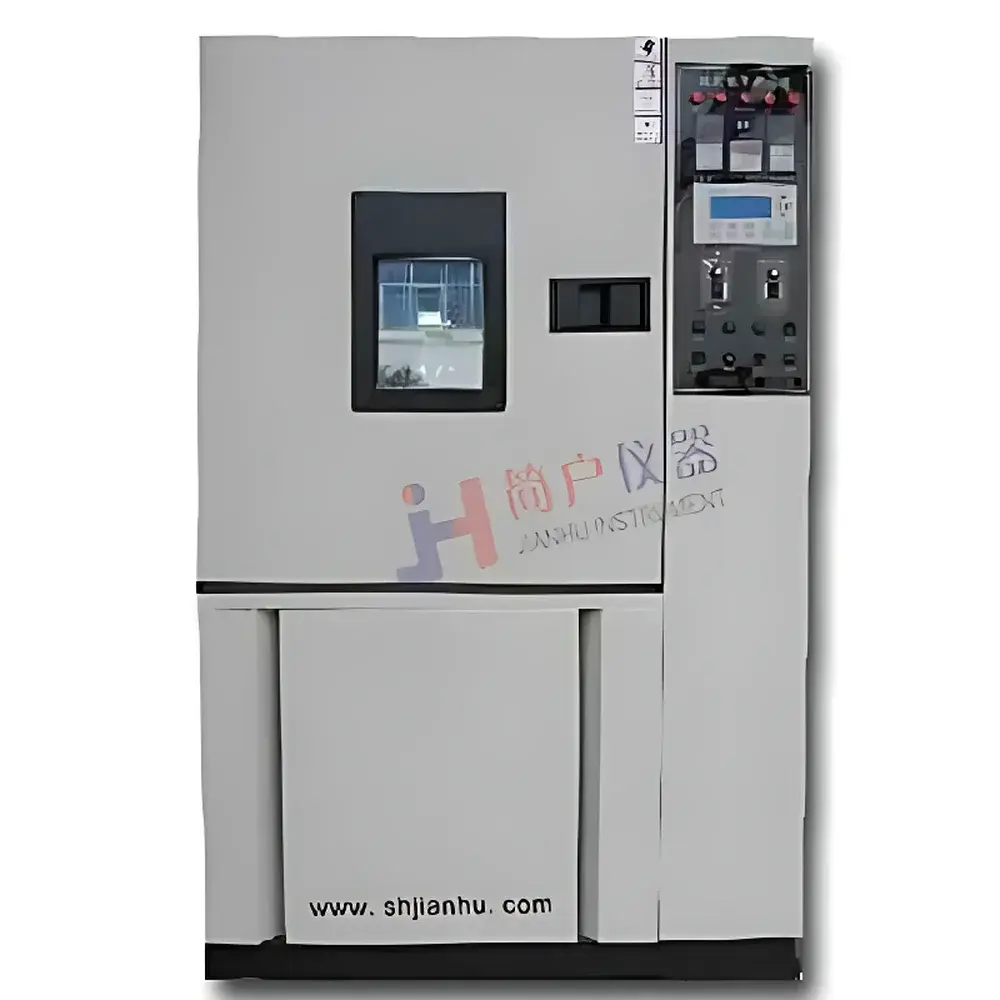
Jianhu JHC-200 Ozone Aging Test Chamber
| Brand | Jianhu |
|---|---|
| Origin | Tianjin, China |
| Manufacturer Type | Authorized Distributor |
| Model | JHC-200 |
| Chamber Dimensions (W×D×H) | 550×550×550 mm |
| Temperature Range | Ambient to 60 °C (Uniformity: ±2 °C) |
| Ozone Concentration Range | 10–1000 pphm (Accuracy: ≤±10% deviation) |
| Sample Rack Rotation Speed | 2 rpm |
| Sample Extension Frequency | 0.5 Hz |
| Gas Flow Rate | 20–80 L/min |
| Power Rating | 6 kW |
| Construction | Cold-rolled steel exterior with powder coating |
| Ozone Generation | Silent discharge type with air drying and purification system |
| Ozone Detection | Non-dispersive UV absorption at 254 nm |
| Temperature Controller | RKC digital programmable controller (Japan) |
Overview
The Jianhu JHC-200 Ozone Aging Test Chamber is an engineered environmental test system designed for accelerated evaluation of rubber, elastomer, and polymer materials under controlled ozone exposure. It operates on the principle of dynamic atmospheric aging—simulating real-world oxidative degradation mechanisms by exposing stretched or static specimens to precisely regulated ozone concentrations within a thermally stabilized environment. Unlike static ozone chambers, the JHC-200 integrates synchronized sample rotation and cyclic extension (0.5 Hz), enabling standardized assessment of crack initiation and propagation in vulcanized rubber compounds per ASTM D1149, ISO 1431-1, and GB/T 7762. Its architecture supports reproducible test conditions critical for QC laboratories, R&D centers, and third-party testing facilities requiring traceable, repeatable aging data aligned with international material durability protocols.
Key Features
- Robust dual-layer chamber construction: exterior cold-rolled steel with epoxy-polyester powder coating; interior 304 stainless steel for corrosion resistance and long-term ozone stability.
- High-fidelity ozone generation via silent discharge technology, coupled with integrated air drying and filtration to eliminate moisture and particulate interference—ensuring stable, contamination-free ozone delivery.
- Real-time ozone monitoring using non-dispersive ultraviolet (UV) absorption at 254 nm, providing direct concentration readout (10–1000 pphm) with ≤±10% measurement deviation against NIST-traceable reference standards.
- Precision temperature control via RKC digital programmable controller (Japan), supporting ramp-soak profiles and maintaining uniformity of ±2 °C across the 550×550×550 mm working volume.
- Motor-driven sample rack system delivering consistent 2 rpm rotation and programmable 0.5 Hz axial extension—mechanically replicating service-induced strain states without manual intervention.
- Adjustable gas flow regulation (20–80 L/min) with calibrated mass flow meters, enabling optimization for varying specimen surface area and chamber residence time requirements.
Sample Compatibility & Compliance
The JHC-200 accommodates standard dumbbell-shaped, ring, or strip specimens conforming to ASTM D1149 Type A/B/C geometries and ISO 1431-1 test piece dimensions. It supports both static and dynamic test modes—static for baseline crack resistance screening; dynamic for evaluating fatigue-related ozone cracking under mechanical stress. The chamber meets essential design and operational criteria referenced in ASTM D1149–22 (Standard Test Method for Rubber Deterioration—Ozone Cracking), ISO 1431-1:2018 (Rubber—Resistance to ozone cracking—Part 1: Static strain), and Chinese national standard GB/T 7762–2014. While not certified as GLP-compliant out-of-the-box, its controller logging capability (via optional RS485/Modbus interface) supports audit-ready data capture when integrated into validated laboratory information management systems (LIMS).
Software & Data Management
The RKC controller provides local setpoint programming, real-time display of chamber temperature and ozone concentration, and event-based alarm outputs (e.g., over-temperature, low ozone, door open). For extended data integrity, optional analog output (4–20 mA) enables connection to external chart recorders or SCADA systems. When interfaced with Jianhu’s optional PC-based monitoring software (sold separately), users gain timestamped CSV export, multi-parameter trend visualization, and configurable pass/fail thresholds aligned with internal quality specifications. All logged data retains metadata including operator ID, test duration, calibration date, and sensor status—supporting compliance with FDA 21 CFR Part 11 requirements when deployed with appropriate electronic signature and audit trail configurations.
Applications
- Quality assurance of automotive rubber components (hoses, seals, bushings) subjected to long-term atmospheric exposure.
- Formulation development for synthetic rubbers (e.g., SBR, EPDM, CR) where ozone resistance is a key performance criterion.
- Comparative lifecycle testing of cable jacketing materials used in outdoor electrical infrastructure.
- Validation of antioxidant and antiozonant additive efficacy in compounded elastomers.
- Third-party certification testing for ISO/IEC 17025-accredited laboratories performing rubber material characterization.
FAQ
What ozone concentration range does the JHC-200 support, and how is accuracy verified?
The chamber delivers 10–1000 pphm ozone with ≤±10% deviation from nominal setpoint, verified using factory-calibrated UV absorption detection at 254 nm and traceable to primary ozone standards. Annual recalibration is recommended.
Can the JHC-200 operate continuously for extended durability tests?
Yes—the system is rated for unattended 72-hour continuous operation at 40 °C and 200 pphm, provided ambient cooling capacity and exhaust ventilation meet manufacturer-specified airflow requirements.
Is the chamber compatible with ASTM D1149 Type C (dynamic) testing?
Yes—the integrated 0.5 Hz extension mechanism and 2 rpm rotation satisfy the mechanical actuation requirements for Type C specimens as defined in ASTM D1149–22.
Does the unit include ozone destruct capability?
No—external catalytic ozone destruct units are required for safe exhaust handling in enclosed laboratory spaces, per OSHA PEL guidelines (0.1 ppm ceiling limit).
What maintenance intervals are recommended for the ozone generator and UV sensor?
Ozone generator electrodes require cleaning every 500 operational hours; UV sensor quartz window should be inspected and cleaned monthly to prevent optical drift. Full preventive maintenance is advised biannually.



