
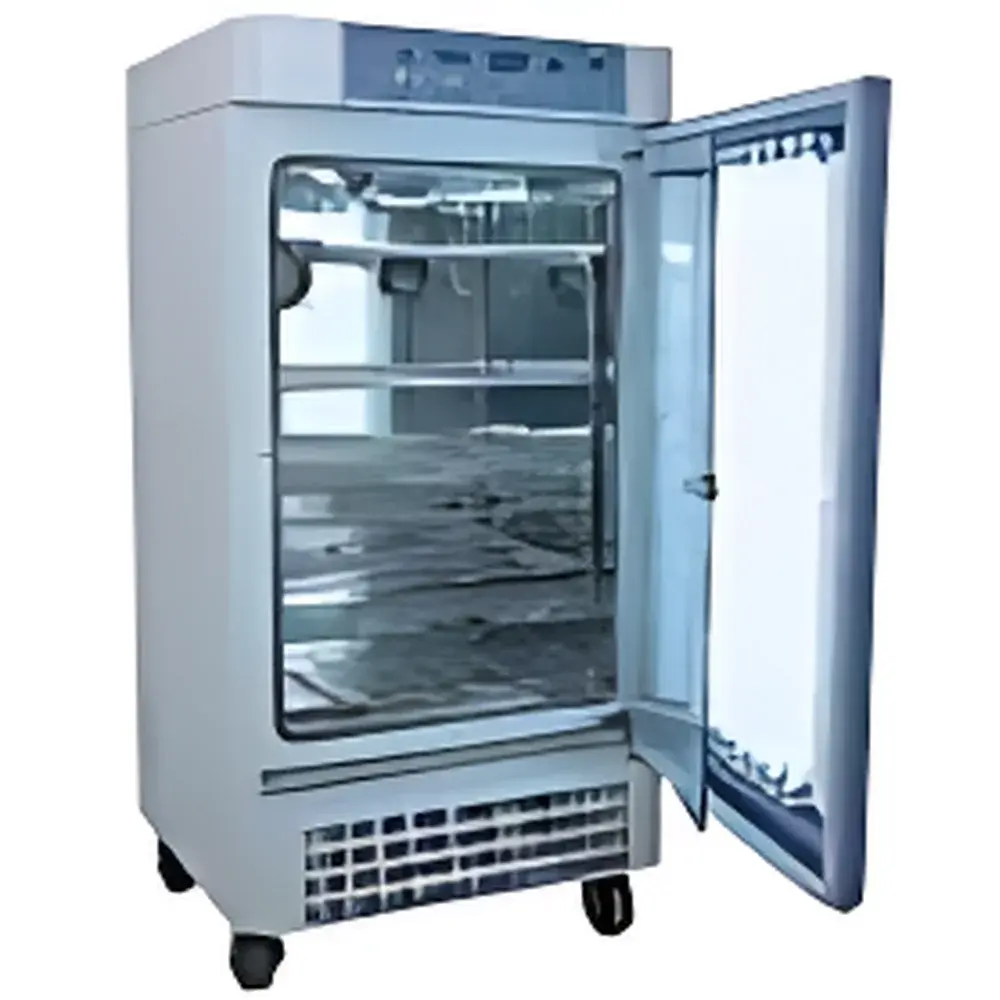
Jianhu JH Series Programmable Light Incubator & Climate Chamber (High-Intensity Illumination, R134a Refrigerant)
| Brand | Jianhu |
|---|---|
| Origin | Shanghai, China |
| Model | JH Series (e.g., JHC-250BP-2L, JHC-350HP-2L, JHC-450BP-2L) |
| Temperature Range | 0–50°C (dark), 10–50°C (with illumination) |
| Temperature Resolution | 0.1°C |
| Temperature Uniformity | ±1.5°C (250L), ±2°C (350/450L) |
| Temperature Stability | ±1°C |
| Humidity Range | 50–90% RH |
| Humidity Control Accuracy | ±5–7% RH |
| Illumination Intensity | 0–12,000 lx / 0–20,000 lx / 0–25,000 lx (model-dependent) |
| Programmability | 30-segment cycle, 1–99 h per segment |
| Refrigerant | R134a (CFC-free) |
| Compressor Configuration | Dual independent international-brand compressors with auto-rotating duty cycling |
| Power Input | 860–2100 W (model-dependent) |
| Internal Dimensions (W×D×H mm) | 580×510×835 / 520×550×1140 / 700×550×1140 |
| Standard Shelving | 3–4 adjustable stainless-steel shelves |
| Interface | RS485 port for PC connectivity and remote monitoring |
Overview
The Jianhu JH Series Programmable Light Incubator & Climate Chamber is an engineered solution for long-duration plant physiology, agricultural research, seed germination, photobiology, and controlled-environment studies requiring high-intensity illumination and precise environmental regulation. Unlike conventional incubators limited by thermal management constraints or single-compressor architecture, this system employs dual independent refrigeration circuits with intelligent load-balancing—enabling uninterrupted operation over extended periods (≥6 months), as required for crop breeding cycles, phenotyping trials, or circadian rhythm investigations. Its core measurement and control architecture integrates microprocessor-based regulation of temperature (0–50°C, with illumination-dependent lower limit), relative humidity (50–90% RH), and spectrally stable, multi-level white-light illumination (up to 25,000 lx). The chamber operates on R134a—a zero-ozone-depletion-potential (ODP = 0), low-global-warming-potential (GWP ≈ 1430) refrigerant—fully compliant with Montreal Protocol phase-out schedules and EU F-Gas Regulation (EU No 517/2014). All structural and thermal design elements—including mirror-finish 304 stainless-steel interior walls with radius-corner transitions—support ISO 14644-1 Class 8 cleanroom-compatible cleaning protocols and minimize microbial retention.
Key Features
- Dual-compressor refrigeration system with automatic alternating duty cycling ensures continuous thermal stability and extends mean time between failures (MTBF) beyond 20,000 hours under nominal load.
- 30-segment programmable controller enables precise replication of diurnal cycles: each segment independently defines target temperature, humidity, and light intensity over durations from 1 to 99 hours—ideal for simulating seasonal transitions or photoperiodic treatments.
- High-efficiency axial circulation fans with aerodynamically optimized blade geometry deliver uniform airflow (±1.5°C temperature uniformity in 250L model), minimizing boundary-layer stagnation around specimens.
- Electro-optically calibrated LED or fluorescent illumination arrays provide consistent spectral output across the visible range (400–700 nm PAR band), with intensity linearity verified per CIE S 026/E:2018 photometric standards.
- RS485 Modbus RTU interface supports integration into centralized laboratory infrastructure—enabling real-time data logging, alarm forwarding, and synchronized control via LIMS or SCADA platforms.
- Mirror-polished 304 stainless-steel chamber interior resists corrosion, facilitates validated cleaning (e.g., 70% ethanol or hydrogen peroxide vapor), and complies with ASTM E2993-15 guidelines for non-porous surface bioburden reduction.
Sample Compatibility & Compliance
The JH Series accommodates a broad spectrum of biological samples—from Petri dishes, growth trays, and hydroponic racks to potted seedlings and tissue culture vessels—without compromising environmental homogeneity. Its chamber geometry and shelf configuration meet ICH Q5C stability testing spatial requirements for multi-point sensor placement. Regulatory alignment includes adherence to ISO 17025:2017 clause 5.9 (environmental condition monitoring), USP “Pharmaceutical Dosage Forms” for photostability chamber qualification, and GLP Annex III (OECD Principles) for audit-ready environmental parameter traceability. Optional independent temperature-limiting hardware (UL-listed thermal cutout) satisfies IEC 61010-1:2010 Clause 6.3.2 for protection against hazardous overheating during software failure scenarios.
Software & Data Management
The embedded controller firmware supports full-cycle event logging—including timestamped setpoint changes, compressor runtime allocation, alarm triggers (e.g., door-open, sensor fault, deviation >±2°C), and ambient condition drift—with local storage (≥100,000 records). When connected via RS485, third-party software (e.g., LabVIEW, MATLAB, or custom Python scripts using PyModbus) can retrieve raw sensor values at user-defined intervals (1 s–10 min resolution). All data exports comply with ASTM E2500-13 Annex A1 for electronic record integrity: timestamps are NTP-synchronized, entries are immutable upon generation, and audit trails capture operator ID, action type, and pre-/post-change values—meeting FDA 21 CFR Part 11 requirements for electronic signatures when paired with identity-authenticated host systems.
Applications
- Long-term photoperiod-controlled experiments in plant genetics, including CRISPR-edited line stabilization and flowering-time phenotyping.
- Seed viability and dormancy studies under standardized ICH Q1A(R2) accelerated stability conditions.
- Microbial growth kinetics under defined light-humidity-temperature matrices for biofilm formation assays.
- Algal cultivation optimization for lipid yield profiling in renewable biofuel research.
- Material photodegradation screening per ISO 4892-2:2013 (Xenon-arc exposure simulation via spectral matching).
- Educational use in undergraduate botany and environmental science curricula requiring reproducible, maintenance-minimized platforms.
FAQ
What refrigerant does the JH Series use, and why is it environmentally compliant?
The system uses R134a (1,1,1,2-tetrafluoroethane), a hydrofluorocarbon (HFC) with zero ozone depletion potential (ODP = 0) and GWP significantly lower than legacy R22 or R404A. It conforms to current EU F-Gas Regulation phase-down timelines and China’s HCFC Phase-Out Management Plan.
Can the chamber maintain humidity during extended light-on cycles?
Yes—the dual-compressor architecture decouples dehumidification demand from lighting heat load; condensate management is enhanced by insulated drain channels and heated evaporator surfaces to prevent frost accumulation during low-temperature/high-RH operation.
Is validation documentation available for GxP environments?
Factory-installed IQ/OQ protocols (per ASTM E2500-13) and calibration certificates traceable to NIM (National Institute of Metrology, China) are provided. PQ support materials—including sensor placement maps and acceptance criteria templates—are included for site-specific qualification.
How is lighting uniformity verified across the working volume?
Each unit undergoes photometric mapping using a calibrated cosine-corrected lux meter at 9 predefined grid points (per ISO/CIE 19476:2014); uniformity is reported as max/min ratio ≤1.3 across the central 70% of shelf area.
Does the system support remote monitoring outside the local network?
While the standard RS485 interface requires direct serial or TCP/IP gateway connection, optional Ethernet-to-RS485 converters with TLS 1.2 encryption enable secure cloud-based telemetry via MQTT or HTTPS—subject to institutional IT security policy approval.



