
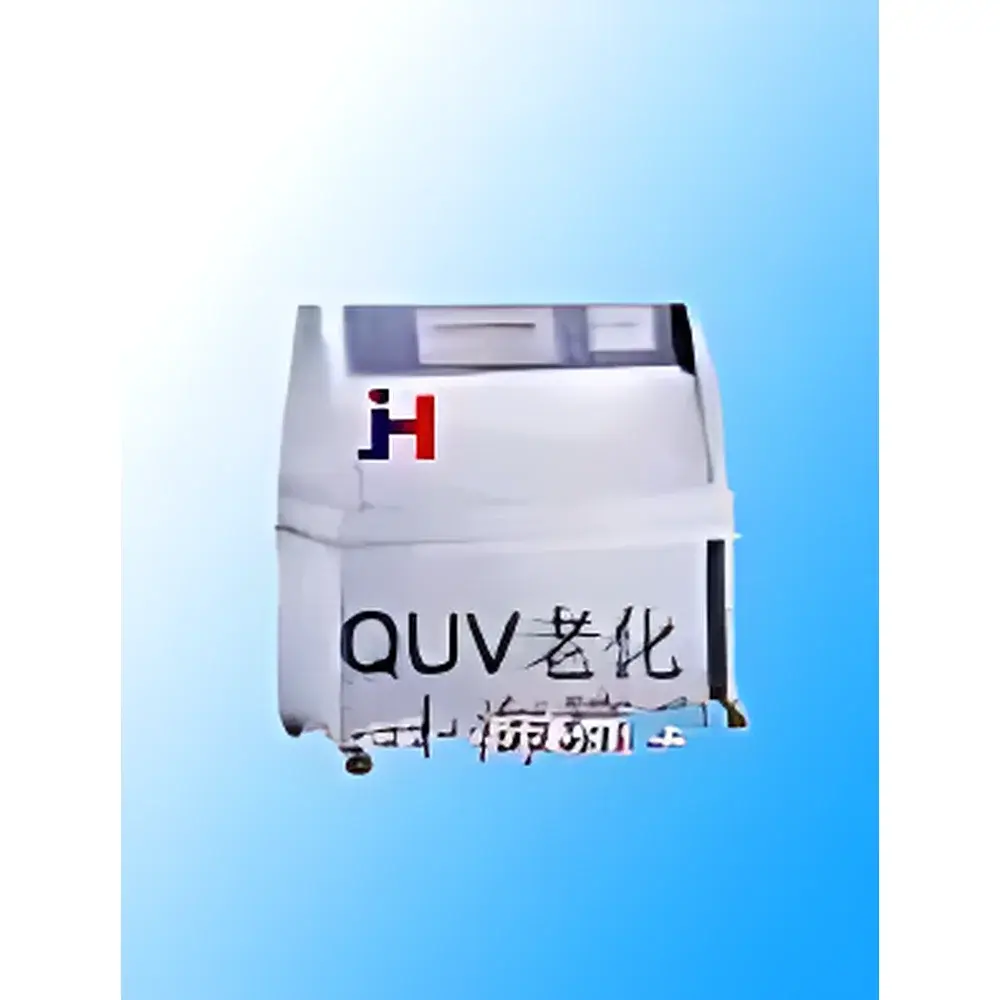
Jianhu UV Weathering Chamber
| Brand | Jianhu |
|---|---|
| Origin | Shanghai, China |
| Manufacturer Type | Authorized Distributor |
| Country of Origin | China |
| Model | Jianhu UV Chamber |
| Quotation | Upon Request |
| Temperature Range | 50–80 °C |
| Humidity Range | 50–98 % RH |
| Sample Holder Dimensions | 300 × 78 mm |
| Distance from Sample Surface to UV Lamp Centerline | 50 mm |
| Center-to-Center Spacing Between UV Lamps | 68 mm |
| Chamber Interior Material | SUS304 Stainless Steel |
| Exterior Finish | Optional Aluminum or Brushed Stainless Steel |
| Control System | Imported Digital Display Controller, Moeller Timer, Domestic Joint-Venture Electrical Components |
| Key Components | PID Temperature Controller, Time Relay, Ammeter, Solenoid Valve, UV Fluorescent Lamps (UVA-340 or UVB-313 equivalent) |
Overview
The Jianhu UV Weathering Chamber is an accelerated environmental testing instrument engineered for simulating the photodegradative effects of solar ultraviolet radiation, combined with controlled temperature and humidity cycles. It operates on the principle of fluorescent UV irradiation—primarily utilizing UVA-340 or UVB-313 spectral output lamps—to replicate critical short-wave UV components (295–365 nm) found in terrestrial sunlight. Unlike xenon arc or carbon arc systems, this chamber delivers high-intensity, spectrally stable UV exposure under tightly regulated thermal and hygrometric conditions—enabling repeatable, comparative aging studies of polymeric materials, coatings, textiles, automotive trim, and architectural finishes. Designed for laboratory-based durability qualification, it supports standardized exposure protocols aligned with international weathering test methodologies.
Key Features
- Stainless steel interior chamber (SUS304) ensures corrosion resistance, long-term dimensional stability, and compliance with cleanroom-compatible maintenance practices.
- Modular UV lamp array with precise geometric configuration: 50 mm sample-to-lamp distance and 68 mm lamp center spacing optimize irradiance uniformity across the test plane per ASTM G154 Annex A1 requirements.
- Dual-parameter environmental control: independent regulation of black panel temperature (50–80 °C) and relative humidity (50–98 % RH) enables simulation of diurnal condensation cycles and thermal stress profiles.
- Imported digital PID temperature controller provides ±0.5 °C stability; integrated Moeller programmable timer supports multi-stage exposure sequences with automatic lamp-on/off scheduling.
- Configurable exterior cladding: brushed stainless steel or anodized aluminum options accommodate integration into ISO 17025-accredited lab environments where surface finish and ESD safety are specified.
- All critical electrical subsystems—including solenoid valves, ammeters, and relays—utilize components from Sino-foreign joint ventures certified to IEC 61000-4 immunity standards.
Sample Compatibility & Compliance
The chamber accommodates flat, rigid specimens up to 300 mm × 78 mm mounted on a fixed-position SUS304 sample holder. Its geometry supports standard ASTM D4329, ISO 4892-3, and GB/T 14522-1993 specimen orientation and loading protocols. The system complies with national and industry-specific validation frameworks including GB/T 5170.9 (Environmental Testing Equipment Verification), GB/T 2424.14–1995 (Guidance for UV Exposure Testing), and Q/CS01–92 (Enterprise Standard for UV Aging Apparatus). While not inherently 21 CFR Part 11 compliant, its analog/digital hybrid control architecture permits integration with external audit-trail-capable data loggers for GLP/GMP-aligned material qualification workflows.
Software & Data Management
This model operates via hardware-based control without embedded firmware or proprietary software. All operational parameters—including exposure duration, temperature setpoints, and humidity targets—are configured manually using front-panel digital interfaces and mechanical timers. Real-time monitoring relies on analog ammeters and calibrated thermocouple inputs routed to external chart recorders or third-party DAQ systems (e.g., National Instruments CompactDAQ). For traceability, users may pair the chamber with ISO/IEC 17025-compliant calibration services for UV radiometers (calibrated per NIST-traceable standards) and hygrothermal sensors. Configuration logs, calibration certificates, and exposure records must be maintained externally in accordance with internal QA documentation procedures.
Applications
- Evaluation of UV-induced degradation mechanisms: chalking, gloss loss, color shift (ΔE*), cracking, and embrittlement in thermoplastics and elastomers.
- Comparative ranking of pigment stability and UV absorber efficacy in automotive clearcoats and architectural sealants.
- Pre-qualification screening for outdoor service life estimation per ISO 4892-3 Cycle 1 (UV/condensation) and Cycle 4 (UV/light/dark).
- Supporting ASTM D4329 Class A/B exposure protocols for PVC, acrylics, and fluoropolymer films used in façade systems.
- Material lot release testing in QC laboratories where reproducible UV dose delivery (measured in kJ/m² @ 340 nm) is required for batch consistency verification.
FAQ
What UV lamp types are compatible with this chamber?
Standard configurations use UVA-340 fluorescent tubes (peak emission at 340 nm) for realistic daylight simulation; UVB-313 tubes (peak at 313 nm) may be substituted for aggressive, accelerated testing per ISO 4892-3 Annex B.
Is irradiance uniformity mapped and certified?
The lamp geometry conforms to ASTM G154 Figure A1.1 specifications; however, end-users are responsible for periodic irradiance mapping using a NIST-traceable UV radiometer calibrated at 340 nm.
Can the chamber operate unattended for extended cycles?
Yes—its relay-based control system supports continuous operation up to 1,000 hours when paired with scheduled maintenance (lamp replacement every 1,600–2,000 h) and ambient cooling provisions.
Does the unit meet CE or UL safety certification?
It carries CCC (China Compulsory Certification) and complies with GB 4793.1–2007 (Safety Requirements for Electrical Equipment for Measurement, Control, and Laboratory Use); CE/UL certification requires site-specific risk assessment and third-party evaluation.
How is humidity generated and controlled?
Humidity is produced via resistive water-heating pans located beneath the sample plane; RH is regulated by modulating pan temperature and chamber air exchange rate—not by steam injection or ultrasonic humidification.



