
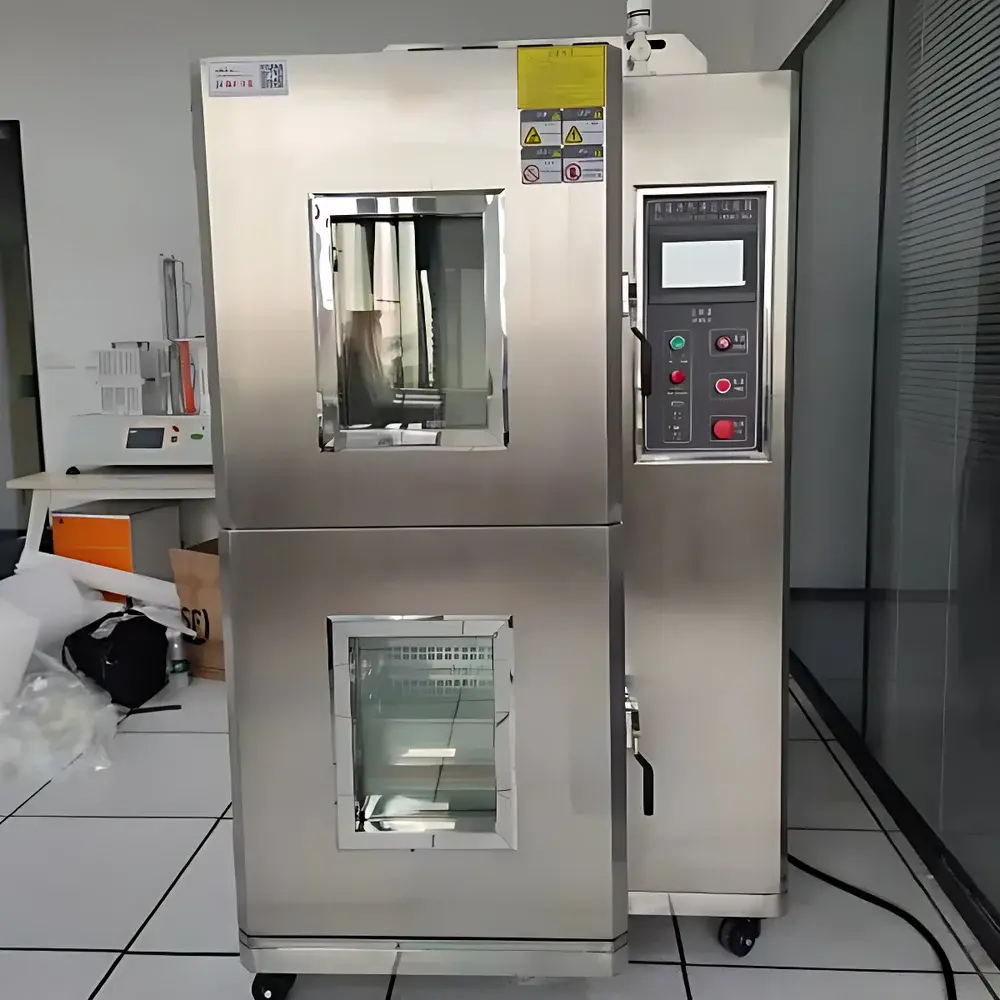
Jianhu Rapid Temperature Transition Chamber for Electronic Component Environmental Reliability Testing
| Brand | Jianhu |
|---|---|
| Origin | Shanghai, China |
| Manufacturer Type | Authorized Distributor |
| Product Origin | Domestic (China) |
| Model | Rapid Temperature Transition Chamber |
| Price Range | USD 700 – 7,000 |
Overview
The Jianhu Rapid Temperature Transition Chamber is an engineered environmental stress screening (ESS) system designed to accelerate thermal fatigue failure mechanisms in electronic components—particularly advanced semiconductor devices, stacked-die packages, and heterogeneous integrated modules. It operates on the physical principle of controlled transient thermal loading: by subjecting test specimens to precisely programmed temperature ramps exceeding 50 °C/min (up to 70 °C/min typical), the chamber induces high-magnitude, time-resolved thermomechanical stresses at material interfaces. Unlike conventional thermal cycling chambers limited to ≤15 °C/min, this system replicates the rapid thermal transients experienced during real-world events such as power-on surges, automotive under-hood thermal shock, or aerospace re-entry conditions. Its core function is not merely temperature exposure, but the *accelerated activation* of failure physics—including interfacial delamination, solder joint fatigue (per Coffin-Manson and Engelmaier models), silicon die cracking, and TSV (through-silicon via) plastic deformation—thereby compressing years of field-relevant degradation into laboratory-scale test durations.
Key Features
- High-rate thermal transition capability: Achieves programmable ramp rates from −65 °C to +150 °C at up to 70 °C/min (heating) and 55 °C/min (cooling), enabled by dual-mode conditioning—liquid nitrogen injection for rapid cooling and high-density vortex heating for instantaneous thermal rise.
- Uniform thermal field control: Equipped with multi-zone air circulation, calibrated platinum RTD sensors (Class A, ±0.15 °C accuracy), and adaptive PID feedback loops ensuring ±0.5 °C chamber uniformity across the working volume (per IEC 60068-3-5).
- Rugged mechanical architecture: Stainless-steel insulated chamber walls with vacuum-jacketed doors, reinforced internal airflow ducts, and corrosion-resistant interior finish compliant with MIL-STD-810H environmental durability requirements.
- Integrated safety & monitoring: Dual independent overtemperature cut-offs, liquid nitrogen level monitoring, pressure relief valves, and real-time fault logging with timestamped event history traceable to ISO/IEC 17025 audit requirements.
- Modular expansion interface: Standard RS-485, Ethernet (TCP/IP), and optional analog I/O ports support integration with external data acquisition systems for synchronized electrical parameter monitoring (e.g., resistance, leakage current, capacitance).
Sample Compatibility & Compliance
The chamber accommodates standard JEDEC trays (JEDEC JESD22-A104F), 300-mm wafer carriers, and custom PCB fixtures up to 600 mm × 600 mm × 500 mm (W×D×H). It meets the thermal profile specifications required for AEC-Q100 Grade 0–3 qualification testing, MIL-STD-883 Method 1010.8 (Temperature Cycling), and IPC-9701A accelerated thermal cycle protocols. All thermal profiles are fully traceable to NIST-traceable calibration standards. The system supports GLP/GMP-compliant operation when paired with validated software (see Software & Data Management section), fulfilling documentation requirements for FDA 21 CFR Part 11 electronic records and signatures where applicable.
Software & Data Management
Control and data acquisition are managed via Jianhu’s proprietary WinTest Pro v4.2 platform—a Windows-based application compliant with IEC 62443-3-3 cybersecurity guidelines. The software enables full profile definition (ramp/soak/hybrid cycles), real-time graphical monitoring of chamber setpoint vs. actual temperature, and automated generation of PDF test reports containing cycle count, dwell times, max/min deviations, and pass/fail status per user-defined acceptance criteria. Audit trails record all operator actions, parameter changes, and system alarms with immutable timestamps. Data export supports CSV, XML, and SQL formats for integration into LIMS or enterprise quality management systems (QMS). Optional 21 CFR Part 11 compliance package includes electronic signature workflows, role-based access control, and encrypted database backups.
Applications
- Qualification of automotive-grade ICs (AEC-Q100 Rev H) and ADAS sensor modules under extended thermal shock envelopes (−65 °C ↔ +150 °C).
- Screening of 2.5D/3D IC packages (e.g., HBM2E, CoWoS) for interposer delamination and microbump fatigue.
- Process validation of underfill dispensing, reflow profiles, and conformal coating adhesion strength.
- Early-life failure screening (ELF) of high-reliability components for aerospace avionics and medical implant electronics.
- Correlation studies between accelerated lab data and field return analysis (FRA), supporting physics-of-failure (PoF) model refinement.
FAQ
What is the maximum achievable temperature ramp rate for this chamber?
Standard configuration delivers up to 70 °C/min heating and 55 °C/min cooling within the −65 °C to +150 °C operating range. Custom configurations with enhanced LN₂ supply capacity may exceed these values under specific ambient and load conditions.
Does the system support automated electrical monitoring during thermal cycling?
Yes—via optional analog/digital I/O modules, the chamber can synchronize with external parametric test equipment (e.g., SMUs, LCR meters) to log electrical parameters in real time against thermal cycle phase.
Is calibration documentation provided with each unit?
Each chamber ships with a factory calibration certificate covering temperature uniformity, stability, and ramp rate verification per IEC 60068-3-5 and ASTM E2202. On-site recalibration services are available globally.
Can the chamber be integrated into an existing test automation framework?
Yes—the system supports Modbus TCP, OPC UA, and SCPI command sets, enabling seamless integration with MES, test sequencers (e.g., NI TestStand), and robotic handling systems.
What maintenance intervals are recommended for sustained performance?
Preventive maintenance is advised every 12 months or 2,000 operational hours—whichever occurs first—including refrigerant purity checks, LN₂ delivery line inspection, sensor recalibration, and airflow path cleaning per manufacturer’s technical bulletin TB-JH-RTT-003.



