
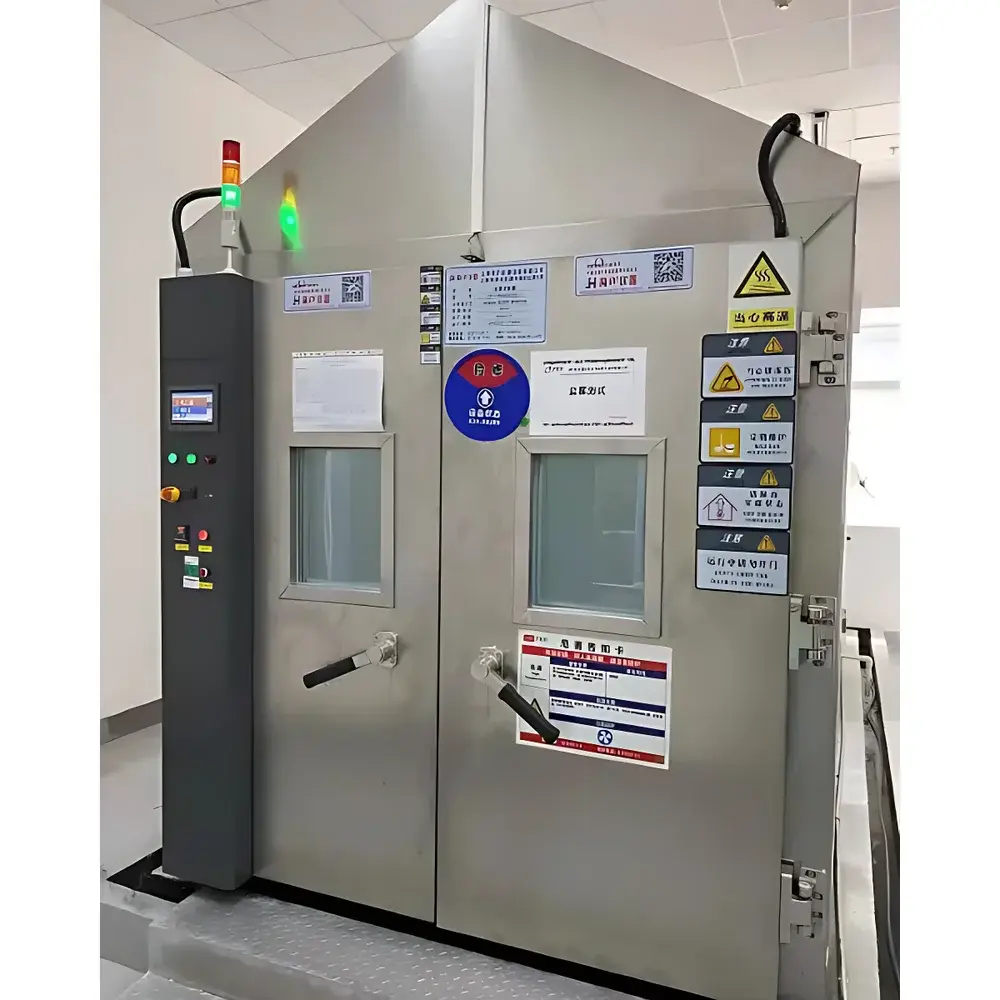
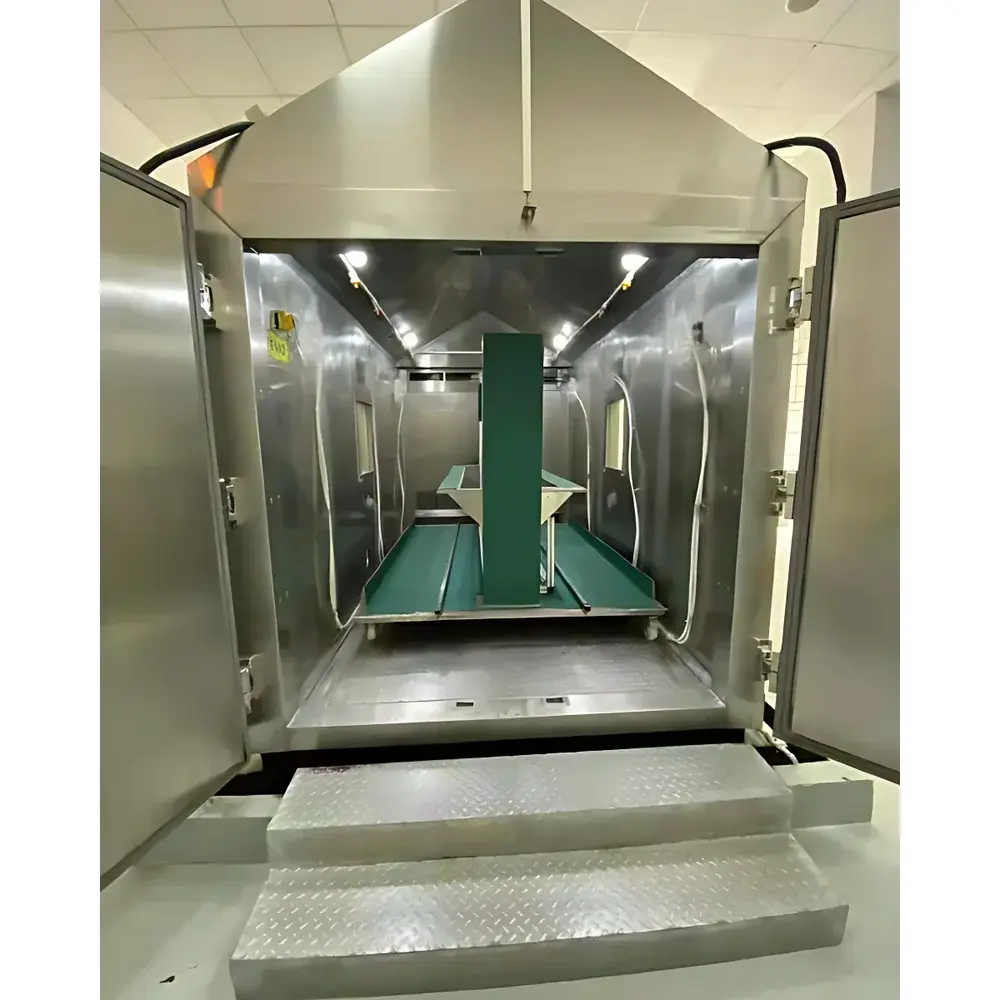
JianHu JH-Walk-In Large-Scale Salt Spray Test Chamber
| Brand | JianHu |
|---|---|
| Origin | Shanghai, China |
| Model | JH-Walk-In Salt Spray Test Chamber |
| Spray Method | Continuous Atomization |
| Fog Output | 1–2 mL per 80 cm² per hour |
| Nozzle Pressure | 0.7–1 kg/cm² |
| De-fogging Method | Air-Compression Exhaust |
Overview
The JianHu JH-Walk-In Large-Scale Salt Spray Test Chamber is an engineered environmental simulation system designed for accelerated corrosion testing of large-scale components and assemblies under controlled saline atmospheric conditions. Based on the ASTM B117 and ISO 9227 standard methodologies, it employs a continuous atomization principle to generate a stable, uniformly distributed sodium chloride (NaCl) aerosol within a thermally regulated chamber environment. Unlike benchtop salt fog chambers, its walk-in configuration enables full-system evaluation—supporting test specimens up to vehicle subassemblies, marine equipment enclosures, aerospace structural panels, and industrial control cabinets. The chamber integrates precision-controlled temperature (typically 35°C ± 2°C), saturated humidity (≥95% RH), and consistent fog density to replicate aggressive coastal, offshore, or de-icing salt exposure scenarios over extended durations (from 24 hours to thousands of hours). Its architecture adheres to fundamental corrosion science principles: electrochemical degradation kinetics are accelerated by maintaining a conductive electrolyte film on metallic surfaces, enabling quantitative assessment of coating integrity, galvanic compatibility, and substrate passivation behavior.
Key Features
- Walk-in structural design with internal dimensions accommodating specimens up to 3 m (W) × 2.5 m (D) × 2.2 m (H)—custom configurations available upon request
- Continuous spray system utilizing corrosion-resistant borosilicate glass nozzles and calibrated air-pressure regulation (0.7–1 kg/cm²) for uniform fog distribution across the entire test volume
- Precise fog generation rate: 1–2 mL per 80 cm² per hour, compliant with ASTM B117 volumetric specifications
- Integrated air-compression de-fogging mechanism for rapid post-test chamber clearance—minimizing residual condensate and enabling safe operator access
- Double-wall insulated chamber construction with polyurethane foam insulation (≥100 mm thickness) and stainless-steel 316L interior cladding for long-term chemical resistance
- Digital PID-controlled heating and humidification system with real-time feedback from platinum RTD sensors (Class A accuracy)
- Compliance-ready hardware architecture supporting optional data logging modules and audit-trail-capable controllers for GLP/GMP environments
Sample Compatibility & Compliance
The JH-Walk-In chamber supports heterogeneous sample geometries—including coated metal panels, welded chassis, electronic enclosures with gasketed seams, and multi-material assemblies—without requiring disassembly. Its large internal volume eliminates edge-effect artifacts common in small-chamber testing, improving spatial uniformity of salt deposition (verified per ISO 9227 Annex A). The system meets core regulatory frameworks for corrosion validation: ASTM B117 (Standard Practice for Operating Salt Spray Chambers), ISO 9227 (Corrosion tests in artificial atmospheres — Salt spray tests), and JIS Z 2371. Optional upgrades include pH monitoring of collected fog solution, temperature gradient mapping per IEC 60068-2-11, and integration with third-party LIMS platforms for traceability. All electrical components conform to IP54 ingress protection; chamber doors feature dual-seal gaskets and positive-pressure interlocks to prevent fog leakage during operation.
Software & Data Management
The standard control interface features a 10.1-inch capacitive touchscreen HMI with embedded firmware supporting multi-step test profiles (e.g., cyclic salt spray + dry + humidity phases per ISO 14993). Logged parameters—including chamber temperature, saturation temperature, nozzle pressure, and elapsed test time—are timestamped and exportable via USB or Ethernet (Modbus TCP). For regulated laboratories, optional FDA 21 CFR Part 11-compliant software packages provide electronic signatures, role-based user access control, and immutable audit trails for all parameter modifications and test initiations. Raw data files adhere to ASTM E2500-18 metadata conventions, facilitating automated report generation aligned with ISO/IEC 17025 documentation requirements.
Applications
- Automotive OEMs validating corrosion resistance of brake calipers, suspension arms, and EV battery enclosures under SAE J2334 and GMW14872 protocols
- Aerospace suppliers qualifying aluminum-lithium alloy fasteners and composite-to-metal bonded joints per Boeing D6-17487 and Airbus AITM 1-0003
- Marine equipment manufacturers verifying IP66-rated control boxes and stainless-steel instrumentation housings against IMO MSC.1/Circ.1212
- Electronics firms assessing conformal coating durability on PCBAs exposed to coastal humidity and salt-laden wind conditions
- Academic and national metrology labs conducting interlaboratory comparison studies on coating adhesion metrics (e.g., ASTM D3359 cross-hatch rating)
- Third-party certification bodies (e.g., SGS, TÜV, UL) performing accredited salt fog testing for CE marking and CCC certification
FAQ
What standards does the JH-Walk-In chamber comply with by default?
It meets ASTM B117 and ISO 9227 as baseline operational standards. Optional calibration certificates and verification reports are available per ISO/IEC 17025.
Can the chamber operate cyclic test programs (e.g., salt spray + drying + humidity)?
Yes—when equipped with the advanced controller option, it supports programmable multi-phase cycles per ISO 14993 and ASTM G85 Annex A5.
Is remote monitoring supported?
Ethernet connectivity enables real-time parameter viewing and alarm notifications via standard web browsers; SCADA integration is achievable using Modbus TCP.
What maintenance intervals are recommended for long-term reliability?
Nozzle inspection every 200 operational hours; compressed air filter replacement quarterly; full chamber calibration annually per ISO 17025 guidelines.
Does the system include fog collection and analysis capability?
A standardized fog collector kit (per ASTM B117 Figure 2) is included; optional conductivity/pH sensors enable real-time solution quality monitoring.



