
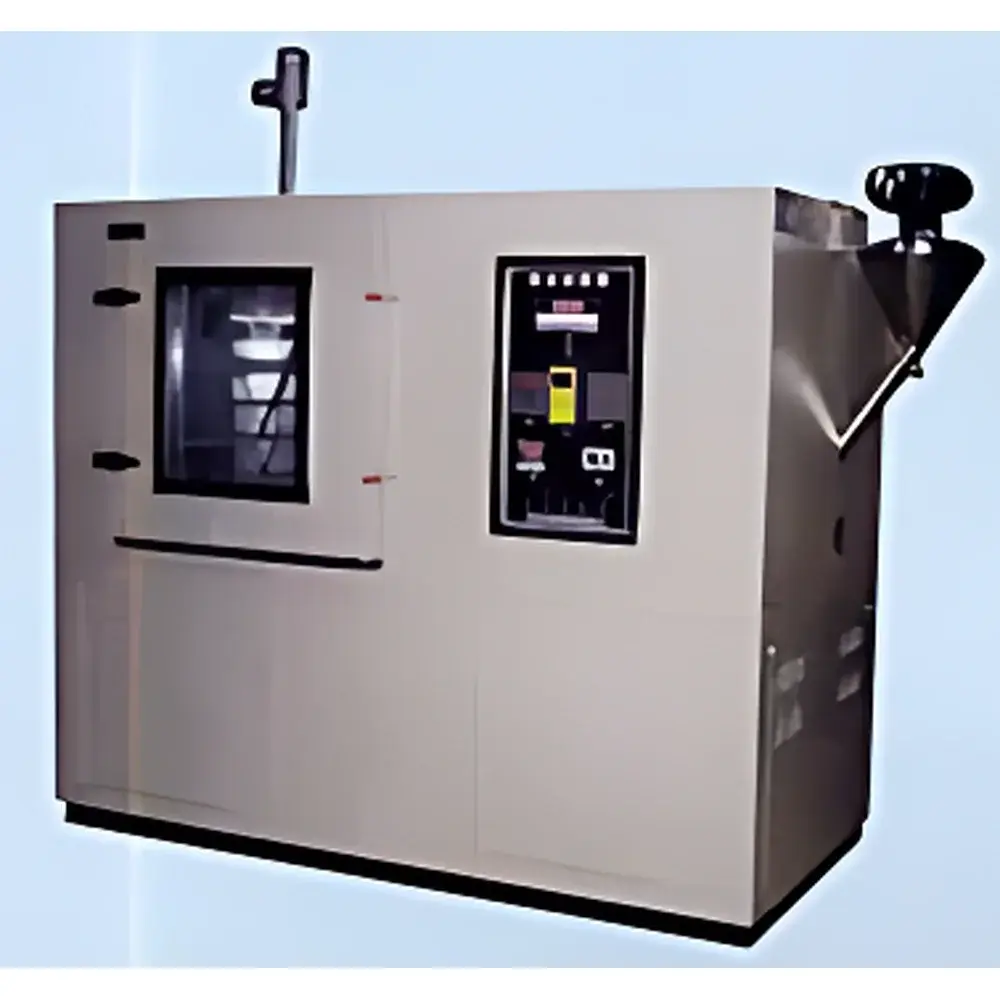
Jianhu JHF-500 Sand and Dust Test Chamber
| Brand | Jianhu |
|---|---|
| Model | JHF-500 |
| Internal Chamber Dimensions | 800 × 800 × 800 mm (D × W × H) |
| Temperature Range | RT + 5°C to 50°C |
| Relative Humidity | 25%–75% RH |
| Sieve Mesh Specifications | 50 µm wire diameter with spacing options of 32 µm, 75 µm, and 250 µm |
| Ambient Pressure Range | 86–106 kPa |
| Airflow Velocity | Adjustable up to 1.5 m/s (displayed via integrated anemometer, KA22, 0–4.99 m/s ±2% FS) |
| Turntable Diameter | 400 mm, variable-speed (via TAIAN frequency inverter) |
| Dust Concentration | 5 g/m³ ±2 g/m³ |
| Power Supply | 3-phase 5-wire AC 380 V, 50 Hz |
| Compliance Standards | IEC 60529, GB 4208–1993, GB/T 2423.37–1989, GJB 150.12–1986, GB 10485–1989, DIN 40050 (IP5K0) |
Overview
The Jianhu JHF-500 Sand and Dust Test Chamber is an engineered environmental test system designed to evaluate the ingress protection (IP) performance of enclosures—particularly against non-abrasive airborne particulates—under controlled, repeatable conditions. It operates on the principle of forced-air suspension and recirculation of standardized dust particles within a sealed chamber, simulating real-world exposure scenarios for electrical, electronic, automotive, and aerospace components. Unlike thermal or humidity chambers, this unit focuses specifically on mechanical particulate resistance, adhering strictly to the airflow dynamics, concentration control, and particle-size distribution requirements defined in international sand and dust test standards. Its architecture supports both steady-state and cyclic dust exposure protocols, enabling rigorous validation of sealing integrity, gasket performance, and housing design robustness under dynamic particulate loading.
Key Features
- Stainless steel SUS304 interior chamber (800 × 800 × 800 mm) ensures corrosion resistance, smooth surface finish, and ease of dust residue removal.
- Triple-mesh sieve configuration (32 µm, 75 µm, and 250 µm spacing) allows selection of particle size cutoffs aligned with specific test severity levels per IEC 60529 and GB/T 2423.37.
- Real-time airflow velocity monitoring and adjustment via a calibrated KA22 anemometer (0–4.99 m/s, ±2% FS) and dedicated TAIAN frequency inverter—ensuring precise compliance with the mandated 1.5 m/s horizontal cross-flow requirement across the test specimen zone.
- Motorized 400 mm diameter turntable with independent speed control enables rotational testing of asymmetrical or multi-port enclosures, enhancing exposure uniformity and reducing positional bias.
- Optical dust concentration sensor continuously measures suspended particulate mass density (target: 5 g/m³ ±2 g/m³) and regulates electromagnetic valve actuation to maintain setpoint concentration using clean compressed air (1–3 kgf/cm²).
- Modular dust handling system: left-side injection, right-side aspiration, bottom-mounted collection reservoir with manual isolation valve, and integrated dust concentration controller—all configured to minimize operator intervention and maximize repeatability.
Sample Compatibility & Compliance
The JHF-500 accommodates samples up to 600 mm in maximum dimension, with full compatibility for IP5X and IP6X-rated enclosures used in industrial control panels, vehicle ECUs, outdoor lighting fixtures, and portable instrumentation housings. It meets the physical and procedural requirements of multiple internationally harmonized standards, including IEC 60529 (Ed. 2.2), GB 4208–1993 (equivalent to IEC 60529), GB/T 2423.37–1989 (sand and dust test method), GJB 150.12–1986 (military-grade environmental testing), and DIN 40050 for road vehicle IP classification (specifically IP5K0). The chamber’s pressure range (86–106 kPa) and humidity control (25–75% RH) permit testing under ambient atmospheric conditions typical of field deployment environments, while its temperature capability (RT + 5°C to 50°C) supports accelerated aging evaluations where thermal stress interacts with particulate ingress.
Software & Data Management
While the JHF-500 utilizes discrete industrial controllers—including the Moeller EASY-412-AC-RC programmable timer for multi-stage timing (total cycle, blow-dust interval, and optional sample actuation)—it is fully compatible with external data acquisition systems via analog outputs (0–10 V or 4–20 mA) from the anemometer and dust concentration meter. All critical operational parameters—including elapsed test time, airflow velocity, dust density, and turntable RPM—are physically displayed on the front panel for immediate verification. For GLP/GMP-aligned laboratories, the system supports integration into validated LIMS or MES platforms through optional RS-485 Modbus RTU communication modules (available as retrofit). Time-stamped logs can be exported manually or triggered by digital I/O signals, satisfying audit requirements under ISO/IEC 17025 and FDA 21 CFR Part 11 when paired with appropriate electronic signature workflows.
Applications
This chamber is routinely deployed in quality assurance labs for pre-certification validation of IP-rated products prior to third-party testing. Key application domains include: qualification of automotive lighting assemblies against DIN 40050 IP5K0; verification of dust sealing in battery enclosures for EV powertrain systems; evaluation of ingress resistance in IoT edge devices deployed in arid or construction-site environments; durability assessment of military-grade connectors under GJB 150.12 protocols; and comparative analysis of gasket materials under sustained low-concentration particulate exposure. Its ability to sustain stable dust concentrations over extended durations (up to 8 hours continuous operation) makes it suitable for long-term reliability studies where cumulative deposition effects are critical.
FAQ
What dust types are recommended for use with the JHF-500?
Standardized talcum powder (ASTM D1898-compliant) or Arizona Test Dust (ISO 12103-1, A2 grade) is recommended. Particle size distribution must conform to the selected mesh specification (e.g., retained on 50 µm wire with 32 µm spacing).
Is compressed air required for operation?
Yes—a clean, oil-free, dry compressed air source (1–3 kgf/cm²) is mandatory for the dust feed system and optical concentration sensor purge.
Can the chamber perform both blowing and suction modes simultaneously?
No. The airflow path is unidirectional: horizontal cross-flow from left to right, with recirculation enabled via internal ducting. Suction occurs only at the right-side intake manifold.
Does the system support automated test sequencing?
The base configuration includes fixed-interval timing via the Moeller EASY-412. Fully programmable multi-step sequences require external PLC integration or optional controller upgrade.
How is calibration traceability maintained?
Anemometer calibration is traceable to national metrology institutes (e.g., NIM China) via annual third-party certification. Dust concentration sensor output is verified using gravimetric sampling per ISO 7708 during routine maintenance.



