
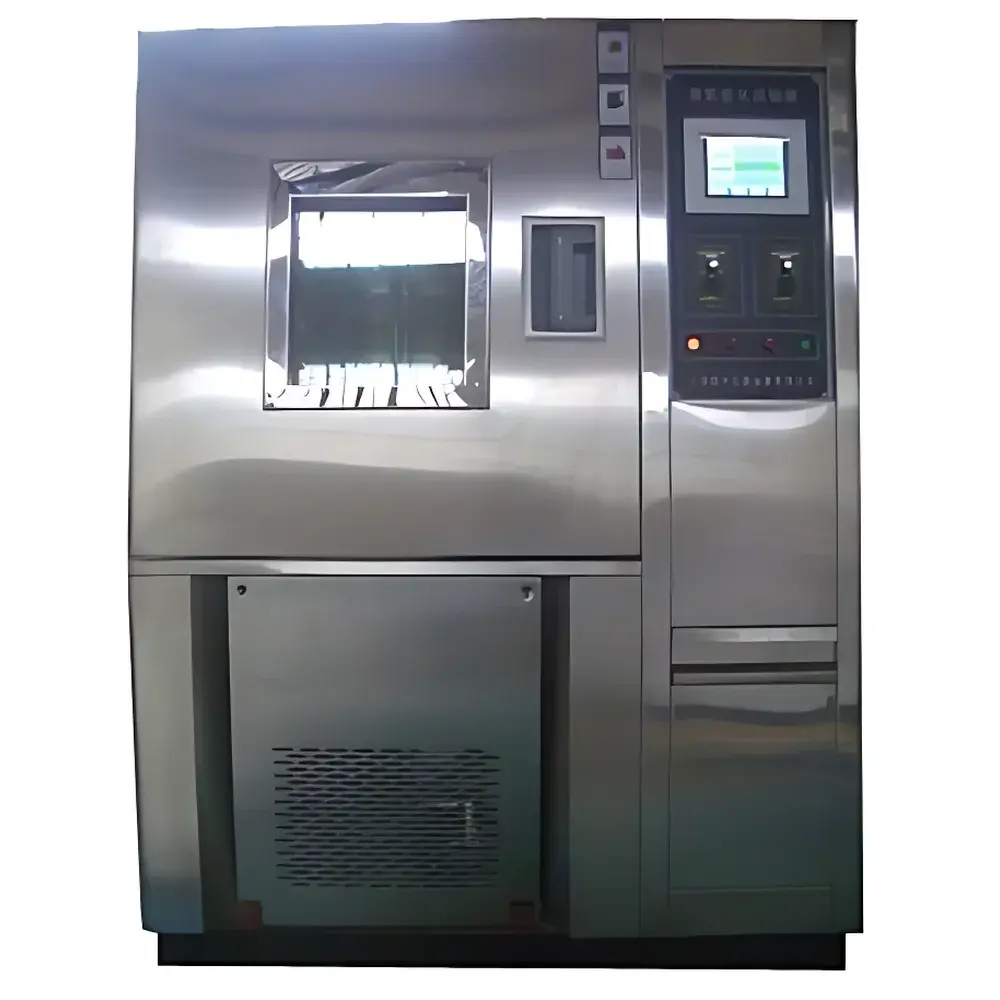
Jianhu SN-Series Xenon Arc Weathering Test Chamber
| Brand | Jianhu |
|---|---|
| Origin | Shanghai, China |
| Model | SN-Series |
| Light Source | Full-Spectrum Xenon Arc Lamp |
| Filter Options | Quartz/Window Glass/Borosilicate |
| Irradiance Control | 0.35–0.65 W/m² @ 340 nm (adjustable) |
| Temperature Range | 10°C to 90°C (black panel) |
| Humidity Range | 10% to 95% RH |
| Water Spray | Intermittent or continuous cycle |
| Sample Capacity | Up to 20 standard specimens (75 mm × 150 mm) |
| Lamp Life | ~1600 hours at nominal irradiance |
| Compliance | GB/T 2423.24–1995, GB/T 16422.2–2014, GB 9344–1988, GB/T 1865–2022, ASTM G155–24, ISO 4892-2:2016 |
Overview
The Jianhu SN-Series Xenon Arc Weathering Test Chamber is an engineered environmental simulation system designed to replicate the photodegradative effects of natural sunlight, heat, and moisture under controlled laboratory conditions. Utilizing a high-intensity, full-spectrum xenon arc lamp—spectrally filtered to match terrestrial solar irradiance—the chamber enables accelerated aging studies that correlate strongly with real-world outdoor exposure. The system operates on the principle of xenon arc irradiation combined with regulated thermal and hygrothermal cycling, allowing precise control over key stressors: UV and visible radiation (290–800 nm), black-panel temperature (BPT), relative humidity (RH), and water spray. This tri-factorial exposure methodology supports quantitative assessment of material degradation mechanisms—including photooxidation, chalking, color shift, gloss loss, cracking, and embrittlement—making it indispensable for R&D labs, quality assurance departments, and regulatory compliance testing in globally regulated industries.
Key Features
- Full-spectrum xenon arc lamp with spectral output closely matching CIE Standard Illuminant D65 and ASTM G155 reference spectra;
- Interchangeable optical filter systems (quartz, borosilicate, and window glass types) to simulate varying atmospheric conditions (e.g., direct sunlight, through-glass exposure);
- Precise irradiance control via calibrated broadband or narrowband (340 nm) sensors, enabling reproducible test protocols across laboratories;
- Integrated black-panel temperature sensor and PID-controlled heating system for accurate surface temperature monitoring and regulation (10°C to 90°C);
- Digital humidity control with capacitive RH sensor and steam generator, maintaining stable 10–95% RH ranges independent of chamber temperature;
- Programmable water spray subsystem with adjustable frequency, duration, and pressure—supporting both light mist and aggressive wetting cycles per ISO 4892-2 Annex B;
- Modular sample rack accommodating irregular geometries and non-standard specimen sizes, with optional back-plate cooling for thermal stabilization;
- Front-access lamp housing with tool-free xenon lamp replacement and long-life optical filters ensuring spectral stability over extended operation;
- Industrial-grade stainless-steel interior, corrosion-resistant construction, and IEC 61000-4 EMC-compliant electronics for laboratory durability.
Sample Compatibility & Compliance
The SN-Series accommodates flat panels, molded parts, coated substrates, textiles, adhesives, and multi-layer composites up to 75 mm × 150 mm per slot (standard configuration). Specimen mounting fixtures are configurable for vertical or inclined orientation to emulate real-world exposure angles. The chamber meets mandatory requirements for international standards including ISO 4892-2:2016 (Plastics—Methods of exposure to laboratory light sources—Part 2: Xenon-arc lamps), ASTM G155–24 (Standard Practice for Operating Xenon Arc Lamp Apparatus for Exposure of Non-Metallic Materials), and GB/T 16422.2–2014 (Chinese national standard equivalent). It also supports method development aligned with automotive OEM specifications (e.g., SAE J2527, GMW 14124) and regulatory frameworks requiring traceable environmental stress validation under GLP or ISO/IEC 17025-accredited conditions.
Software & Data Management
Equipped with embedded 7-inch touchscreen HMI running proprietary firmware, the chamber provides real-time monitoring of irradiance (W/m²), BPT, chamber air temperature, RH, and spray status. All parameters are logged at user-defined intervals (1–60 s) and exported via USB or Ethernet as CSV files compliant with 21 CFR Part 11 audit trail requirements. Optional PC-based software (Jianhu LabControl v3.2) enables remote scheduling, multi-step program sequencing, automated pass/fail evaluation against preset thresholds, and export-ready reporting templates compatible with LIMS integration. Calibration certificates for irradiance sensors and temperature/humidity probes are provided with NIST-traceable documentation upon installation.
Applications
- Automotive: Accelerated evaluation of exterior trim, paint systems, headlamp lenses, and sealants under cyclic UV/heat/moisture;
- Coatings & Inks: Correlation of pigment stability, binder degradation, and adhesion loss across formulation variants;
- Polymers & Plastics: Quantification of yellowing index (YI), carbonyl index (FTIR), and tensile retention after defined radiant exposure doses;
- Medical Packaging: Validation of UV barrier performance for sterile barrier systems per ISO 11607-1;
- Textiles & Geotextiles: Assessment of colorfastness (ISO 105-B02) and tensile strength decay under simulated subtropical climates;
- Electronics Enclosures: Long-term verification of UV resistance for polycarbonate housings and conformal coatings used in outdoor IoT devices.
FAQ
What spectral range does the xenon lamp cover, and how is it filtered?
The lamp emits continuous radiation from 290 nm to >800 nm. Optical filters (quartz, borosilicate, or window glass) are selected to modify the UV cutoff and simulate specific exposure conditions—e.g., “Daylight-Q” for outdoor exposure or “Window-Glass” for indoor applications.
Can the chamber operate without water spray?
Yes. The water spray function is fully programmable and may be disabled for dry-heat or UV-only test profiles.
Is calibration support available for ISO/IEC 17025 accreditation?
Yes. Jianhu provides factory calibration services with uncertainty budgets and traceability to national metrology institutes; on-site recalibration kits and third-party verification protocols are also supported.
How is irradiance uniformity verified across the specimen plane?
Uniformity is validated per ASTM G155 Annex A using a 3×3 grid mapping procedure; typical deviation is ≤±15% across the standard exposure area.
Does the system comply with FDA 21 CFR Part 11 for electronic records?
When configured with optional audit-trail-enabled firmware and user access controls, the system meets Part 11 requirements for signed electronic records and secure data archiving.



