
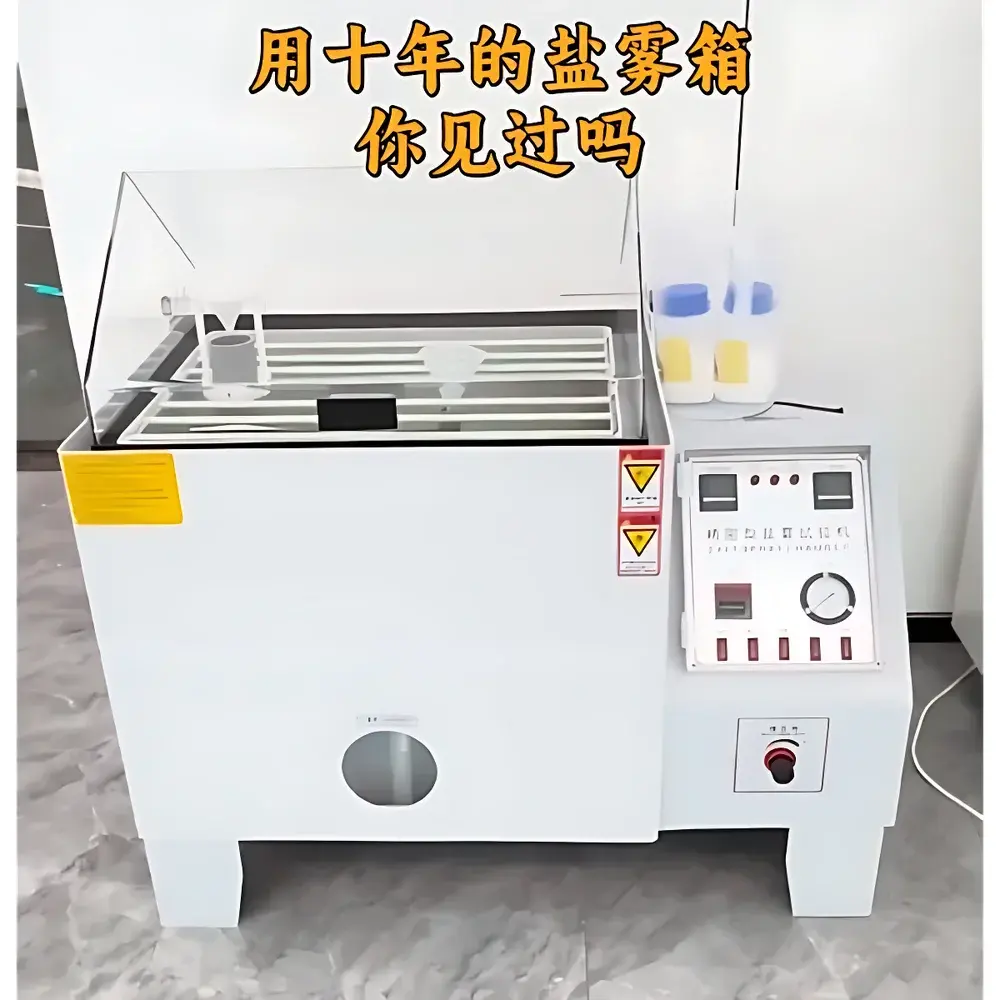
Jianhu CASS-50 Advanced Salt Spray & Environmental Cycling Chamber
| Brand | Jianhu |
|---|---|
| Origin | Shanghai, China |
| Model | CASS (Copper-Accelerated Acetic Acid Salt Spray) |
| Spray Method | Continuous Atomization |
| Fog Output | 1–2 mL/(80 cm²·h) |
| Nozzle Pressure | 0.7–1.0 kg/cm² |
| Fog Removal | Pneumatic Air-Compression Exhaust |
| Temperature Range | 50 °C ±2 °C |
| Construction | PP-modified polymer chamber with reinforced sealing architecture |
| Compliance | Designed to meet ASTM B117, ISO 9227, JIS Z2243, and GB/T 10587 requirements for accelerated corrosion testing |
Overview
The Jianhu CASS-50 Advanced Salt Spray & Environmental Cycling Chamber is an engineered environmental test system designed for accelerated corrosion evaluation of metallic and coated materials under controlled, reproducible conditions. It implements the Copper-Accelerated Acetic Acid Salt Spray (CASS) test method—a standardized, high-aggressivity variant of neutral salt spray (NSS) testing—where copper chloride and glacial acetic acid are added to the sodium chloride solution to intensify electrochemical corrosion kinetics. Unlike basic static salt fog chambers, the CASS-50 integrates precise thermal regulation (50 °C ±2 °C), continuous fog generation, and pneumatic de-fogging capability to support cyclic exposure protocols that simulate real-world service environments involving alternating wet/dry, salt-laden, and thermally stressed conditions. Its design prioritizes long-term operational stability in highly corrosive atmospheres, minimizing drift in fog deposition rate and temperature uniformity over extended test durations.
Key Features
- Stable CASS-compliant fog generation: Maintains consistent salt fog deposition of 1–2 mL per 80 cm² per hour across the test chamber floor, verified per ASTM B117 and ISO 9227 calibration protocols.
- Thermally regulated test environment: Equipped with PID-controlled heating and insulation architecture to sustain 50 °C ±2 °C within the working volume, critical for accelerating chloride-induced pitting and crevice corrosion mechanisms.
- Corrosion-resistant chamber construction: Utilizes modified polypropylene (PP) polymer with enhanced UV and halide resistance—engineered to withstand prolonged exposure to acidic chloride mists without dimensional deformation or seal degradation.
- Pneumatic fog removal system: Employs compressed air displacement rather than thermal drying or passive venting, enabling rapid and residue-free chamber clearance between test cycles—reducing cross-contamination risk and improving repeatability.
- Adjustable nozzle pressure control: Regulates atomization pressure between 0.7–1.0 kg/cm² to optimize droplet size distribution and ensure uniform fog coverage without oversaturation or pooling.
- Modular internal layout: Accommodates standardized test specimen racks (ASTM G85 Annex A3 compliant), facilitating parallel evaluation of multiple samples under identical exposure conditions.
Sample Compatibility & Compliance
The CASS-50 supports evaluation of a broad range of metallic substrates—including electroplated steel, aluminum alloys, zinc-nickel coatings, and passivated stainless steels—as well as organic coatings such as epoxies, polyurethanes, and chromate conversion layers. It is validated for use in accordance with internationally recognized standards: ASTM B117 (Neutral Salt Spray), ASTM G85 Annex A3 (CASS), ISO 9227 (Corrosion tests — Salt spray tests), JIS Z2243, and GB/T 10587. The chamber’s thermal and fog delivery performance is traceable to NIST-traceable reference instruments, supporting GLP-compliant documentation workflows. While not inherently FDA 21 CFR Part 11–compliant, its operational parameters are fully recordable via external data loggers meeting audit-trail requirements for regulated industries.
Software & Data Management
The CASS-50 operates as a standalone hardware platform with analog-digital hybrid control logic; no embedded software or touchscreen interface is included. Temperature setpoint, timer duration, and nozzle pressure are managed via front-panel mechanical dials and calibrated analog gauges—ensuring electromagnetic compatibility (EMC) robustness and eliminating firmware-related failure modes common in digitally intensive chambers. For full data capture, users integrate third-party USB or RS-485 data loggers (e.g., Omega OM-DAQ, Testo 176 T4) to record chamber temperature, elapsed cycle time, and external humidity metrics. All parameter settings and maintenance logs must be manually documented to satisfy ISO/IEC 17025 or IATF 16949 laboratory quality system requirements.
Applications
This chamber serves critical roles in automotive component qualification (e.g., brake calipers, fasteners, trim hardware), aerospace fastener coatings (Ti-6Al-4V with Alodine), electronics enclosure plating validation, marine-grade alloy certification, and supplier incoming inspection for OEMs requiring accelerated corrosion screening. It is routinely deployed in R&D labs evaluating new anti-corrosion inhibitors, conducting comparative coating lifetime modeling, and generating failure mode datasets for FMEA development. Universities and national metrology institutes utilize the CASS-50 for inter-laboratory round-robin studies on coating adhesion loss, white rust formation kinetics, and galvanic coupling behavior under chloride stress.
FAQ
Does the CASS-50 support programmable cycling between salt spray, dry, and humid phases?
No. The CASS-50 is configured exclusively for continuous CASS exposure. For multi-phase cycling (e.g., wet/dry/humidity), integration with an external environmental chamber or custom automation interface is required.
What is the expected service life of the fog nozzles under daily CASS operation?
With proper filtration of the salt solution and quarterly ultrasonic cleaning, the brass-nozzle assembly maintains specification compliance for ≥18 months of uninterrupted use.
Is the chamber compatible with alternative test solutions beyond CASS?
Yes—NSS (5% NaCl), ASS (acidified NaCl), and modified formulations per ASTM G85 Annexes A1–A5 can be used, provided solution pH and conductivity remain within specified ranges.
How frequently should temperature uniformity mapping be performed?
Per ISO/IEC 17025 guidance, initial mapping is mandatory at commissioning; re-mapping is recommended every 12 months or after major maintenance affecting heater or airflow components.
Can test specimens be monitored visually during operation without interrupting the cycle?
Yes—the chamber features a tempered glass observation window with anti-fog coating and integrated LED lighting, enabling non-intrusive visual assessment of corrosion progression without opening the door or breaking test continuity.



