
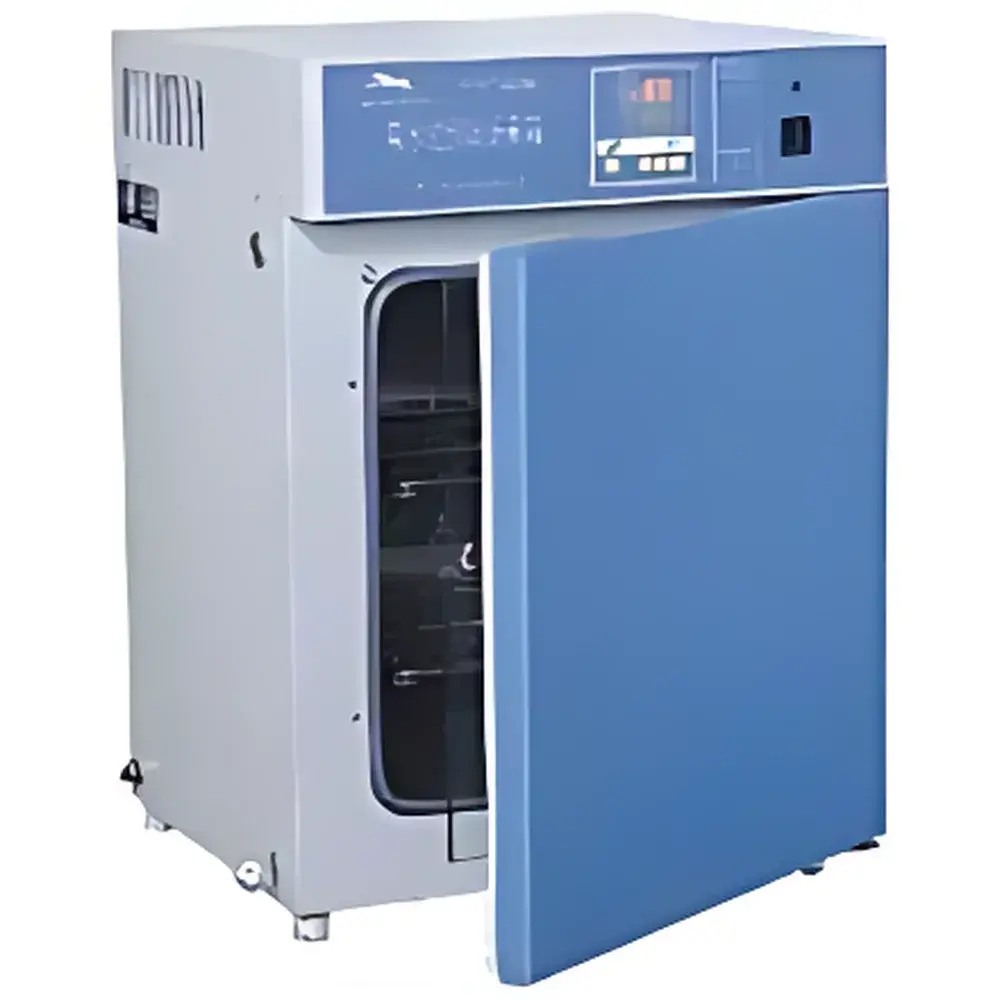
Jianhu JHP-Series Water-Jacketed Incubator
| Brand | Jianhu |
|---|---|
| Origin | Shanghai, China |
| Model | JHP-9050 / JHP-9080 / JHP-9160 / JHP-9270 |
| Power Supply | 220 V, 50 Hz |
| Heating Method | Water-jacketed |
| Temperature Range | RT + 5 °C to 65 °C |
| Temperature Resolution | 0.1 °C |
| Ambient Operating Temperature | +5 °C to +35 °C |
| Chamber Volume | 50 L / 80 L / 178 L / 270 L |
| Interior Dimensions (W×D×H, mm) | 350×350×410 / 400×400×500 / 500×500×650 / 600×600×750 |
| Exterior Dimensions (W×D×H, mm) | 500×500×700 / 550×550×800 / 650×640×950 / 750×740×1050 |
| Standard Shelving | 2 / 3 / 3 / 3 stainless steel trays |
| Timer Range | 1–9999 minutes |
| Output Interface | 4–20 mA analog signal & RS-485 digital interface (optional) |
| Safety Features | Dual-limit temperature alarm, low-water-level cutoff, door-interlocked fan/heating shutdown |
Overview
The Jianhu JHP-Series Water-Jacketed Incubator is an engineered solution for stable, uniform, and contamination-resilient thermal environments in microbiological, cell culture, and biochemical applications. Unlike forced-air incubators, this series employs a water-jacketed heating architecture—where a sealed outer chamber filled with thermally buffered water surrounds the inner stainless-steel working chamber. This design delivers exceptional thermal inertia, minimizing temperature fluctuations (< ±0.3 °C stability at setpoint) and sustaining near-constant conditions during brief power interruptions. The system operates within a precise range of RT + 5 °C to 65 °C, with 0.1 °C resolution via a microprocessor-based PID controller. Its passive thermal mass ensures slow, predictable cooldown profiles—critical for sensitive biological samples requiring gradual thermal transitions. The front-facing double-glazed observation window enables non-invasive visual monitoring without compromising chamber integrity or thermal equilibrium.
Key Features
- Water-jacketed thermal enclosure with high-heat-capacity water reservoir for superior temperature uniformity and retention
- Double-glazed, argon-filled observation door with automatic interlock: fan circulation and heating deactivate immediately upon door opening—eliminating thermal overshoot and ensuring operator safety
- Microcomputer PID temperature controller with real-time deviation correction and adjustable ramp/soak profiles
- Integrated water-level monitoring circuit: optical alarm triggers for both high- and low-water conditions; heater automatically de-energizes during low-level state
- Optional independent overtemperature cut-off system compliant with IEC 61000-4-11 for fail-safe operation under fault conditions
- Electropolished 304 stainless-steel interior chamber—corrosion-resistant, non-porous, and compatible with alcohol-, hydrogen peroxide-, and formaldehyde-based decontamination protocols
- Standard 4–20 mA analog output and RS-485 Modbus RTU interface for integration into centralized laboratory monitoring systems (e.g., LabVantage, Siemens Desigo, or custom SCADA)
Sample Compatibility & Compliance
The JHP-Series accommodates standard ISO/IEC 68-2-2 compliant Petri dishes, multi-well plates (6–96-well), roller bottles, and flasks up to 2 L volume. Its uniform thermal field (±0.5 °C across full chamber volume per ASTM E2234) meets requirements for USP environmental control in stability testing and CLSI M22-A3 guidelines for aerobic bacterial culture. The stainless-steel construction supports GLP-compliant cleaning validation, while optional data logging (via RS-485) enables audit-ready temperature traceability aligned with FDA 21 CFR Part 11 electronic record requirements when paired with validated software. All electrical components conform to IEC 61010-1:2010 safety standards for laboratory equipment.
Software & Data Management
While the incubator operates autonomously via its embedded controller, optional RS-485 connectivity allows seamless integration with third-party data acquisition platforms. Users may configure continuous temperature logging at user-defined intervals (1 s to 60 min), export CSV-formatted datasets, and generate time-stamped PDF reports with digital signatures. Alarm events—including door-open duration, water-level anomalies, and temperature excursions—are timestamped and stored in non-volatile memory for post-event forensic analysis. Firmware updates are performed via secure UART bootloader, supporting version-controlled maintenance per ISO/IEC 17025 Clause 5.9.
Applications
- Bacterial and fungal cultivation under controlled aerobic conditions (e.g., E. coli, S. aureus, C. albicans)
- Cell line maintenance (HEK293, CHO, MCF-7) requiring stable 37 °C environments with minimal CO₂ interference
- Enzyme activity assays where thermal drift must remain below ±0.2 °C over 24 h
- Pharmaceutical stability studies (ICH Q1A–Q1E) conducted at 25 °C/60% RH and 30 °C/65% RH reference points
- Environmental simulation for accelerated aging of polymer-based medical devices
- Quality control of diagnostic reagents and ELISA kits during shelf-life verification
FAQ
What is the thermal recovery time after door opening?
Typical recovery to ±0.5 °C of setpoint requires ≤12 minutes following a 15-second door opening at 37 °C, verified per ISO 15195 Annex B.
Is calibration certificate included?
A factory-issued NIST-traceable calibration report (covering three points: 25 °C, 37 °C, and 55 °C) is available upon request and complies with ISO/IEC 17025 documentation requirements.
Can the incubator be used for CO₂-sensitive applications?
Yes—the water-jacketed design eliminates internal air exchange mechanisms, making it inherently suitable for applications where ambient CO₂ levels must remain unaltered.
What maintenance is required for the water jacket?
Deionized water must be refilled every 3–6 months; annual inspection of silicone gaskets and water-level sensor calibration is recommended per preventive maintenance schedule.
Does the unit support remote monitoring via Ethernet or Wi-Fi?
No native Ethernet/Wi-Fi module is integrated; however, RS-485 output can be bridged to IP networks using commercially available protocol gateways (e.g., Moxa EDS-G205A) for cloud-based dashboards.



