
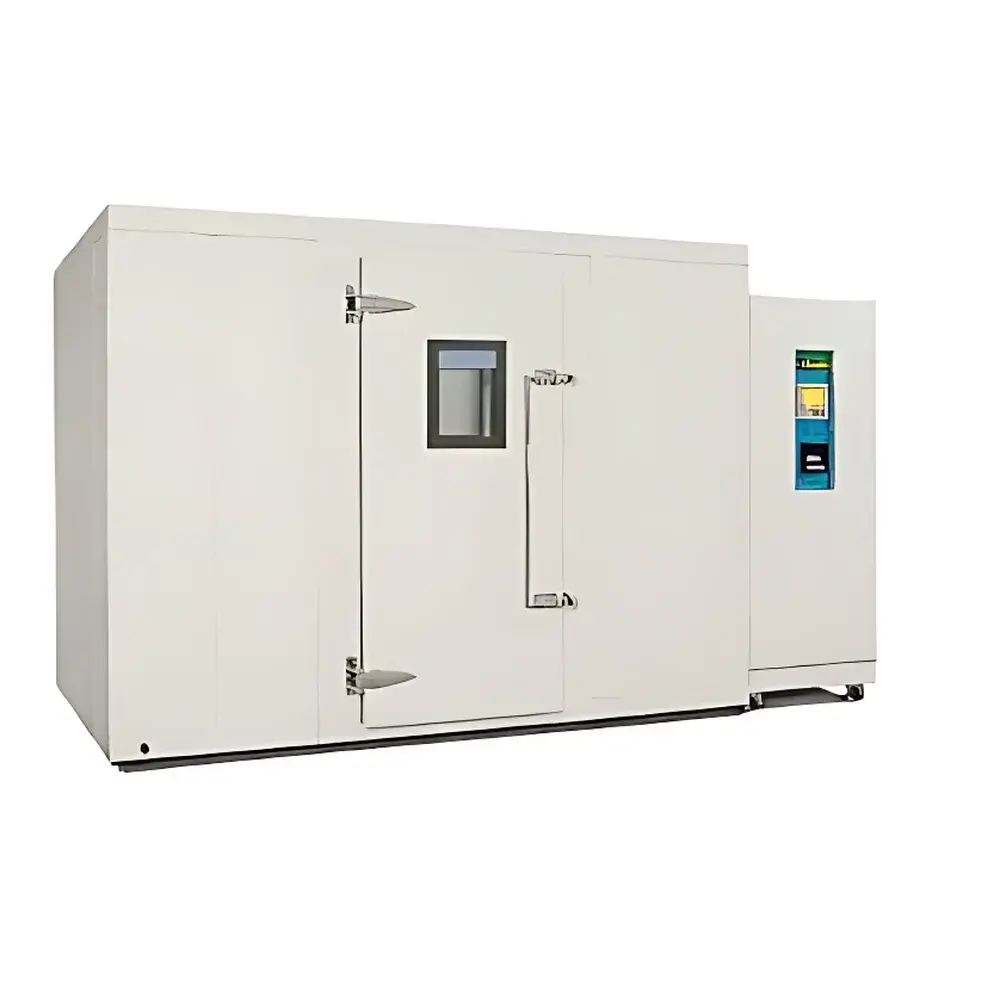
Jianhu JTH-50P-AR Walk-in Environmental Test Chamber
| Brand | Jianhu |
|---|---|
| Origin | Sichuan, China |
| Manufacturer Type | Authorized Distributor |
| Country of Origin | China |
| Model | JTH-50P-AR |
| Temperature Range | −65 °C to +80 °C (configurable via low-temp option A–D) |
| Humidity Range | 20–95 % RH |
| Temp. Uniformity | ±1.5 °C |
| Humidity Uniformity | ±5.0 % RH |
| Temp. Stability | ±0.5 °C |
| Humidity Stability | ±3.0 % RH |
| Heating Rate | ~4.0 °C/min |
| Cooling Rate | 0.7–1.2 °C/min |
| Construction | Exterior – powder-coated color steel or brushed stainless steel |
| Refrigeration System | Water-cooled, two-stage compressor |
| Controller | TEMI (Korea) or OYO (Japan), programmable |
| Compressor | Tecumseh (France) |
| Power Supply | 3Φ 380 VAC ±10 %, 50/60 Hz |
| Compliance | GB/T 10586, GB/T 2423.1–4, IEC 60068-2-1 & -2, GJB 150.3/4/9 |
Overview
The Jianhu JTH-50P-AR Walk-in Environmental Test Chamber is an engineered solution for large-scale, long-duration thermal and hygrothermal stress testing of industrial components, subsystems, and finished products. Designed in accordance with internationally recognized environmental simulation principles, it employs a closed-loop feedback control architecture integrating precision PID regulation, dual-stage refrigeration, steam-based humidification, and resistive heating to maintain stable, repeatable conditions across volumetric test spaces up to 260 m³. Unlike benchtop chambers, this walk-in system accommodates full-size automotive assemblies, server racks, aerospace avionics enclosures, and medical device cabinets—enabling real-world validation under controlled climatic extremes. Its operational envelope spans −65 °C to +80 °C with humidity modulation from 20 % to 95 % RH, supporting both steady-state and dynamic profile execution—including temperature ramping, cycling, and combined temperature/humidity stress sequences.
Key Features
- Modular structural design using 100–150 mm thick high-density, HCFC-free polyurethane insulation panels (λ ≤ 0.022 W/m·K), minimizing thermal bridging and ensuring long-term energy efficiency.
- Dual-stage, water-cooled refrigeration system with imported Tecumseh compressors, enabling rapid cooling down to −65 °C while maintaining condensation control and oil return integrity at ultra-low temperatures.
- Steam-type humidification system with stainless-steel boiler and PID-controlled water level management, delivering precise moisture injection without droplet carryover or mineral deposition.
- Programmable microprocessor controller (TEMI or OYO platform) featuring 128-segment ramp-soak profiles, real-time data logging (optional), USB export, and Ethernet connectivity for remote monitoring and integration into centralized lab networks.
- Redundant safety architecture including high/low refrigerant pressure switches, overtemperature and overhumidity cutouts, phase failure protection, motor overload relays, and audible/visual fault indication per IEC 61000-6-2 EMC requirements.
- Standard equipment includes double-layer tempered glass observation window, 50 mm diameter test port with silicone gasket, interior LED lighting, adjustable stainless-steel shelves, and dry/wet bulb sensor assembly with calibrated wick replacement kit.
Sample Compatibility & Compliance
The JTH-50P-AR chamber supports testing of physically large specimens—such as automotive ECUs, battery modules, HVAC units, and telecom base station cabinets—without disassembly or dimensional compromise. Its internal dimensions are fully customizable to client-specified footprints and height clearances, with load capacity verified for static weight distribution and airflow obstruction limits. The system complies with national and international environmental test standards including GB/T 2423.1–4 (equivalent to IEC 60068-2-1, -2, -3, -4), GB/T 10586 (moist heat testing), GJB 150.3/4/9 (military environmental test methods), and ISO 16750-4 (road vehicles—environmental conditions). All calibration and verification procedures follow traceable metrology practices aligned with ISO/IEC 17025 requirements, and optional IQ/OQ documentation packages support GLP and GMP-regulated validation protocols.
Software & Data Management
Controller firmware supports configurable audit trails, user-level access control (admin/operator/guest), and event-driven alarm logging with timestamped records of setpoint deviations, sensor faults, and safety interlock activations. Optional data acquisition modules enable continuous recording of up to 16 channels (temperature, humidity, dew point, power consumption, door status) at 1-second intervals. Export formats include CSV and PDF reports compatible with LIMS integration. For regulated environments, the system can be configured to meet FDA 21 CFR Part 11 requirements—including electronic signatures, operation history retention (>18 months), and immutable record generation—when deployed with validated software versioning and network authentication infrastructure.
Applications
- Automotive component qualification per ISO 16750-4 and SAE J2357, including ECU thermal shock endurance and infotainment system humidity resistance testing.
- Aerospace electronics screening for condensation-induced corrosion, conformal coating integrity, and solder joint reliability under cyclic temperature-humidity loads.
- Medical device shelf-life studies under accelerated aging conditions per ISO 11607-1, particularly for sterile barrier packaging and implantable housing materials.
- Renewable energy system validation—including solar inverter thermal cycling, EV battery pack cold-soak performance, and wind turbine pitch controller environmental robustness.
- Industrial automation hardware verification, such as PLC enclosures, HMIs, and motor drives subjected to factory-floor ambient fluctuations.
FAQ
What is the standard lead time for custom-sized JTH-50P-AR chambers?
Lead time ranges from 12 to 16 weeks following final dimensional approval and electrical interface confirmation, inclusive of factory acceptance testing and third-party calibration certification.
Can the chamber be integrated with existing building management systems (BMS)?
Yes—via Modbus RTU or BACnet MS/TP protocols through optional gateway modules; analog 4–20 mA outputs are standard for temperature and humidity signals.
Is on-site installation and commissioning included?
Installation supervision and functional performance verification are provided by certified field engineers; civil works, utility connections, and crane services remain client responsibilities.
How is temperature and humidity uniformity validated?
Uniformity is verified per GB/T 2423.1 and IEC 60068-2-1 using nine-point sensor mapping (3×3 grid at mid-height) during steady-state operation at extreme setpoints, with results documented in the final FAT report.
What maintenance intervals are recommended for the refrigeration system?
Compressor oil analysis and filter-drier replacement every 24 months; annual inspection of condenser fouling, refrigerant charge verification, and humidifier scale removal using citric acid descaling protocol.



