
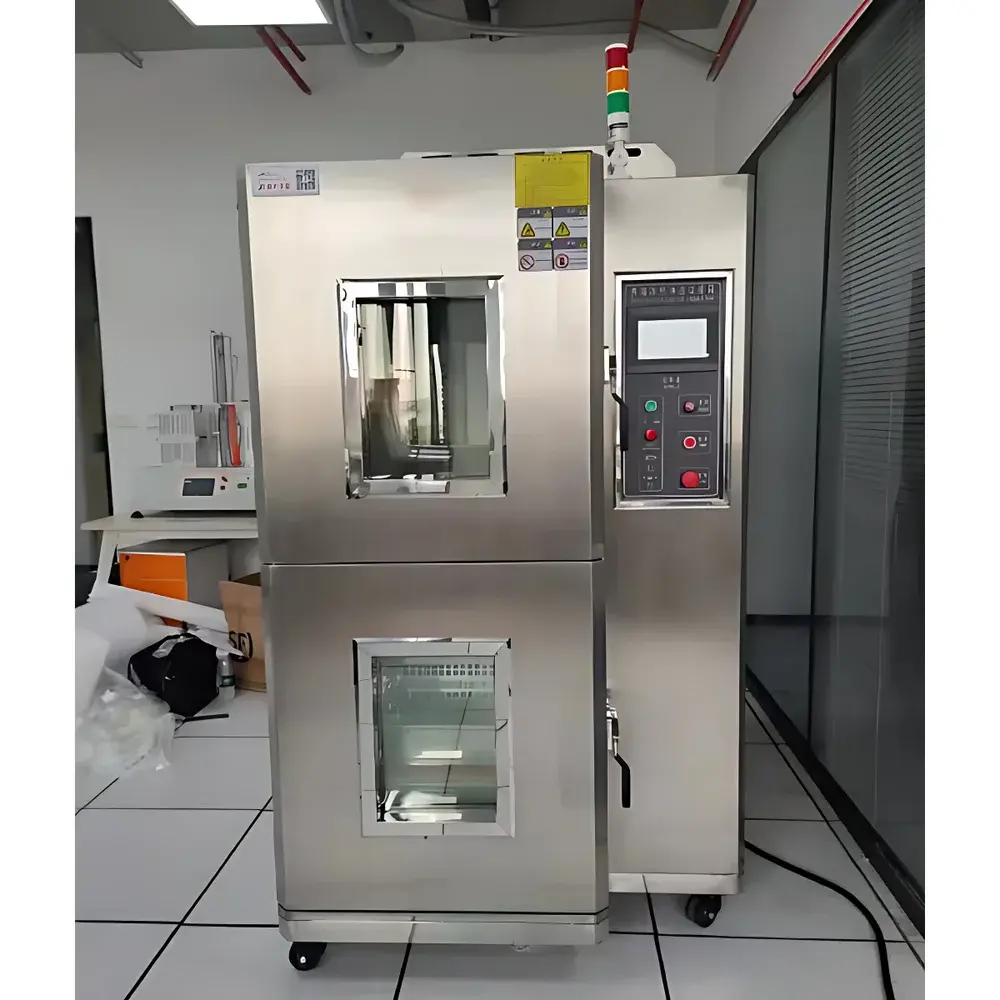
JianHu JH-Series Industrial Thermal Shock Test Chamber
| Brand | JianHu |
|---|---|
| Origin | Shanghai, China |
| Model | JH-Thermal Shock Test Chamber |
| Temperature Range (High) | Consult Technical Support |
| Temperature Range (Low) | Consult Technical Support |
| Thermal Shock Transition Time | Typically < 15 s (typical for three-zone industrial configurations) |
| Compliance | Designed to meet ISO 16750-4, MIL-STD-810H Method 503.5, IEC 60068-2-14, ASTM D6988, and GB/T 2423.22 |
Overview
The JianHu JH-Series Industrial Thermal Shock Test Chamber is an engineered environmental stress screening (ESS) system designed for rapid, repeatable, and controlled thermal cycling between extreme high- and low-temperature zones. Based on the three-chamber (hot / ambient / cold) or two-chamber (hot/cold) forced-air transfer principle, it subjects test specimens to abrupt temperature transitions—typically achieving chamber-to-chamber transfer in under 15 seconds—thereby inducing thermally driven mechanical stresses in materials, solder joints, laminates, and encapsulated assemblies. This accelerates failure mechanisms such as interfacial delamination, coefficient-of-thermal-expansion (CTE) mismatch cracking, sealant fatigue, and solder joint fracture. Unlike standard temperature cycling chambers, the JH-Series prioritizes thermal shock severity over dwell stability, making it essential for qualification testing per automotive AEC-Q200, aerospace AS9100, and reliability standards like JEDEC JESD22-A104.
Key Features
- Industrial-grade dual- or triple-zone architecture with independent PID-controlled heating (electric resistive) and cooling (cascade refrigeration with R404A/R23 mixed-refrigerant system)
- Stainless steel 304 interior chamber with electrostatically coated structural frame; reinforced door seals and thermal break insulation for minimal cross-contamination
- Programmable shock profiles: up to 999 cycles, user-defined dwell times (1 min–999 h), transfer timing, and sequence logic (e.g., hot→cold→ambient→hot)
- Integrated safety interlocks: over-temperature cut-off, refrigerant pressure monitoring, door-open alarm, and emergency stop with hardware-based fail-safe circuitry
- Real-time chamber temperature logging at ≥1 Hz sampling rate, traceable to NIST-traceable reference sensors (Class A PT100)
- Compliant with electrical safety standards IEC 61000-6-2/6-4 and EMC Class B requirements for laboratory environments
Sample Compatibility & Compliance
The JH-Series accommodates samples up to 500 mm × 500 mm × 500 mm (W×D×H) with maximum payload of 30 kg. It supports PCBs, battery modules, automotive ECUs, optical housings, medical device enclosures, and hermetically sealed microelectromechanical systems (MEMS). All operational parameters—including ramp rates, dwell durations, and transition intervals—are configurable to align with test plans derived from ISO 16750-4 (road vehicles), MIL-STD-810H Method 503.5 (thermal shock), IEC 60068-2-14 (change of temperature), and GB/T 2423.22 (Chinese national standard for environmental testing). The system’s thermal uniformity (±2.0°C) and stability (±0.5°C) across the working volume are validated per IEC 60068-3-5 and documented in factory calibration reports.
Software & Data Management
Controlled via a 10.1″ capacitive touchscreen HMI running embedded Linux OS, the JH-Series includes native support for test program import/export in CSV and XML formats. Full audit trail functionality complies with GLP and GMP requirements: every parameter change, cycle start/stop event, alarm condition, and manual override is timestamped, user-ID logged, and stored in non-volatile memory for ≥12 months. Optional Ethernet/IP and Modbus TCP interfaces enable integration into enterprise MES/QMS platforms. Data export supports .csv, .pdf, and .xlsx formats—with embedded metadata including operator ID, calibration status, and environmental chamber ID—for seamless inclusion in regulatory submissions (e.g., FDA 21 CFR Part 11 compliant archives when paired with third-party validation packages).
Applications
- Automotive electronics: Qualification of ADAS sensors, power inverters, and EV battery management systems per AEC-Q200 Rev H
- Semiconductor packaging: Evaluation of wire bond integrity and mold compound adhesion in QFN, BGA, and SiP devices
- Aerospace components: Screening of avionics housings, radar waveguides, and composite airframe fasteners against rapid altitude-induced thermal transients
- Medical devices: Verification of sterilization-resistant housing seals and piezoelectric actuator reliability under repeated autoclave-cooling cycles
- Research & development labs: Accelerated aging studies of polymer blends, phase-change materials, and thermally conductive interface pads
FAQ
What is the typical thermal shock transition time between chambers?
Standard JH-Series configurations achieve specimen transfer in ≤15 seconds for three-zone systems and ≤10 seconds for two-zone pneumatic shuttle designs—verified per IEC 60068-2-14 Annex B.
Does the system support custom test profiles required by internal reliability standards?
Yes—users can define multi-step sequences with variable dwell, ramp, and hold parameters; profiles may be imported/exported and version-controlled via USB or network.
Is calibration documentation provided with shipment?
Each unit ships with a factory calibration certificate covering temperature uniformity, stability, and sensor accuracy—traceable to CNAS-accredited laboratories per ISO/IEC 17025.
Can the chamber be integrated into a centralized lab monitoring system?
Standard Modbus TCP and optional OPC UA protocols enable real-time data streaming and remote supervision within LabVantage, Siemens Desigo, or custom SCADA architectures.
What maintenance intervals are recommended for long-term operational integrity?
Refrigeration oil analysis and filter replacement every 12 months; full system performance verification (per IEC 60068-3-5) recommended biannually or after 500 operational cycles.
Related Products



