
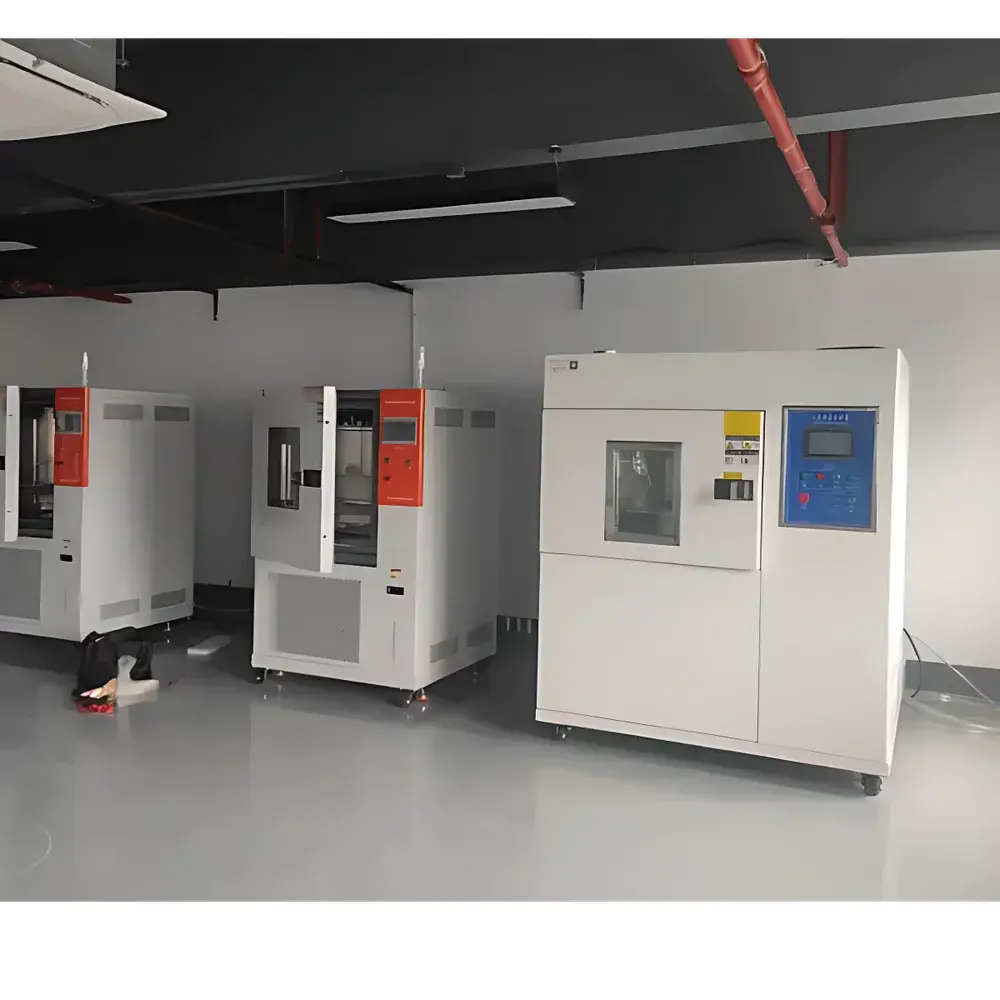
JianHu JH Series Thermal Shock Test Chamber
| Brand | JianHu |
|---|---|
| Origin | Shanghai, China |
| Model | JH Thermal Shock Test Chamber |
| Temperature Range (High) | Consult for specification |
| Temperature Range (Low) | Consult for specification |
| Transfer Time | Standardized rapid basket transfer (< 10 s typical) |
| Control System | PID-based digital temperature controller with dual-sensor feedback |
| Construction | Stainless steel inner chamber, high-density polyurethane insulation, reinforced structural frame |
| Compliance | Designed to support ASTM D5229, ISO 11357-6, MIL-STD-810H Method 503.5, IEC 60068-2-14, GB/T 2423.22 |
Overview
The JianHu JH Series Thermal Shock Test Chamber is an engineered environmental simulation system designed to evaluate material and component resilience under extreme, rapid thermal transitions. Operating on the principle of two-zone (hot/cold) or three-zone (hot/cold/ambient) forced-air thermal shock, the chamber subjects test specimens to abrupt, repeatable temperature shifts—typically between +150 °C and −70 °C—with transfer times under 10 seconds. This methodology replicates real-world thermal stress conditions encountered during aerospace deployment, automotive cold-start cycles, outdoor electronics operation in desert-to-alpine climates, or semiconductor packaging validation. Unlike gradual thermal cycling, thermal shock testing accelerates failure mechanisms related to coefficient-of-thermal-expansion (CTE) mismatch, interfacial delamination, solder joint fatigue, and seal integrity degradation—making it indispensable for reliability engineering and accelerated life testing protocols.
Key Features
- Robust dual-chamber architecture with independent high-temperature (+150 °C max) and low-temperature (−70 °C min) zones, minimizing cross-contamination and enabling precise thermal boundary control.
- PID-controlled digital temperature regulation with dual platinum resistance thermometers (Pt100) per zone, delivering ±0.5 °C uniformity and ±0.3 °C stability over extended test durations.
- High-efficiency refrigeration system utilizing cascade compression with environmentally compliant R404A/R23 refrigerant blends, paired with rapid-response electric heating elements for sub-30-second ramp rates (e.g., −40 °C → +85 °C).
- Motorized stainless-steel test specimen carrier with pneumatic or servo-driven positioning, ensuring reproducible dwell and transfer timing per IEC 60068-2-14 requirements.
- Full-spectrum safety architecture including over-temperature cut-off, refrigerant pressure monitoring, door interlock, and emergency power-off circuitry compliant with EN 61000-6-2/6-4 EMC standards.
- Modular design supporting optional upgrades: data logging via RS485/Modbus TCP, Ethernet/IP integration, and external alarm relay outputs for factory automation systems.
Sample Compatibility & Compliance
The JH chamber accommodates a broad range of sample geometries—from PCB assemblies and MEMS sensors to automotive ECUs, battery modules, optical lenses, and polymer housings—within standard internal dimensions (e.g., 200 × 250 × 200 mm, customizable). Its mechanical and thermal specifications align with internationally recognized qualification frameworks: ASTM D5229 (polymer thermal shock resistance), ISO 11357-6 (DSC-based thermal shock assessment), MIL-STD-810H Method 503.5 (environmental engineering considerations), and IEC 60068-2-14 (change of temperature testing). The system supports GLP-compliant operation when configured with audit-trail-enabled software, satisfying traceability requirements for ISO/IEC 17025-accredited laboratories and FDA-regulated product development workflows.
Software & Data Management
The embedded controller provides real-time graphical display of chamber temperatures, transfer timing, dwell duration, and cycle count. Optional PC-based software (JianHu TestSuite™) enables full test sequence programming—including multi-step profiles, conditional branching, and pass/fail threshold logic—while exporting time-stamped CSV and PDF reports. All data logs include metadata such as operator ID, calibration status, sensor serial numbers, and environmental timestamps. When deployed in regulated environments, the software optionally supports 21 CFR Part 11 compliance through electronic signatures, role-based access control, and immutable audit trails—ensuring data integrity for GMP, ISO 13485, or AS9100 audits.
Applications
- Electronics reliability validation: SMT solder joint integrity, BGA package cracking, conformal coating adhesion, and flex circuit bending endurance.
- Automotive component certification: Engine control units (ECUs), ADAS sensors, LED headlamps, and EV battery thermal management systems.
- Aerospace hardware qualification: Avionics enclosures, satellite thermal blankets, and composite airframe joints exposed to stratospheric thermal gradients.
- Medical device verification: Sterilizable surgical tools, implantable electronics, and diagnostic imaging components subjected to autoclave-to-operating-room transitions.
- Materials science research: Polymer phase transition analysis, ceramic microcrack propagation studies, and thin-film adhesion quantification under cyclic thermal strain.
FAQ
What temperature ranges are supported by the JH series?
Standard configurations operate from −70 °C to +150 °C; custom variants extend to −80 °C or +200 °C upon request.
Is the chamber suitable for testing sealed or pressurized devices?
Yes—chambers can be equipped with inert gas purge ports (N₂ or dry air) and optional pressure monitoring interfaces to maintain internal atmosphere integrity during shock cycles.
How is calibration traceability maintained?
Each unit ships with NIST-traceable calibration certificates for all primary temperature sensors; annual recalibration services include on-site verification and uncertainty reporting per ISO/IEC 17025.
Can the system integrate with existing MES or LIMS platforms?
Via Modbus TCP or OPC UA drivers, the controller supports bidirectional communication with manufacturing execution systems and laboratory information management systems for automated job dispatch and result ingestion.
What maintenance intervals are recommended?
Compressor oil and filter replacement every 2,000 operating hours; refrigerant leak checks quarterly; full preventive maintenance—including sensor recalibration and door gasket inspection—annually or per 500 test cycles, whichever occurs first.



