
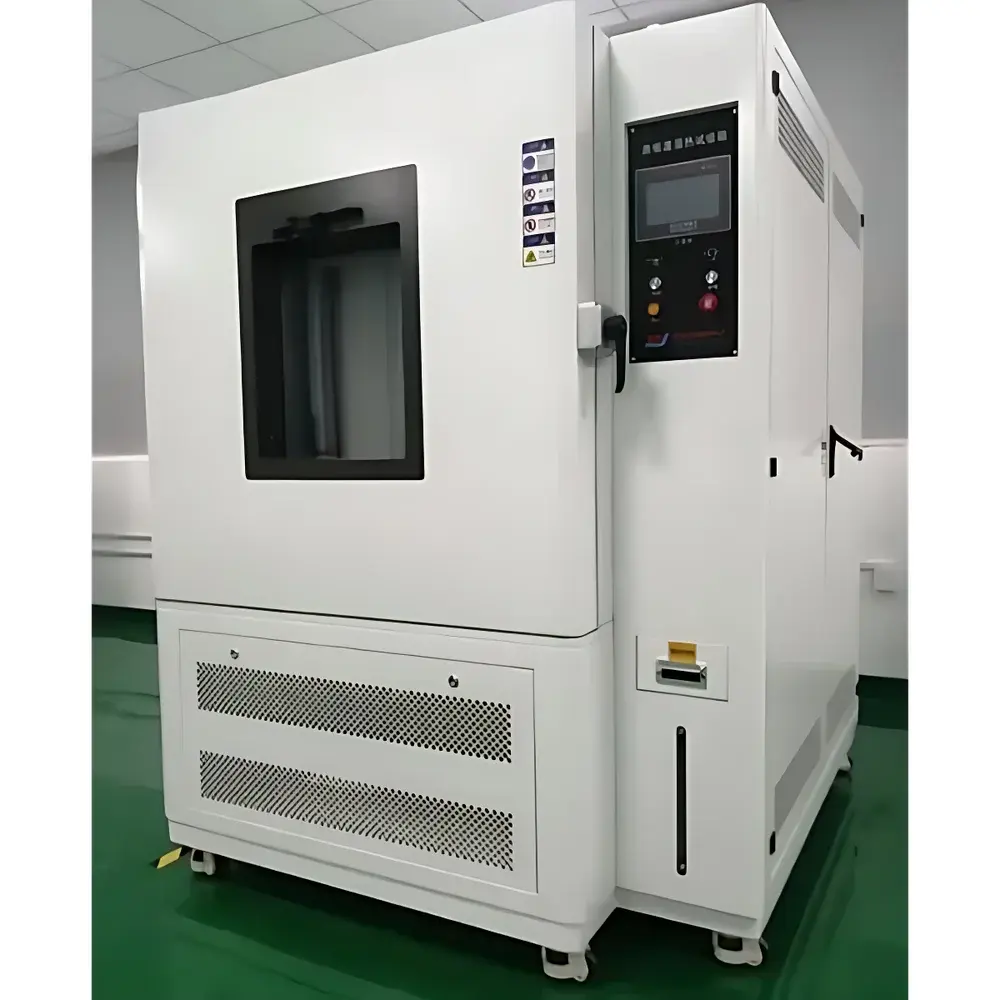
Jianhu JH Series Battery High-Low Temperature Environmental Test Chamber
| Brand | Jianhu |
|---|---|
| Origin | Shanghai, China |
| Model | JH-Battery-CL |
| Temperature Range | -70°C to +150°C |
| Refrigeration | Compressor-based |
| Explosion-Proof Design | Yes |
| Temperature Fluctuation | ±0.5°C |
| Temperature Uniformity | ±2.0°C |
| Temperature Deviation | ±2.0°C |
| Heating Rate | ≤60 min (from 25°C to +150°C) |
| Cooling Rate | ≤45 min (25°C to -40°C), ≤60 min (25°C to -55°C), ≤80 min (25°C to -70°C) |
| Internal Chamber Dimensions | Customizable |
| Compliance | ISO 17025-supporting test environment, GLP-compliant operation architecture, meets IEC 62133 & UN 38.3 thermal preconditioning requirements |
Overview
The Jianhu JH Series Battery High-Low Temperature Environmental Test Chamber is an engineered solution for precise thermal simulation in constrained laboratory environments. Designed specifically for battery R&D, quality assurance, and safety validation, this chamber employs a dual-stage compressor refrigeration system coupled with PID-controlled resistive heating and high-resolution platinum RTD sensors (Class A, IEC 60751) to deliver stable, repeatable thermal profiles across the full operating range of –70°C to +150°C. Its core measurement principle relies on closed-loop thermodynamic control: real-time feedback from multiple spatially distributed temperature probes enables dynamic power modulation of both heating elements and refrigerant expansion valves—ensuring minimal thermal inertia and rapid transient response. Unlike generic environmental chambers, the JH Series integrates battery-specific operational logic—including programmable soak-hold sequences, ramp-and-soak profiles per UN 38.3 Section 38.3.4, and thermal preconditioning cycles aligned with IEC 62133-2 Clause 8.2. This architecture supports reproducible evaluation of lithium-ion, solid-state, and emerging chemistries under defined thermal stress conditions.
Key Features
- Explosion-proof construction certified to Class I, Division 2, Group C/D (per NEC 500) with intrinsically safe internal wiring and non-sparking fan motors—enabling safe testing of volatile electrolyte systems.
- Compact footprint design: standard units occupy ≤0.8 m² floor space while maintaining ≥120 L usable chamber volume; ideal for benchtop integration or retrofit into ISO-classified cleanrooms with limited floor area.
- High-fidelity temperature control: ±0.5°C fluctuation (at steady state), ±2.0°C uniformity (9-point mapping per IEC 60068-3-5), and ±2.0°C deviation across the full range—validated via NIST-traceable calibration reports.
- Multi-rate cooling capability: achieves –40°C in ≤45 minutes, –55°C in ≤60 minutes, and –70°C in ≤80 minutes from ambient (25°C), supporting accelerated thermal cycling protocols required by automotive OEM specifications (e.g., GMW16341).
- Modular chamber geometry: internal dimensions fully customizable—from 30 L mini-chambers for coin-cell evaluation to 500 L configurations for EV module testing—without compromising structural integrity or thermal performance.
Sample Compatibility & Compliance
The JH Series accommodates diverse battery formats—including cylindrical (18650, 21700), prismatic, pouch, and button cells—as well as assembled modules up to 25 kg. Chamber interior features removable stainless-steel shelves, integrated cable ports with silicone grommets (IP54-rated), and optional inert gas purge interfaces (N₂/Ar) for oxygen-sensitive testing. All operational parameters comply with internationally recognized standards: thermal preconditioning cycles align with UN Manual of Tests and Criteria Part III, Subsection 38.3; temperature stability metrics satisfy IEC 60068-3-5 Annex B; and data logging integrity conforms to FDA 21 CFR Part 11 requirements when paired with optional audit-trail-enabled software. The system is routinely deployed in GLP-regulated labs supporting battery certification per UL 1642, UL 2580, and GB/T 31485.
Software & Data Management
Equipped with Jianhu’s proprietary JH-TCM v4.2 control software, the chamber supports multi-segment programmable profiles (up to 99 steps), real-time graphical monitoring of all sensor channels, and automatic generation of CSV- and PDF-formatted test reports compliant with ISO/IEC 17025 documentation requirements. Data logging resolution is 0.1°C at 1 Hz sampling, with onboard storage for ≥30 days of continuous operation. Optional Ethernet/WiFi connectivity enables remote supervision via secure TLS 1.2–encrypted web interface. Audit trail functionality records user logins, parameter changes, alarm events, and calibration actions—meeting traceability mandates under GMP Annex 11 and EU GMP Part IV. Software validation packages (IQ/OQ/PQ documentation) are available upon request.
Applications
- Thermal runaway propagation studies under controlled low-temperature initiation (e.g., –30°C preconditioning prior to nail penetration per UL 9540A).
- Capacity retention and impedance spectroscopy (EIS) preconditioning at extreme temperatures to assess SEI layer stability.
- Storage life validation per IEEE 1625/1188 guidelines, including 1000-hour elevated-temperature hold tests at +60°C and +85°C.
- Preconditioning of battery management systems (BMS) for cold-start performance verification in electric vehicle applications.
- Accelerated aging protocols combining thermal cycling (–40°C ↔ +85°C) with humidity exposure in hybrid chamber configurations.
FAQ
Does the JH Series support automated pass/fail criteria based on temperature deviation thresholds?
Yes—customizable alarm logic allows users to define upper/lower limits per test step, triggering email/SMS notifications and halting profiles upon breach.
Can the chamber be integrated into existing MES or LIMS platforms?
Fully supported via Modbus TCP and OPC UA protocols; API documentation and driver libraries provided for seamless integration.
Is third-party calibration certification included with delivery?
Each unit ships with a factory-issued NIST-traceable calibration certificate covering all critical sensors; UKAS-accredited calibration services available separately.
What maintenance intervals are recommended for compressor-based refrigeration systems?
Compressor oil and filter replacement every 24 months; annual verification of refrigerant charge and leak integrity per ISO 5149.
Are custom chamber linings (e.g., anti-static, corrosion-resistant) available?
Yes—options include electropolished 316L stainless steel, epoxy-coated aluminum, and conductive carbon-fiber composites for ESD-sensitive applications.



