
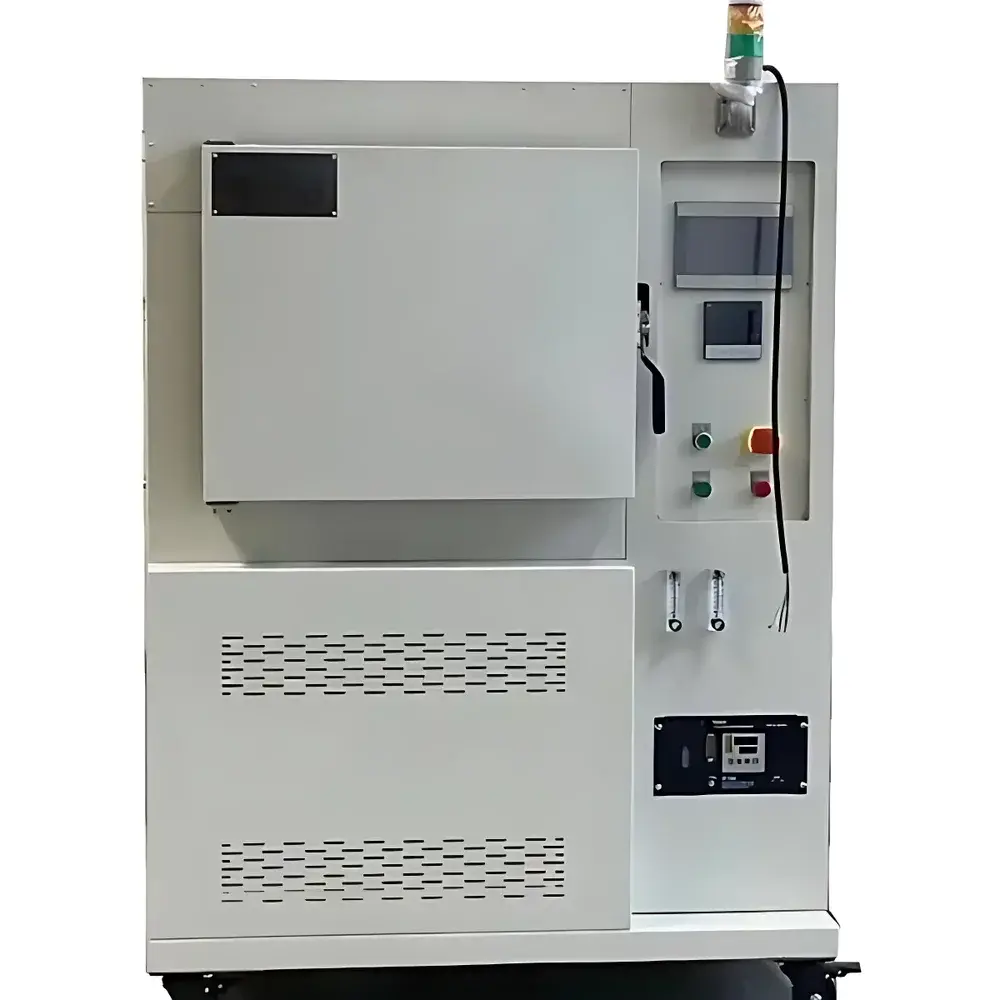
Jianhu JH-Series Polyimide Vacuum Oxygen-Free High-Temperature Aging Oven
| Brand | Jianhu |
|---|---|
| Origin | Shanghai, China |
| Manufacturer Type | OEM/ODM Manufacturer |
| Product Category | Domestic |
| Model | JH-Series Polyimide Vacuum Oxygen-Free Oven |
| Temperature Range | 150°C to 450°C |
| Temperature Uniformity | ±1.0°C |
| Temperature Stability | ±0.2°C to ±0.5°C |
| Temperature Deviation | ≤ ±2.0°C |
| Heating Rate | Up to 20°C/min |
| Cooling Rate | From 150°C to −40°C in ≤45 min |
| Vacuum Level | 5×10⁻⁴ Pa (with molecular pump + roots pump system) |
| Oxygen Concentration Control | ≤5 ppm (via laser-based O₂ sensor and adaptive N₂ purge algorithm) |
| Chamber Volume | Customizable (from 30 L to >5 m³) |
| Compliance | SEMI S2/S8, ISO 9001, AS9100D, GLP-ready architecture |
Overview
The Jianhu JH-Series Polyimide Vacuum Oxygen-Free High-Temperature Aging Oven is an engineered solution for precision thermal processing of polyimide (PI) films and advanced electronic materials under strictly controlled inert or ultra-high vacuum conditions. Designed specifically for semiconductor photolithography, flexible display fabrication, and high-energy-density battery manufacturing, this oven employs Couette-flow-optimized convection-free heating architecture, carbon-silicon (SiC) heating elements rated to 450°C, and distributed multi-zone thermocouple arrays (32 channels, ±0.1°C accuracy) to ensure spatial temperature uniformity within ±1.0°C across the full working volume. Unlike conventional air-circulation aging chambers, the JH-Series eliminates oxidative degradation pathways by maintaining dynamic vacuum integrity below 5×10⁻⁴ Pa and real-time oxygen suppression ≤5 ppm—critical for preserving PI backbone integrity during imidization at 350–450°C. Its core function is not general-purpose thermal aging, but rather process-critical, metrology-grade curing of photosensitive polyimides (PSPI), dielectric interlayer films, and thermally stable encapsulants where carbonization onset, CTE mismatch, and surface roughness (LER <5 nm) are directly governed by thermal history and ambient purity.
Key Features
- Ultra-high-temperature capability: SiC heating elements with 5,000-hour service life, rated for continuous operation up to 450°C
- Multi-zone independent PID control: 32-point thermocouple network with adaptive gain scheduling ensures ±1.0°C uniformity even at 400°C
- Dynamic vacuum compensation system: Integrated molecular pump + roots pump train, coupled with laser-tuned oxygen sensor (±0.1 ppm resolution) and closed-loop N₂ mass flow controller
- CFD-validated thermal chamber design: Zero-turbulence radiant heating path minimizes thermal stress gradients and suppresses localized hot spots
- AI-driven process optimization platform: Pre-loaded library of 500+ PI material curing profiles; machine learning module adjusts ramp/soak parameters based on real-time pressure-temperature-oxygen feedback
- Digital twin interface: OPC UA–compliant export enables virtual commissioning and DOE validation prior to physical run
Sample Compatibility & Compliance
The JH-Series accommodates rigid wafers (up to 300 mm), flexible OLED substrates (PET, PI, ultrathin glass), pouch-cell electrode stacks, and ceramic-coated separator laminates. All internal surfaces are electropolished 316L stainless steel with low-outgassing PTFE gasketing (rated for 450°C). The system meets SEMI F47 (voltage sag immunity), SEMI S2/S8 (safety & environmental health), and ISO 9001:2015 manufacturing controls. For regulated environments, audit trails comply with FDA 21 CFR Part 11 requirements—including electronic signature support, immutable event logging, and user-role–based access control. Validation documentation (IQ/OQ/PQ protocols) is provided per ASTM E2297 and IEC 60068-3-5 standards.
Software & Data Management
Control is executed via a deterministic real-time OS running on an industrial-grade embedded controller (Intel Atom x64, 4 GB RAM). The HMI supports multi-language UI (EN/JP/KO/CN) and integrates with MES via MQTT or OPC UA. All thermal-vacuum-oxygen data streams are timestamped at 100 Hz and archived in HDF5 format with SHA-256 checksums. Built-in reporting modules generate ASTM-compliant test certificates, including max/min/mean deviation plots, vacuum decay curves, and oxygen concentration histograms. Raw datasets are exportable for third-party analysis in MATLAB, Python (Pandas/HDF5), or JMP. Audit trail records include operator ID, parameter changes, alarm events, and calibration timestamps—all retained for ≥36 months.
Applications
- Semiconductor front-end: PSPI curing for 28 nm node lithography (reducing LER from 8 nm to 5 nm); interlayer dielectric annealing in 3D NAND stack fabrication
- EV battery R&D: Anode/cathode binder crosslinking under inert atmosphere to suppress gas evolution and improve cycle stability (>3,000 cycles at 250 Wh/kg)
- Flexible electronics: PI substrate imidization for foldable displays (thickness tolerance ±3 µm at 30 µm nominal; validated >300,000 fold cycles)
- Aerospace composites: Out-of-autoclave curing of polyimide-matrix prepregs requiring precise Tg development without oxidation-induced embrittlement
- Photonics packaging: Thermal stabilization of EUV mask pellicles and low-k dielectrics where carbon loss must remain <0.3 wt% over 4-hr soak
FAQ
What vacuum level is guaranteed during continuous 450°C operation?
The system maintains ≤5×10⁻⁴ Pa for ≥200 hours at 450°C using actively cooled pump heads and dual-stage trapping; vacuum decay rate is monitored and logged continuously.
Is the oven compatible with nitrogen, argon, or forming gas purging?
Yes—gas inlet ports support MFC-controlled delivery of N₂ (99.999%), Ar (99.999%), or 5% H₂/95% N₂ mixtures, with automatic purge sequencing and residual oxygen verification pre-cycle.
Can the system be integrated into a Class 100 cleanroom environment?
Standard configuration includes ISO Class 5-compatible HEPA-filtered exhaust recirculation and VHP-decontaminable chamber surfaces; optional FFU integration available.
Does the software support automated qualification per JEDEC JESD22-A108F?
Yes—the thermal profile generator includes preconfigured JEDEC HTSL, uHAST, and TCT templates with pass/fail logic per clause 4.2 and automatic report generation.
What maintenance intervals are recommended for the vacuum system?
Molecular pump oil replacement every 6,000 operating hours; cold trap regeneration every 500 cycles; quarterly calibration of oxygen sensor and thermocouple array using NIST-traceable references.



