
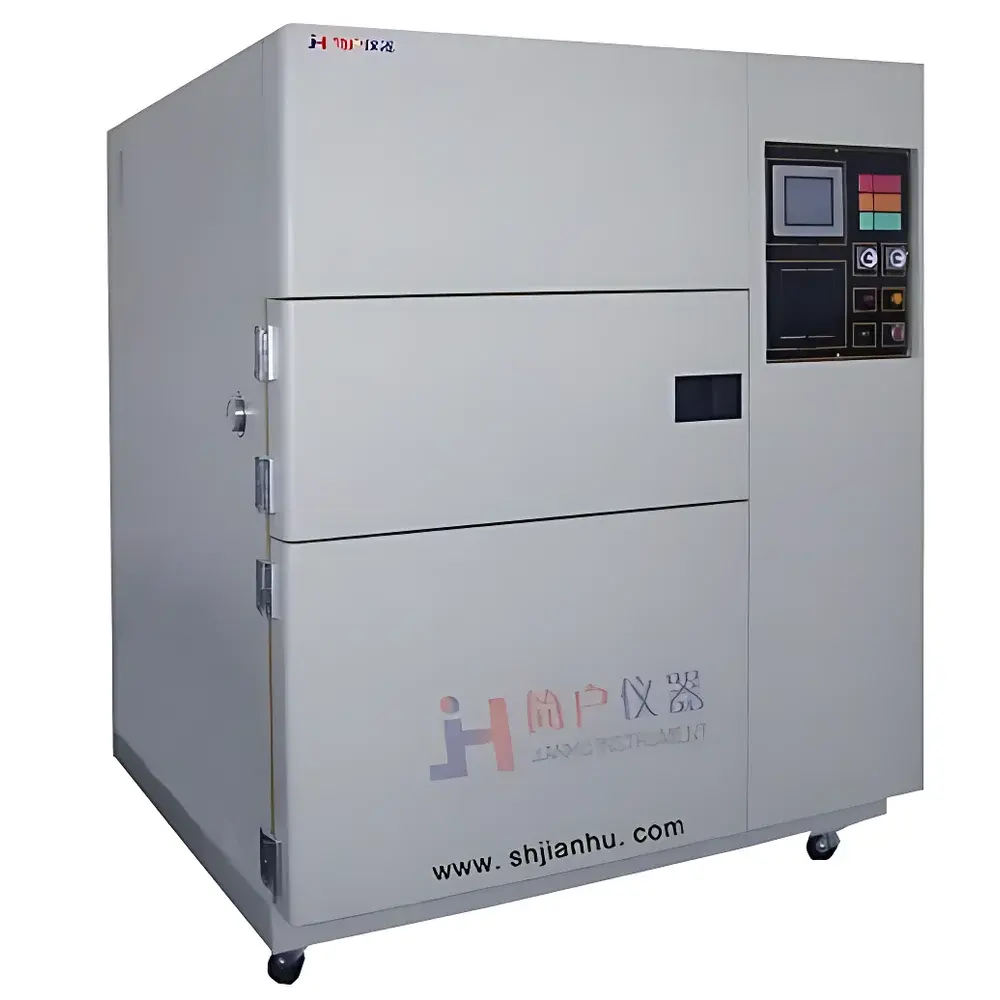
Jianhu TS Series Thermal Shock Test Chamber (Three-Zone, Programmable, Liquid Nitrogen Optional)
| Brand | Jianhu |
|---|---|
| Model | LS Series |
| Temperature Range | -65°C to +150°C |
| Chamber Configuration | Three-Zone (Hot Zone / Cold Zone / Test Zone) |
| Control System | 7.5" TFT Color Touchscreen with PID Algorithm |
| Compliance | GB/T 2423.22, GJB 150.5, IEC 60068-2-14, MIL-STD-810H, QC/T 17, EIA-364-32 |
| Refrigeration | Dual-Stage Mechanical Refrigeration with R-507/R-23 Eco-Friendly Refrigerants |
| Communication Interface | RS-232 & RS-485 |
| Safety Features | Dual Independent Over-Temp Protection, Compressor High-Pressure/Low-Pressure Cutouts, Air Pressure Monitoring, Leakage Circuit Breaker, PT100 Sensor Redundancy |
Overview
The Jianhu TS Series Thermal Shock Test Chamber is an engineered three-zone environmental test system designed for high-reliability thermal cycling validation of electronic components, aerospace hardware, automotive modules, and advanced materials. Unlike single- or dual-chamber thermal shock systems, the TS Series employs a physically segregated architecture—comprising independent high-temperature, low-temperature, and test zones—enabling true static-sample testing under ISO/IEC 17025-compliant conditions. During operation, the test specimen remains stationary in the central test chamber while thermally conditioned air is rapidly transferred via pneumatically actuated ducting and centrifugal/axial fan arrays. This design eliminates mechanical stress from sample movement, ensures precise thermal gradient control, and supports repeatable ΔT ramp rates up to 15°C/min (typical), critical for failure mode analysis per JEDEC JESD22-A106B and IPC-9701. The system operates across a full functional spectrum: as a standalone high-temperature chamber (+60°C to +150°C), a standalone low-temperature chamber (-10°C to -65°C), or a programmable thermal shock platform executing two- or three-step transitions between extreme thermal states.
Key Features
- Three-zone physical isolation architecture with stainless steel (SUS304) inner chamber walls and high-density polyurethane + fiberglass composite insulation for thermal stability and minimal cross-contamination.
- Dual-stage mechanical refrigeration system using imported semi-hermetic compressors and brazed-plate heat exchangers, charged with R-507 (high-stage) and R-23 (low-stage) eco-friendly refrigerants meeting EU F-Gas Regulation (EU) No 517/2014.
- Intelligent pneumatic damper control with compressed air-driven actuators (optional integrated air compressor available), enabling sub-second transition between hot/cold airflow paths and minimizing dwell time at intermediate temperatures.
- 7.5-inch TFT color touchscreen HMI with intuitive Chinese/English bilingual interface, supporting 96 user-defined test programs, real-time curve logging, and alarm history with timestamped event records.
- Comprehensive safety architecture including dual independent over-temperature cutouts (hardware + software), refrigerant pressure monitoring, motor thermal overload protection, phase reversal prevention, and emergency power-off circuitry compliant with IEC 61000-6-2 EMC standards.
- Configurable test port (Φ50 mm standard, optional larger apertures) with silicone gasket sealing for external load wiring, sensor feedthroughs, or in-situ electrical biasing during thermal cycling.
Sample Compatibility & Compliance
The TS Series accommodates specimens up to 80 × 70 × 60 cm (W×D×H) internal volume (E-type configuration), with uniformity maintained within ±2.0°C across the working volume per IEC 60068-3-5. Chamber interiors are constructed from food-grade SUS304 stainless steel, eliminating outgassing concerns for optics, MEMS, or medical device qualification. The system is validated to meet and exceed requirements of multiple international standards, including: GB/T 2423.22–2012 (Temperature Change Testing), GJB 150.5A–2009 (Military Equipment Thermal Shock), IEC 60068-2-14 (Test N: Change of Temperature), MIL-STD-810H Method 503.5, EIA-364-32 (Thermal Shock for Connectors), and QC/T 17–1992 (Automotive Component Environmental Endurance). All temperature sensors utilize calibrated PT100 Class A elements traceable to NIST standards, and controller firmware supports audit-ready data export in CSV format for GLP/GMP-regulated environments.
Software & Data Management
The embedded controller firmware implements closed-loop PID temperature regulation with adaptive tuning parameters optimized for thermal mass variation. Real-time data—including chamber setpoint, actual temperature (hot/cold/test zones), compressor discharge/suction pressures, and damper position status—is logged at user-selectable intervals (1 sec to 10 min) and stored internally for ≥30 days. Export functionality supports USB flash drive transfer of raw time-series data, alarm logs, and calibration certificates. RS-232/RS-485 serial interfaces enable integration with LabVIEW, MATLAB, or enterprise MES platforms via Modbus RTU protocol. Optional PC-based supervision software provides remote monitoring, multi-chamber fleet management, and automated report generation aligned with FDA 21 CFR Part 11 requirements—including electronic signatures, audit trails, and role-based access control.
Applications
This thermal shock chamber is routinely deployed in reliability engineering labs for solder joint fatigue assessment (IPC-J-STD-020), die attach integrity verification, conformal coating adhesion testing, battery cell thermal runaway screening, and qualification of avionics enclosures per DO-160 Section 4. It serves as a core tool in accelerated life testing (ALT) protocols for semiconductor packaging (QFN, BGA, SiP), where rapid thermal transients induce interfacial delamination or coefficient-of-thermal-expansion (CTE) mismatch failures. In R&D settings, it supports material selection studies for thermal interface materials (TIMs), encapsulants, and PCB substrates under cyclic thermal stress. Automotive Tier-1 suppliers use the system for ISO/TS 16949-compliant validation of ADAS sensors, power inverters, and EV battery management systems subjected to extreme ambient exposure profiles.
FAQ
What is the difference between two-zone and three-zone thermal shock configurations?
A two-zone system alternates the test sample between hot and cold chambers via mechanical transfer; a three-zone system keeps the sample stationary while routing pre-conditioned air—reducing mechanical wear, improving repeatability, and enabling continuous electrical monitoring.
Can the chamber operate as a standalone high-temperature or low-temperature test unit?
Yes. The system supports independent operation modes: high-temperature soak (up to +150°C), low-temperature soak (down to -65°C), or full thermal shock cycling with user-defined dwell times, transition rates, and cycle counts.
Is liquid nitrogen (LN2) cooling supported?
Optional LN2 auxiliary cooling is available for ultra-low thermal shock profiles (< -70°C) or accelerated ramp rates, integrated via dedicated solenoid valves and vaporization manifolds with pressure regulation and dew-point monitoring.
How is calibration traceability maintained?
Each unit ships with factory calibration certificate referencing NIST-traceable PT100 probes; on-site recalibration services include ISO/IEC 17025-accredited third-party verification with uncertainty budgets per ANSI/NCSL Z540.
What maintenance intervals are recommended?
Compressor oil and refrigerant filter driers require replacement every 24 months; pneumatic system desiccant cartridges every 12 months; and full performance verification (uniformity, recovery time, ramp rate) annually or after 500 operational hours—whichever occurs first.



