
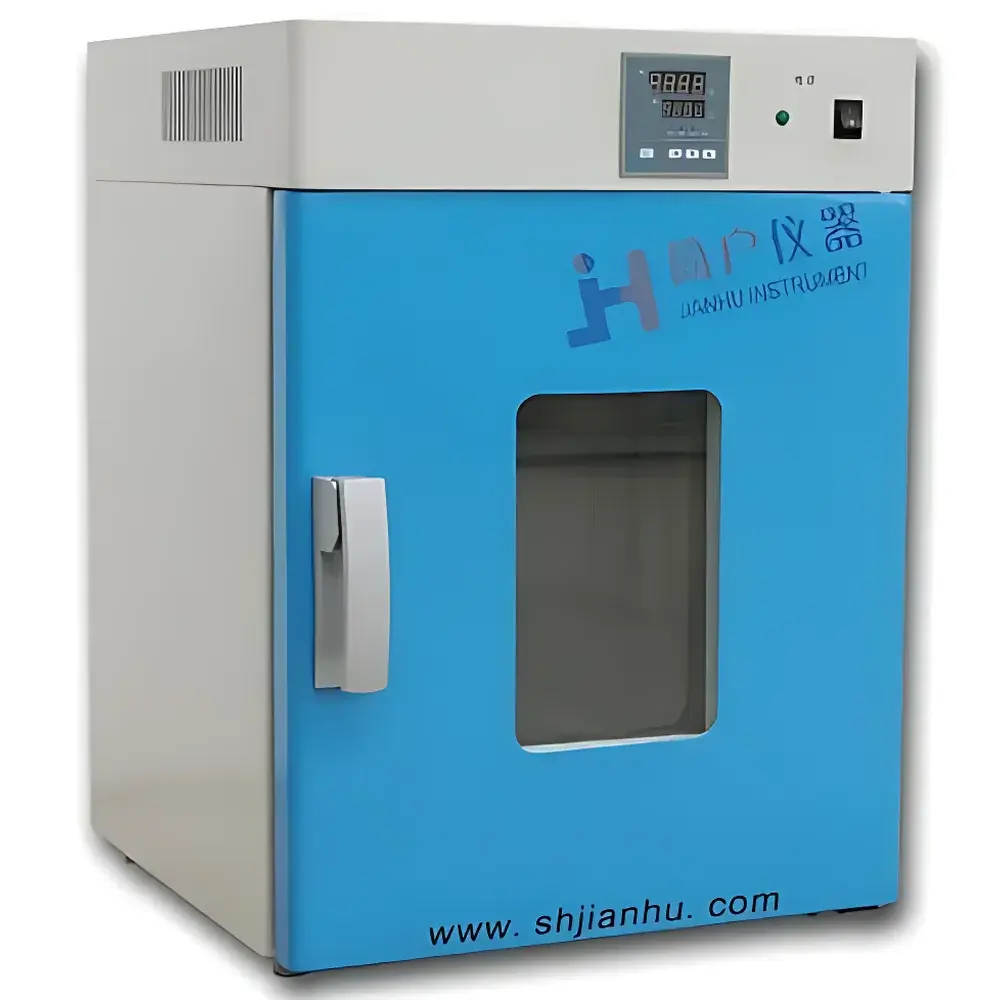
Jianhu JH Series High-Temperature Forced-Air Circulation Oven / Environmental Aging Test Chamber
| Brand | Jianhu |
|---|---|
| Origin | Shanghai, China |
| Model | JH-9050A / JH-9100A / JH-9200A / DJH-30L–DJH-1000L Series |
| Max Temperature | 400 °C (JH-A series) / 300 °C (DJH-L/M series) |
| Temperature Range | RT+10 °C to 400 °C |
| Temperature Resolution | 0.1 °C |
| Temperature Uniformity | ±1 °C |
| Power Supply | 220 V / 50 Hz (models ≤220 L), 380 V / 50 Hz (models ≥420 L) |
| Internal Volume | 30 L to 1000 L |
| Construction | Mirror-finish stainless steel inner chamber, powder-coated carbon steel outer casing |
| Air Circulation | Vertical forced convection with high-temp-rated imported centrifugal blower |
| Viewing Window | Double-layer tempered glass |
| Standard Shelving | 2–5 adjustable stainless steel trays |
| Timer Range | 1–9999 minutes |
| Compliance | Designed for GLP/GMP-aligned laboratory and industrial aging validation workflows |
Overview
The Jianhu JH Series High-Temperature Forced-Air Circulation Oven is an engineered environmental test chamber designed for thermal aging, drying, curing, sterilization validation, and accelerated stability testing in R&D laboratories, quality control departments, and manufacturing facilities. Operating on the principle of vertical forced-air convection, the chamber ensures uniform heat distribution across the entire working volume via a precisely balanced airflow path—comprising a high-efficiency impeller, thermally stable duct geometry, and optimized inlet/outlet positioning. Unlike natural convection ovens, this design minimizes thermal stratification and delivers reproducible temperature profiles critical for ASTM D3045 (Heat Aging of Plastics), ISO 188 (Rubber—Accelerated Ageing), and IEC 60068-2-2 (Environmental Testing—Part 2: Tests—Test B: Dry Heat). The JH-A series extends operational capability up to 400 °C, enabling evaluation of high-performance polymers, ceramic precursors, and metal oxide coatings under sustained thermal stress.
Key Features
- Microprocessor-based digital temperature controller with 0.1 °C resolution and ±1 °C uniformity across the chamber volume—calibration traceable to NIST-compatible reference standards.
- Programmable ten-segment LCD controller (D-series models) supporting ramp-hold cycles for complex aging protocols, including multi-step thermal profiles required by IPC-TM-650 2.6.25 (PCB Thermal Stress).
- Robust chamber construction: mirror-polished 304 stainless steel inner lining (argon-welded seams) and electrostatically applied epoxy-polyester powder coating on the outer shell for corrosion resistance and mechanical durability.
- Double-layer tempered glass observation window with high-temperature silicone gasket seal, permitting real-time visual monitoring without compromising thermal integrity or safety.
- Independent over-temperature protection circuit with audible/visual alarm and automatic power cutoff—meets IEC 61000-4-2 ESD immunity requirements and supports fail-safe operation per EN 61010-1.
- High-temperature-rated centrifugal blower (rated continuous operation at 400 °C) integrated into a low-turbulence air channel system, ensuring minimal velocity gradients and consistent convective heat transfer coefficients.
Sample Compatibility & Compliance
The JH Series accommodates diverse sample formats—including petri dishes, crucibles, PCB assemblies, polymer coupons, battery cells, and coated substrates—within standardized stainless steel trays (adjustable spacing, load capacity ≥15 kg per shelf). Chamber dimensions are optimized to maintain laminar flow characteristics at elevated temperatures, minimizing localized hot spots that could skew degradation kinetics. Units comply with structural and electrical safety requirements outlined in UL 61010-1 and GB/T 10589 (Chinese national standard for electric heating ovens). While not certified to FDA 21 CFR Part 11 out-of-the-box, the programmable controllers support audit trail configuration and user-access-level management—enabling integration into validated environments under ISO 13485 or GMP Annex 11 frameworks when paired with documented SOPs and periodic calibration records.
Software & Data Management
Standard operation relies on embedded firmware with local parameter logging (temperature setpoint, actual chamber reading, elapsed time, alarm events) stored in non-volatile memory for up to 30 days. Optional RS485/Modbus RTU interface enables connection to SCADA systems or centralized lab data acquisition platforms (e.g., LabVIEW, DeltaV). For regulated applications, third-party software packages can be deployed to generate electronic records compliant with ALCOA+ principles (Attributable, Legible, Contemporaneous, Original, Accurate, Complete, Consistent, Enduring, Available), including electronic signatures and change-control logs. All controller firmware updates undergo version-controlled release testing prior to field deployment.
Applications
- Accelerated thermal aging of elastomers, thermoplastics, and composite matrices per ASTM D573 and ISO 11359.
- Drying of moisture-sensitive powders (e.g., pharmaceutical excipients, catalyst precursors) under controlled humidity-free conditions.
- Curing of adhesives, conformal coatings, and encapsulants used in aerospace and automotive electronics.
- Pre-conditioning of sensors, MEMS devices, and battery modules prior to functional testing.
- Residual solvent removal from printed electronics and thin-film photovoltaic layers.
- Validation of thermal stability limits for packaging materials subjected to sterilization or transport simulation.
FAQ
What is the maximum allowable ambient temperature for safe operation?
The unit must be installed in an environment maintained between +5 °C and +40 °C, with relative humidity ≤85% RH non-condensing. Exceeding these limits may impair controller accuracy and reduce blower bearing service life.
Can the oven be used for inert-atmosphere testing?
No. The JH Series is configured for ambient air circulation only. For nitrogen or argon purging, external gas manifolds and pressure-regulated inlet ports must be added as custom modifications—subject to engineering review and safety certification.
Is calibration documentation provided with shipment?
A factory calibration certificate (indicating as-found/as-left values at three points across the operating range) is included. Full ISO/IEC 17025-accredited calibration requires engagement with an accredited third-party laboratory.
How often should preventive maintenance be performed?
Blower inspection and door gasket integrity check are recommended every 6 months; full thermal mapping and controller verification every 12 months—or per internal quality protocol frequency.



