
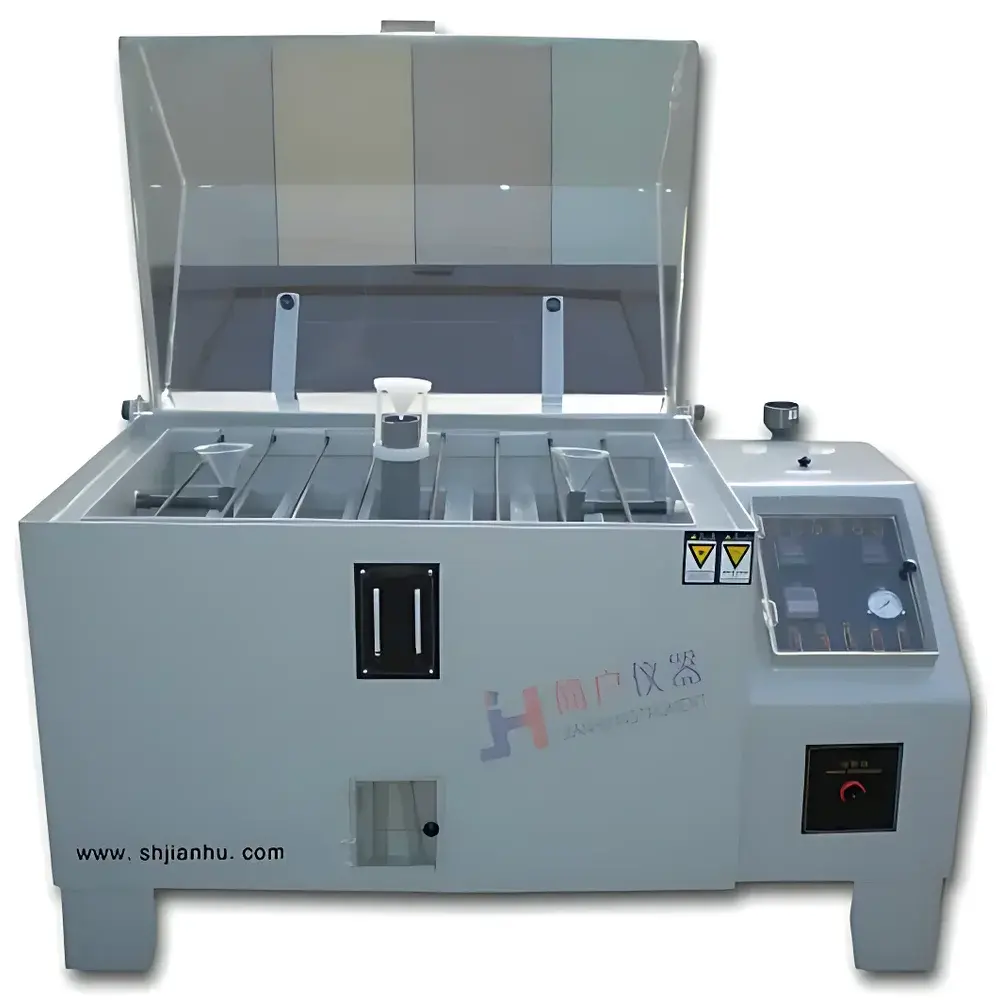
Jianhu JST-120 Salt Spray Test Chamber (ASTM B117 / ISO 9227 Compliant)
| Brand | Jianhu |
|---|---|
| Model | JST-120 |
| Origin | Shanghai, China |
| Chamber Dimensions (L×W×H) | 120×80×50 cm |
| Internal Volume | 480 L |
| Test Temperature | NSS/ACSS: 35±1°C |
| CASS | 50±1°C |
| Saturated Air Chamber Temperature | NSS/ACSS: 37±1°C |
| CASS | 63±1°C |
| Fog Deposition Rate | 1.0–2.0 mL/80 cm²/h |
| pH Range | NSS/ACSS: 6.5–7.2 |
| CASS | 3.0–3.2 |
| Power Supply | AC 1-phase 220 V, 20 A |
| Construction Material | Imported PVC and PP板材 (PVC & Polypropylene) |
| Compliance | ASTM B117, ISO 9227, JIS Z2371, GB/T 2423.17, CNS 3627, GJB 150.11A |
Overview
The Jianhu JST-120 Salt Spray Test Chamber is an engineered environmental test system designed to evaluate the corrosion resistance of metallic materials, coatings, and surface treatments under accelerated saline atmospheric conditions. It operates on the principle of continuous or cyclic salt fog exposure—generating a controlled, reproducible chloride-laden aerosol environment via compressed air atomization through precision glass nozzles. The chamber conforms strictly to internationally recognized test standards including ASTM B117 (Neutral Salt Spray), ISO 9227 (NSS, AASS, CASS), JIS Z2371, and GB/T 2423.17, ensuring data traceability and inter-laboratory comparability. Its robust construction—using imported corrosion-resistant PVC and polypropylene—eliminates structural degradation during prolonged exposure to acidic or alkaline mists, supporting long-term operational stability in QC laboratories, R&D facilities, and third-party testing centers.
Key Features
- Monolithic chamber body fabricated from high-purity, UV-stabilized imported PVC and PP sheets—chemically inert, non-deforming, and resistant to thermal aging up to 60°C.
- Dual-mode water supply system with automatic level detection and visual/audible low-water alarm—ensures uninterrupted test cycles without manual intervention.
- Calibrated borosilicate glass spray nozzles with conical diffusers for uniform fog distribution and gravity-driven deposition—minimizing salt crystallization and nozzle clogging.
- Integrated control panel housing digital PID temperature controllers (±0.1°C accuracy), programmable timer (up to 999 hours), and dual over-temperature protection circuits.
- Saturated air chamber operating per Henry’s Law principles—precisely regulating humidity and temperature to maintain thermodynamic equilibrium required by ASTM B117.
- Steam-jacketed heating system enabling rapid, homogeneous chamber temperature ramp-up—reducing standby time between test sequences.
- Pneumatically actuated top lid (on larger models) for safe, ergonomic access—compliant with ISO 13857 mechanical hazard clearance requirements.
- Post-test demisting system using filtered ambient air purge—enabling immediate visual inspection of specimens without condensation interference.
Sample Compatibility & Compliance
The JST-120 accommodates standard test specimens up to 120 cm × 80 cm footprint, with vertical orientation support for flat panels, fasteners, electronic enclosures, and coated automotive components. Its internal geometry permits unobstructed fog circulation per ASTM B117’s “free-fall” requirement, while the calibrated deposition rate (1.0–2.0 mL/80 cm²/h) is verified using standardized collection funnels per ISO 9227 Annex A. All electrical components meet IP54 ingress protection; temperature and humidity sensors are NIST-traceable upon calibration. The system supports GLP-aligned operation through configurable audit trails when paired with optional data logging modules, and is compatible with FDA 21 CFR Part 11–compliant software upgrades for regulated industries.
Software & Data Management
While the base JST-120 utilizes a standalone digital controller with real-time display of chamber temperature, saturated air temperature, elapsed time, and alarm status, optional RS-485/Modbus RTU interface enables integration into centralized laboratory information management systems (LIMS). Third-party SCADA platforms can log timestamped temperature profiles, cycle completion signals, and fault codes for ISO/IEC 17025 documentation. Firmware supports user-defined multi-step programs—including dwell, dry, and wet phases—for custom cyclic corrosion testing (CCT) protocols aligned with GMW14872 or VDA 621-415. Calibration certificates include as-found/as-left data per ISO/IEC 17025 Clause 6.5.
Applications
This chamber serves critical validation functions across aerospace (fastener plating qualification per AMS 2700), automotive (corrosion performance of Zn-Ni coatings per ISO 1456), electronics (PCB conformal coating endurance per IPC-TM-650 2.6.17), and defense sectors (military hardware per GJB 150.11A). It is routinely deployed for incoming material inspection, process capability studies of electroplating lines, and comparative evaluation of anti-corrosion inhibitors. Its modular design allows factory retrofitting for combined salt-spray/dry-humidity cycling—supporting development of next-generation CCT test methods.
FAQ
What standards does the JST-120 comply with?
It meets ASTM B117, ISO 9227 (NSS, AASS, CASS), JIS Z2371, GB/T 2423.17, CNS 3627, and GJB 150.11A—fully documented in the supplied conformity statement.
Is the chamber suitable for CASS testing?
Yes—the saturated air chamber reaches 63±1°C and maintains pH 3.0–3.2 with copper chloride additive, satisfying ISO 9227 CASS requirements.
Can test parameters be logged and exported?
With optional communication module and PC software, real-time temperature, runtime, and alarm events are exportable as CSV or PDF reports.
What maintenance is required for long-term reliability?
Monthly cleaning of nozzles and saturation tower, quarterly verification of temperature sensors, and annual recalibration of PID controller against reference thermistors.
Does it support custom test chamber modifications?
Yes—Jianhu offers OEM engineering for extended volume, integrated drying stages, or climate-controlled pre-conditioning zones per client specifications.



