
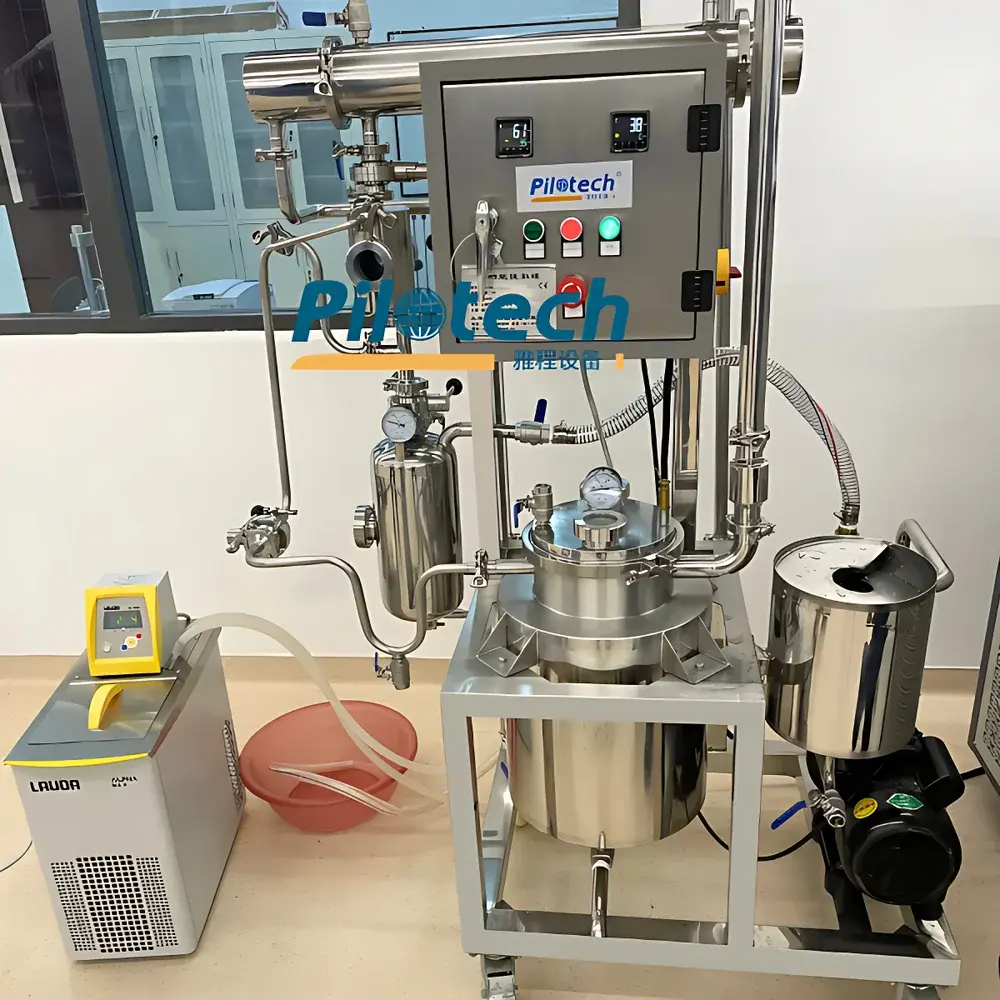
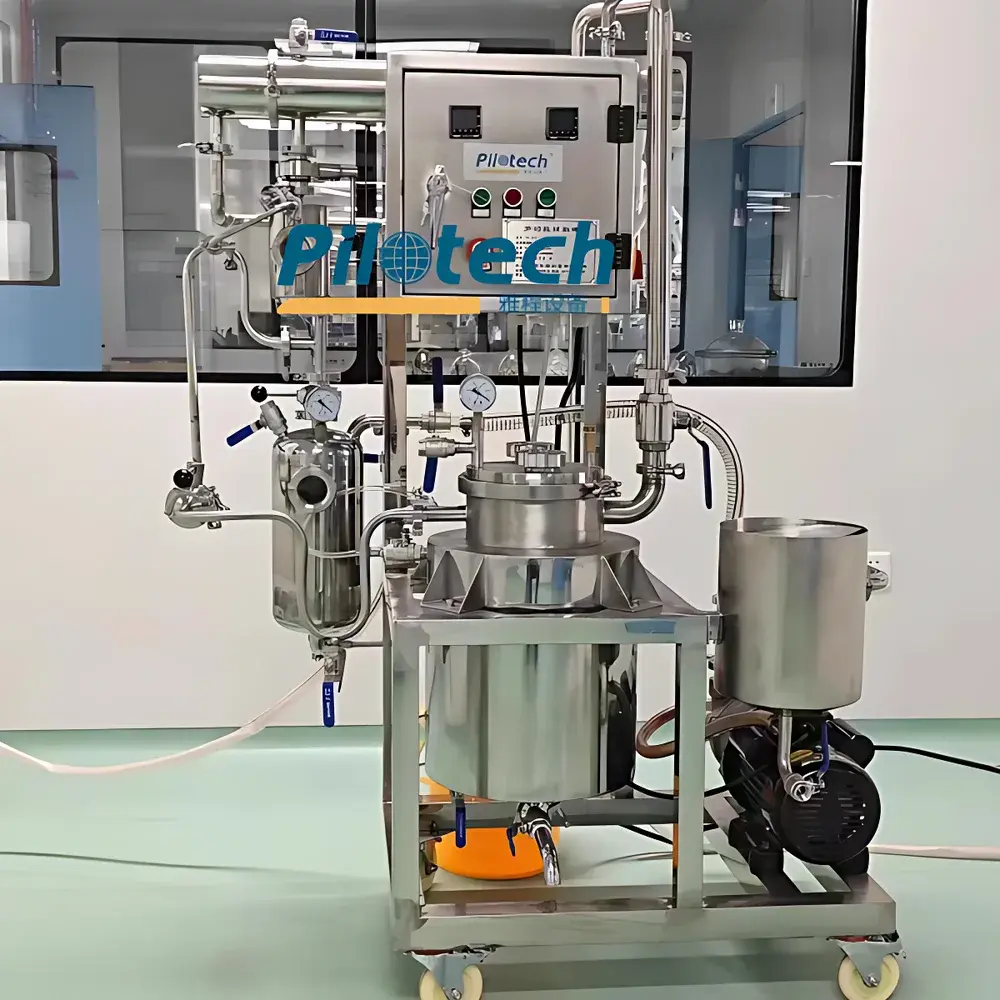
PILOTECH YC-010 Multifunctional Laboratory Extraction and Concentration System
| Brand | PILOTECH |
|---|---|
| Origin | Shanghai, China |
| Manufacturer Type | Direct Manufacturer |
| Model | YC-010 |
| Extraction Chamber Volume | 10 L |
| Temperature Control Accuracy | ±2 °C |
| Operating Pressure Range | −0.08 MPa to +0.1 MPa (vacuum to slight overpressure) |
| Construction Material | 316L stainless steel (wetted parts) |
| Heating Method | Jacketed thermal oil circulation (pressure-free) |
| Condenser Surface Area | 0.5 m² (tubular) |
| Optional Ultrasonic Module | Titanium alloy transducer, frequency selectable from 15–60 kHz |
| Cooling Water Requirement | 0.5 t/h at < 0.3 MPa |
Overview
The PILOTECH YC-010 Multifunctional Laboratory Extraction and Concentration System is an integrated, bench-scale platform engineered for reproducible solid–liquid extraction and subsequent vacuum concentration of heat-sensitive botanical matrices. Designed in accordance with fundamental principles of mass transfer and thermodynamic phase separation, the system employs a jacketed 10 L stainless steel extraction vessel coupled with a tubular condenser (0.5 m² surface area), oil–water separator, and integrated evaporative concentrator. Its architecture supports multiple operational modes—including reflux extraction, ethanol-based extraction, aqueous decoction, hydrodistillation, and low-temperature vacuum concentration—enabling researchers to replicate pilot-scale process parameters under controlled laboratory conditions. The system operates across a full pressure spectrum (−0.08 MPa to +0.1 MPa), permitting both vacuum-assisted solvent recovery and atmospheric or mild overpressure extraction as required by pharmacopeial methods (e.g., Chinese Pharmacopoeia ChP 2020, USP , ISO 11023). All fluid-contact surfaces are constructed from electropolished 316L stainless steel, compliant with FDA CFR 21 Part 11 material eligibility criteria for pharmaceutical development workflows.
Key Features
- Compact footprint (≤1 m² floor space) with modular integration—requires only electrical supply (220 V / 50 Hz) and cooling water inlet.
- Triple-layer extraction vessel: inner polished 316L chamber, middle thermal oil heating jacket (pressure-free design), outer polyurethane insulation layer.
- PID-controlled temperature regulation (±2 °C accuracy) via Omron digital controller with real-time setpoint adjustment and ramp/soak programming.
- Integrated vacuum concentration module with dynamic circulation evaporation, achieving final extract densities of 1.1–1.38 g/mL without thermal degradation.
- Oil–water separator enables quantitative recovery of volatile aromatic oils (e.g., limonene, eugenol, camphor) during hydrodistillation or steam distillation protocols.
- Standard configuration includes water-ring vacuum pump, vacuum gauge, sight glasses, sanitary valves, and PLC-based electrical control cabinet with emergency stop circuitry.
- Optional ultrasonic enhancement module features titanium alloy focused transducers (15–60 kHz selectable), delivering localized cavitation energy to disrupt plant cell walls and accelerate solute diffusion—particularly beneficial for polyphenols, alkaloids, and terpenoids.
Sample Compatibility & Compliance
The YC-010 accommodates solid herbal materials (0.3–1.5 kg batch load), liquid extracts, fruit juices, tea infusions, and fermented broths. It complies with ISO 9001:2015 manufacturing standards and meets structural integrity requirements per ASME BPE-2022 for biopharmaceutical equipment. All wetted components conform to ASTM A240/A240M for 316L stainless steel and pass passivation per ASTM A967. The system supports GLP/GMP-aligned documentation practices: optional touchscreen HMI includes audit trail logging, user access levels, electronic signature capability, and USB/Ethernet data export compatible with LIMS integration. Vacuum performance satisfies ISO 21649 for residual gas analysis in solvent recovery applications.
Software & Data Management
The optional 7-inch resistive touchscreen HMI provides intuitive parameter visualization and control. Logged data—including temperature profiles, vacuum pressure trends, runtime, and ultrasonic duty cycle (if equipped)—are timestamped and stored internally (≥30 days) with CSV export via USB. Ethernet connectivity enables remote monitoring through standard Modbus TCP protocol. Software architecture supports 21 CFR Part 11 compliance when paired with validated authentication modules (username/password + role-based permissions), electronic signatures, and immutable audit trails. No proprietary drivers or cloud dependencies are required; raw data files are natively readable in Excel, MATLAB, or LabVIEW environments.
Applications
- Phytochemical isolation: standardized extraction of flavonoids, saponins, iridoids, and essential oils from Artemisia annua, Ginkgo biloba, and Salvia miltiorrhiza.
- Food & beverage R&D: tea polyphenol enrichment, citrus peel oil recovery, and functional ingredient concentration (e.g., anthocyanins from berry pomace).
- Academic research: method development for ASE (Accelerated Solvent Extraction), UAE (Ultrasound-Assisted Extraction), and MAE (Microwave-Assisted Extraction) validation studies.
- Preformulation screening: comparative yield analysis across solvents (water, ethanol, methanol, ethyl acetate) under identical thermal and mechanical stress conditions.
- Process scale-up support: generation of kinetic extraction curves, mass balance reports, and solvent recovery efficiency metrics for tech-transfer packages.
FAQ
What is the maximum allowable operating pressure of the extraction vessel?
The vessel is rated for continuous operation from −0.08 MPa (vacuum) to +0.1 MPa (gauge), with safety relief valves certified per PED 2014/68/EU.
Can the system handle corrosive solvents such as chloroform or dichloromethane?
Yes—provided all elastomeric seals (EPDM or FKM options) are selected for chemical compatibility; contact technical support for seal material specification sheets.
Is third-party calibration certification available?
Calibration certificates traceable to NIST standards (temperature, pressure, flow) can be provided upon request, with optional on-site verification by accredited metrology partners.
Does the ultrasonic module affect the validity of pharmacopeial monographs?
Ultrasonic assistance is considered a process enhancement—not a replacement for official methods; it must be justified and documented per ICH Q5C and included in process validation protocols.
What maintenance intervals are recommended for the vacuum pump and condenser?
Water-ring pump oil replacement every 500 operating hours; condenser tube inspection and descaling every 200 cycles or per visible fouling—logbook templates are supplied with commissioning documentation.



