
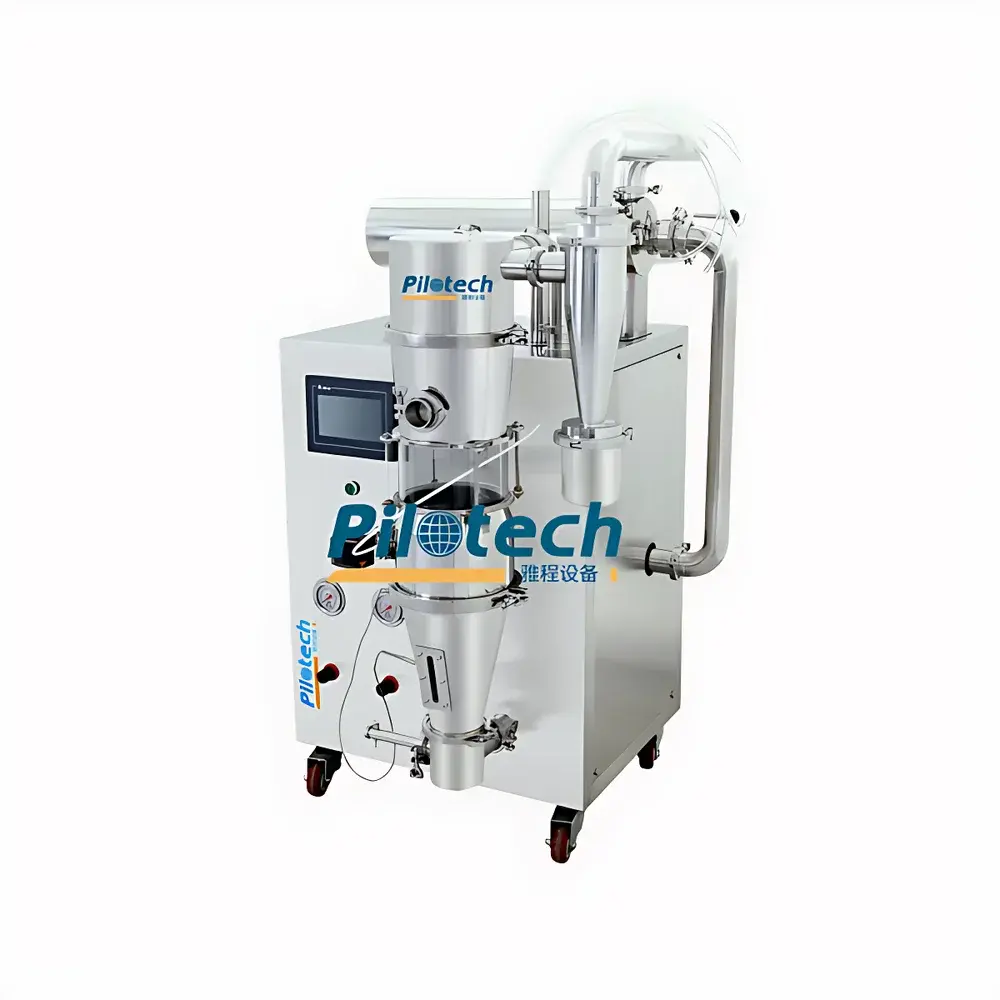
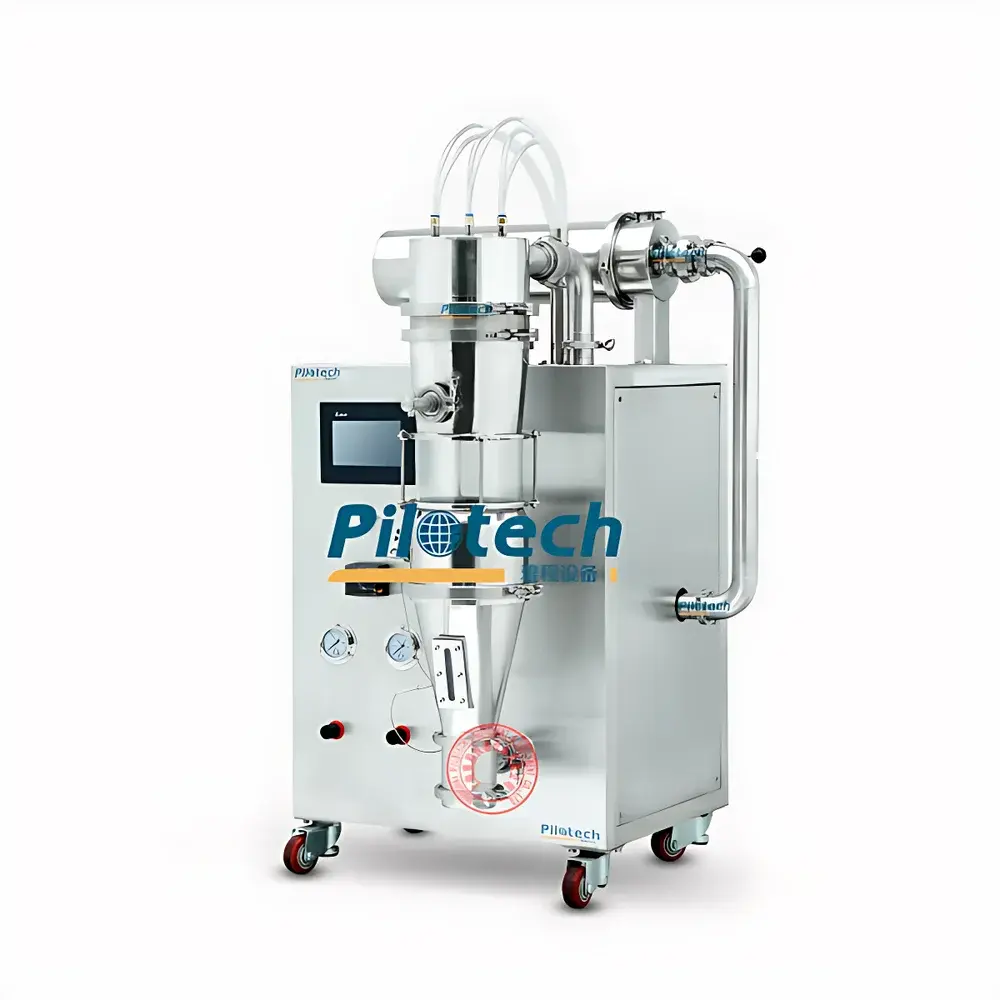
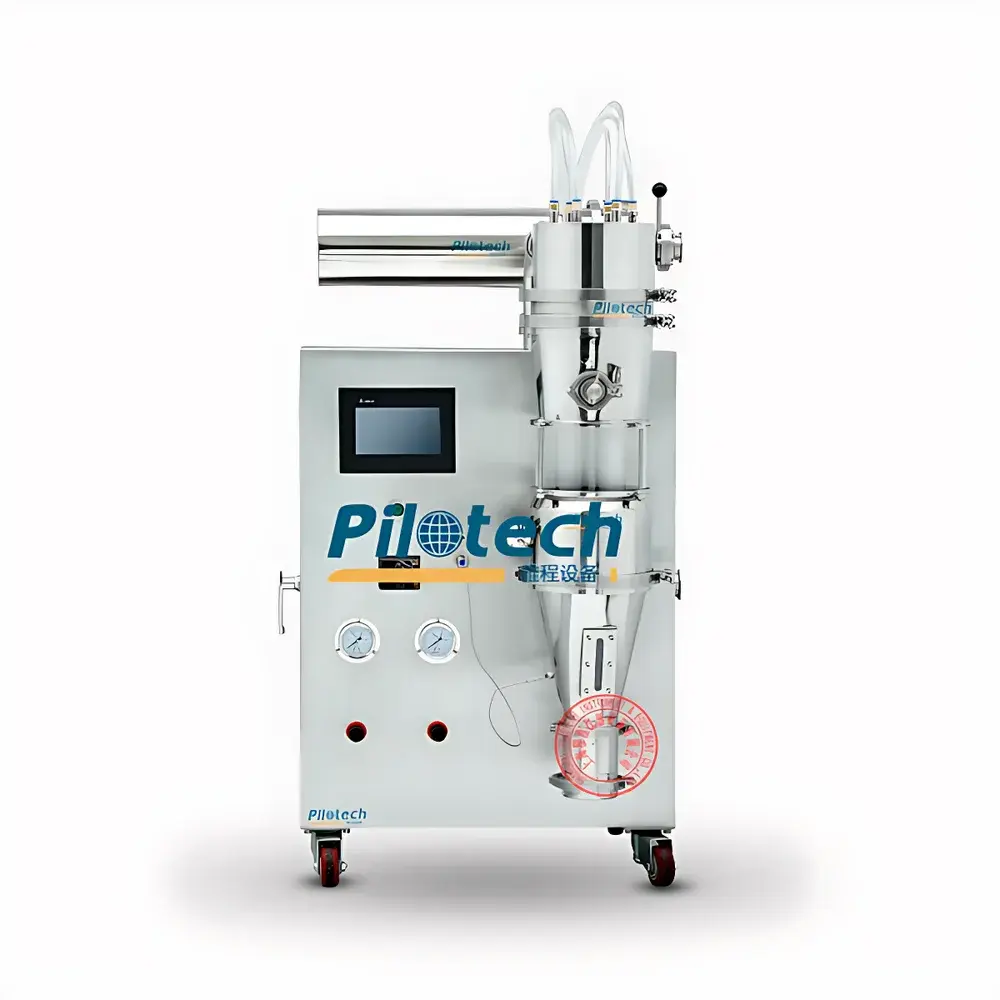
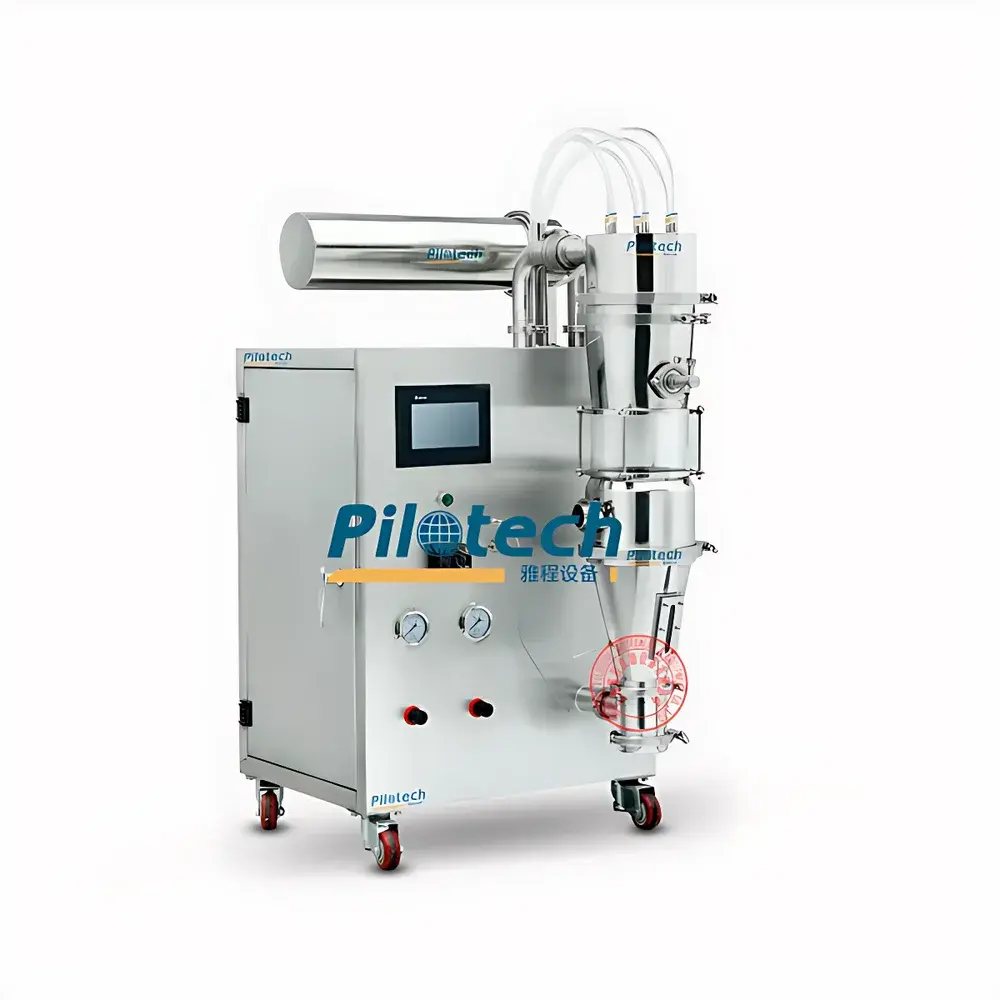
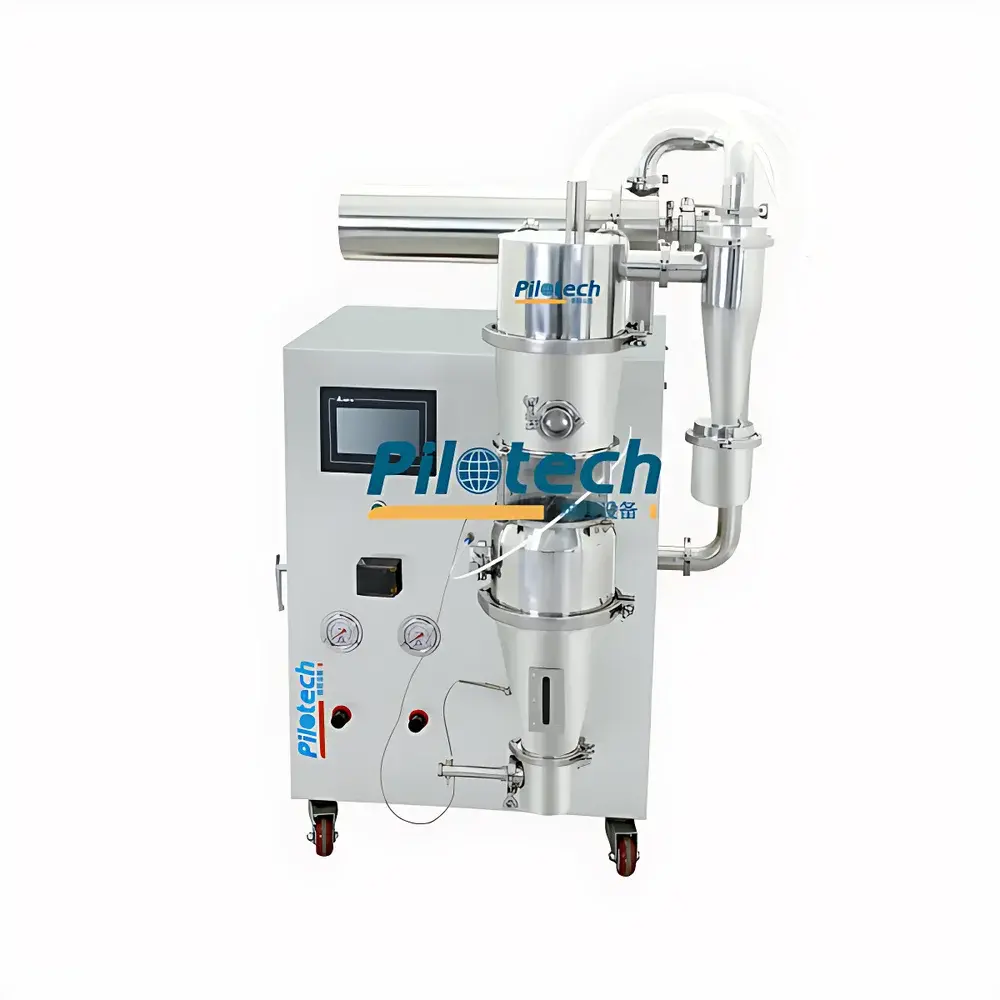
Yacheng YC-1000 Integrated Laboratory Spray Dryer, Fluidized Bed Granulator & Coater
| Brand | Yacheng / PILOTECH |
|---|---|
| Origin | Shanghai, China |
| Manufacturer Type | Direct Manufacturer |
| Product Origin | Domestic (China) |
| Model | YC-1000 |
| Sample Type | Aqueous solutions only |
| Max. Spray Drying Throughput | 1500 mL/h |
| Max. Fluidized Bed Batch Capacity | 1000 g/batch |
| Inlet Air Temperature Range (Spray Drying) | 105–200 °C |
| Fluidized Bed Inlet Air Temperature Range | 40–150 °C |
| Peristaltic Pump Flow Rate | Adjustable up to 1500 mL/h |
| Atomizing Air Pressure | 1–3 bar |
| Drying Chamber Volume | 10 L (Borosilicate glass + stainless steel) |
| Heating Power | 3 kW |
| Total Electrical Load | 5 kW (220 V / 50 Hz) |
| PID Temperature Control | Real-time, closed-loop |
| Display | Color LCD touchscreen with monitoring of inlet temperature, fan frequency, fluid bed temperature, pump speed, and pulse-jet cleaning frequency |
Overview
The Yacheng YC-1000 Integrated Laboratory Spray Dryer, Fluidized Bed Granulator & Coater is an engineered platform for concurrent or sequential unit operations—spray drying, fluidized bed granulation, drying, and film coating—within a single compact footprint. It operates on the principle of rapid solvent evaporation via atomization in a controlled hot-air stream (spray drying), followed by particle growth through binder solution deposition and simultaneous drying in a fluidized state (top-spray or bottom-spray granulation), and optionally, functional polymer film application under precise thermal and airflow conditions (fluidized bed coating). Designed specifically for R&D-scale formulation development, the system enables process intensification without cross-contamination risk between steps, minimizing material consumption and experimental iteration time. Its architecture supports thermolabile compounds—such as peptides, probiotics, botanical extracts, and amorphous solid dispersions—by permitting low-temperature inlet air operation (down to 105 °C) while maintaining final product moisture content below 1 wt% after spray drying.
Key Features
- Triple-function integration: spray drying, fluidized bed granulation, and coating—all programmable and monitorable from one control interface
- Minimal sample requirement: as low as 50 g per granulation or coating batch, enabling early-stage API or excipient screening
- Compact footprint: 0.5 m² floor space; fully mobile on integrated casters with leveling feet for stable operation on standard lab benches
- PLC-based control system with color LCD touchscreen displaying real-time parameters—including inlet air temperature, fluid bed temperature, peristaltic pump RPM, fan frequency, and reverse-pulse cleaning intervals
- Robust construction: full 316L stainless steel frame and contact parts; borosilicate glass drying chamber for visual process observation and corrosion resistance
- Dual-atomizer design: two-fluid nozzle system ensuring consistent droplet size distribution and high reproducibility across batches
- Thermal safety protocol: automatic shutdown sequence upon stop command—fan continues post-heating cycle to prevent thermal damage to heating elements
- PID-controlled precision: independent temperature regulation for both spray drying inlet air and fluidized bed air streams
Sample Compatibility & Compliance
The YC-1000 is validated for aqueous-based feed solutions only, excluding organic solvents or highly viscous suspensions beyond 500 cP. It complies with general electrical safety standards (IEC 61000-6-3, IEC 61000-6-4) and meets mechanical design requirements for laboratory-scale powder processing equipment per ISO 14644-1 Class 8 cleanroom-compatible operation when used with optional HEPA exhaust filtration. While not certified to GMP Annex 1 or FDA 21 CFR Part 11 out-of-the-box, its audit-ready data logging—timestamped parameter records stored locally on internal memory—supports GLP-compliant documentation workflows. All stainless steel wetted surfaces adhere to ASME BPE surface finish specifications (Ra ≤ 0.8 µm), facilitating cleanability validation per ASTM E2656.
Software & Data Management
The embedded HMI provides intuitive navigation for recipe creation, stepwise process sequencing, and manual override modes. Parameter sets—including temperature ramps, pump profiles, airflow setpoints, and pulse-jet timing—are saved as named protocols with version timestamps. Raw operational data (every 2 seconds) is exportable via USB to CSV format for external statistical analysis (e.g., JMP, Minitab) or integration into LIMS environments. Optional Ethernet connectivity allows remote monitoring via Modbus TCP, supporting centralized lab equipment dashboards. Audit trail functionality logs user login/logout events, parameter changes, and emergency stops—meeting foundational ALCOA+ data integrity expectations for preclinical formulation labs.
Applications
The YC-1000 serves pharmaceutical solid dosage form development (e.g., sustained-release pellets, taste-masked microspheres, inhalable dry powders), nutraceutical encapsulation (omega-3, vitamins, polyphenols), food ingredient engineering (instant coffee agglomerates, dairy protein microparticles), and advanced materials synthesis (ceramic precursors, polymer latex particles, catalyst supports). Its dual thermal zones allow decoupled optimization—e.g., gentle drying of heat-sensitive actives followed by elevated-temperature coating for enteric release. Academic and industrial users leverage it for DOE-driven process mapping, scale-up correlation studies, and regulatory filing batch production (Phase I–II clinical supply).
FAQ
Can the YC-1000 handle organic solvents such as ethanol or acetone?
No. The system is designed exclusively for aqueous solutions due to explosion-proofing limitations and absence of inert gas purge capability.
Is the drying chamber pressure-rated or vacuum-capable?
No. It operates at atmospheric pressure only; no vacuum or overpressure functionality is integrated.
What is the minimum particle size achievable via spray drying mode?
Typical median particle diameter (D50) ranges from 5–30 µm depending on feed concentration, nozzle geometry, and inlet temperature—consistent with literature values for lab-scale two-fluid systems.
Does the system support automated cleaning-in-place (CIP)?
No. Manual disassembly and cleaning are required; however, modular design minimizes component count and eliminates dead-leg geometries.
Is third-party IQ/OQ documentation available?
Yes—customizable qualification packages (including test protocols and summary reports) can be supplied upon request for GxP-aligned installations.



