
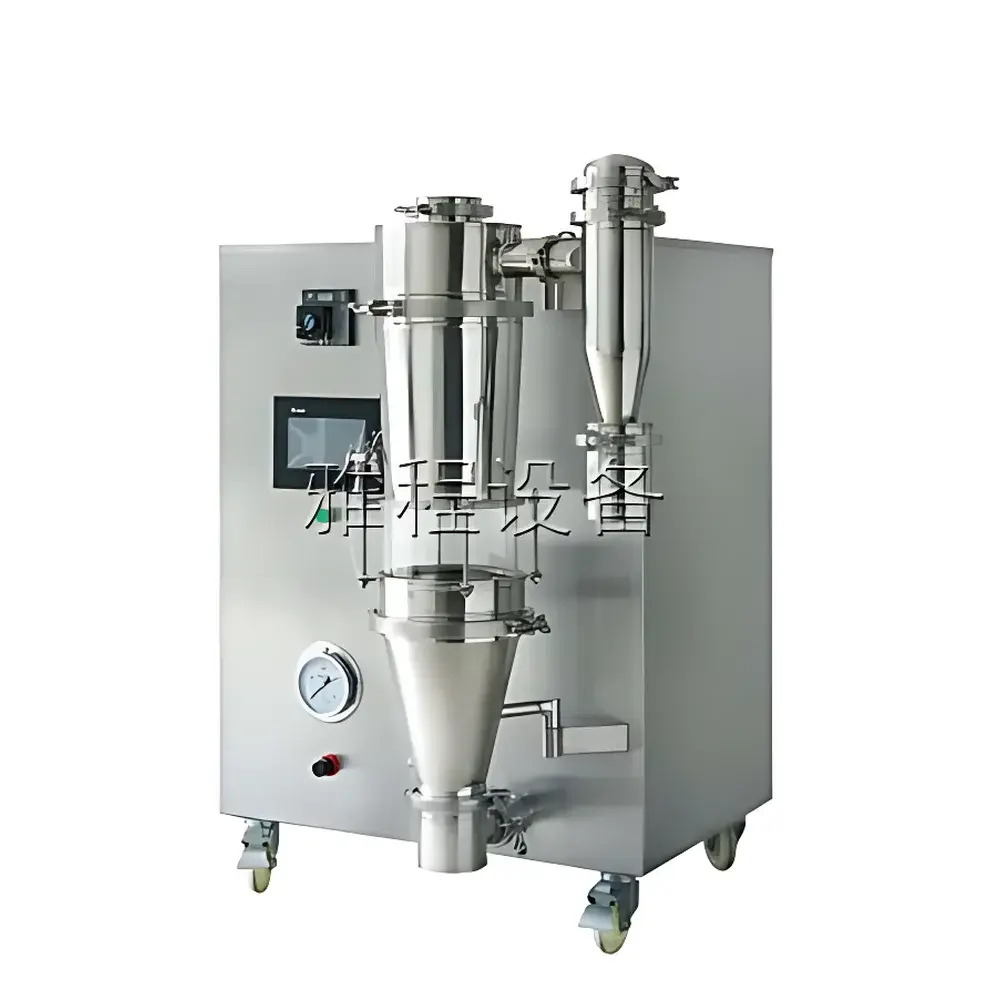
雅程YC-1800实验室低温喷雾干燥器
| Origin | Shanghai, China |
|---|---|
| Manufacturer Type | Authorized Distributor |
| Origin Category | Domestic (PRC) |
| Model | YC-1800 |
| Price | USD 12,000 (FOB Shanghai) |
| Sample Type | Aqueous solutions only |
| Max Feed Rate | 1000–1500 mL/h |
| Inlet Air Temperature Range | 105–200 °C |
| Particle Size Distribution | 1–25 µm |
Overview
The Yacheng YC-1800 Benchtop Low-Temperature Spray Dryer is an engineered solution for the gentle, reproducible conversion of thermolabile aqueous feedstocks—such as herbal extracts, fruit juices, biopolymer solutions, and protein-containing formulations—into free-flowing, low-moisture powders. Unlike conventional laboratory-scale spray dryers that rely on inlet air temperatures ≥140 °C, the YC-1800 achieves complete droplet-to-particle conversion at a controlled inlet temperature as low as 105 °C. This capability is grounded in optimized two-fluid nozzle atomization, precise PID-regulated thermal management, and integrated residence-time modulation via adjustable concurrent/counter-current drying configuration. The system operates on the principle of rapid evaporative cooling: fine liquid droplets (generated by compressed-air-assisted atomization) enter a heated drying chamber where moisture removal occurs within <2 seconds, minimizing thermal degradation pathways common in sugar-rich or proteinaceous matrices. Its compact, self-contained architecture eliminates dependency on external chillers, compressors, or exhaust ducting—making it suitable for ISO Class 7 clean benches, fume hoods, and regulated GMP-adjacent lab environments.
Key Features
- Low-temperature operation: Full drying cycle achievable at 105–110 °C inlet air temperature—critical for preserving glycosidic bonds, enzymatic activity, and volatile aroma compounds.
- Two-fluid pneumatic nozzle system: Precision-machined stainless-steel nozzles (0.5–2.0 mm interchangeable orifice options) ensure consistent droplet size distribution and minimal clogging with viscous or particulate-laden feeds.
- Real-time PID temperature control: ±1 °C accuracy across full 105–200 °C inlet range; independent monitoring of inlet/outlet air temperatures enables process validation and deviation logging.
- Modular drying configuration: Central-positioned spray head supports both concurrent and counter-current airflow modes, allowing empirical optimization of particle residence time for heat-sensitive materials.
- Integrated fluidized bed function: Enhances powder collection efficiency and reduces wall deposition—particularly beneficial for high-sugar-content feeds prone to tackiness and agglomeration.
- 1-µm final-stage particulate filter: Installed downstream of cyclone separator to recover submicron fines and improve overall yield (>92% typical for 5–15 µm median particles).
- Full-color LCD touchscreen interface: Intuitive Chinese/English bilingual GUI with programmable protocols, real-time trend graphs (temperature, feed rate, outlet humidity), and audit-trail-capable event logging.
Sample Compatibility & Compliance
The YC-1800 is validated for aqueous-based feed solutions containing ≤65% total solids (w/w), including polysaccharide-rich botanical extracts (e.g., ginseng, goji, green tea), fruit concentrates (apple, orange, berry), whey protein isolates, alginate hydrogels, and water-soluble synthetic polymers (PVP, PVA). It is not designed for organic solvents, suspensions with >5 µm insoluble particles, or highly saline brines (>10% NaCl). While not certified to FDA 21 CFR Part 11 out-of-the-box, its data logging architecture supports ALCOA+ principles (Attributable, Legible, Contemporaneous, Original, Accurate) when operated under defined SOPs. All wetted parts comply with ASTM F899-22 (stainless steel grade 304/316 surface finish standards), and electrical design conforms to IEC 61010-1:2010 for laboratory equipment safety.
Software & Data Management
The embedded controller records timestamped values for inlet/outlet air temperature, feed pump RPM, chamber pressure differential, and touch-screen operator actions at 1-second intervals. Raw logs export via USB to CSV format for post-processing in MATLAB, Python (pandas), or LIMS-compatible platforms. Optional Ethernet connectivity enables remote monitoring and integration into centralized lab automation systems (e.g., LabVantage, Thermo Fisher SampleManager). Audit trails include user ID, parameter change history, and system error codes—supporting GLP-compliant documentation per OECD Series on Principles of Good Laboratory Practice (ENV/MC/CHEM(98)17).
Applications
- Phytochemical stabilization: Production of stable, non-hygroscopic powders from polyphenol- or saponin-rich plant extracts without Maillard browning or caramelization.
- Functional food ingredient development: Encapsulation of probiotics, vitamins, or omega-3 emulsions using maltodextrin or gum arabic carriers under sub-110 °C conditions.
- Biopharmaceutical formulation screening: Rapid generation of inhalable or lyophilization-ready powders from monoclonal antibody solutions or vaccine adjuvant suspensions.
- Polymer processing R&D: Synthesis of uniform microparticles for controlled-release matrices, avoiding thermal crosslinking or chain scission.
- Academic method development: Teaching tool for mass transfer kinetics, droplet evaporation modeling, and powder rheology correlation studies (e.g., Carr index, Hausner ratio).
FAQ
What is the minimum sample volume required for a valid run?
50 mL (dependent on solids content; ≥5% w/w recommended for reliable powder recovery).
Can the YC-1800 handle organic solvent-based feeds?
No—this model is strictly rated for aqueous solutions. Explosion-proof variants (e.g., YC-1800-EX) are available under separate certification.
Is the system compliant with ISO 22000 or USP <1151> requirements?
It meets foundational engineering controls cited in USP <1151> (drying process suitability) and supports hazard analysis per ISO 22000 Annex H when deployed in validated workflows.
How is particle size distribution controlled?
Via nozzle orifice selection (0.5–2.0 mm), feed concentration, inlet temperature, and airflow velocity—validated using laser diffraction (e.g., Malvern Mastersizer) per ISO 13320.
Does the unit support 21 CFR Part 11 electronic signatures?
Not natively; however, third-party validation packages (including role-based access control and electronic signature modules) are available upon request for regulated environments.



