
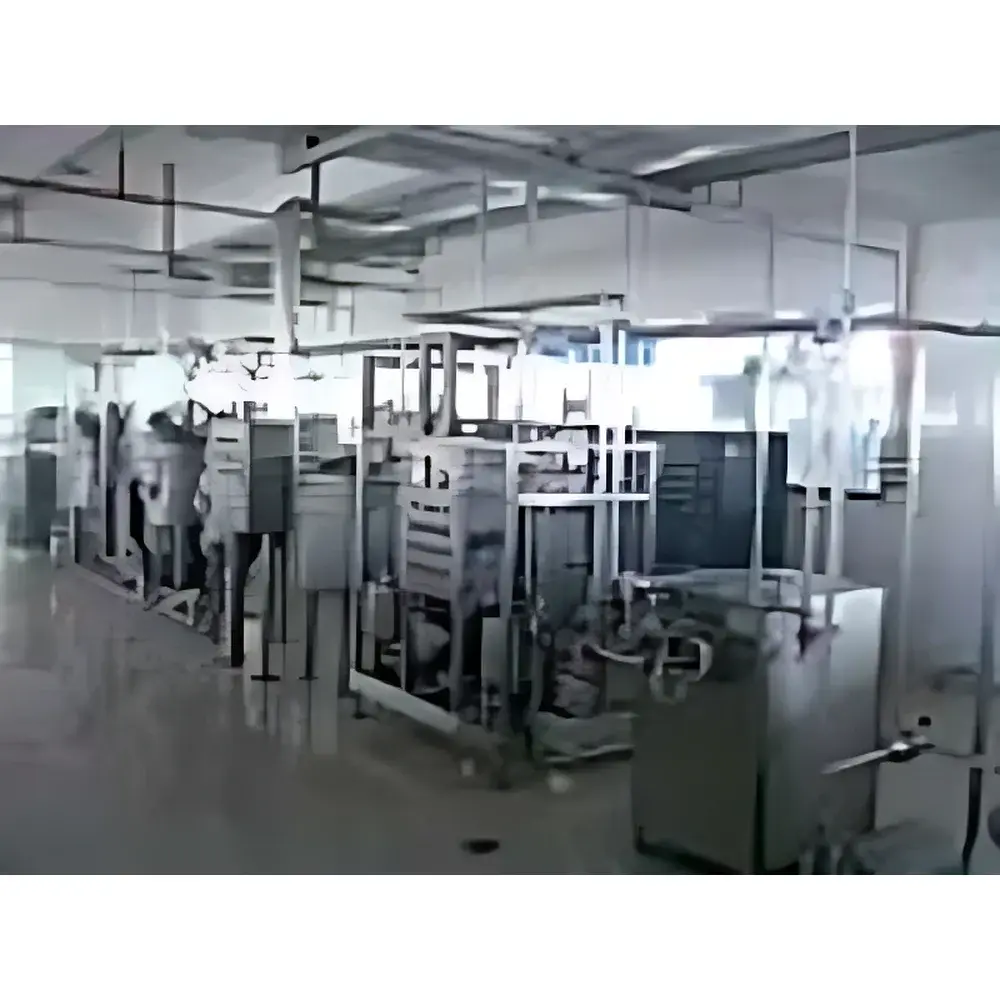
Yacheng / PILOTECH YC Pilot-Scale Dairy & Beverage Processing Line
| Brand | Yacheng / PILOTECH |
|---|---|
| Origin | Shanghai, China |
| Manufacturer Type | Direct Manufacturer |
| Region Classification | Domestic (China) |
| Model | YC |
| Pricing | Upon Request |
| Capacity | 20 L/h, 50 L/h, 100 L/h, 200 L/h, 500 L/h |
Overview
The Yacheng / PILOTECH YC Pilot-Scale Dairy & Beverage Processing Line is an integrated, modular processing system engineered for laboratory-scale process development, formulation optimization, and small-batch production of dairy and beverage products. Designed around continuous-flow unit operations—including juice extraction, coarse filtration, blending, homogenization, vacuum deaeration, heat treatment (HTST or batch pasteurization), fermentation (for yogurt), and aseptic or hot-fill packaging—the system replicates core industrial processing principles while operating at controlled, scalable throughput levels (20–500 L/h). Its architecture follows the Couette-type flow dynamics in homogenization, thermal kinetics in pasteurization (validated per ISO 11133 and ISO 8556), and mass-transfer-limited deaeration under sub-atmospheric conditions. The line supports both batch and semi-continuous modes, enabling precise control over residence time, temperature profiles, shear history, and microbial load reduction—critical parameters for functional stability, shelf-life prediction, and regulatory compliance in dairy and acidified beverage development.
Key Features
- Fully representative pilot-scale architecture: Mirrors commercial dairy and beverage processing logic—including raw material intake, thermal processing, microbial control, and final packaging—enabling direct scalability assessment from lab to plant.
- Modular unit operation design: Each subsystem—including centrifugal juice extractor, plate-and-frame filter, high-shear mixer, two-stage piston homogenizer (up to 200 MPa), vacuum deaerator (≤ 5 mbar), steam-jacketed holding tubes, and jacketed fermentation vessels—is functionally independent and can be operated standalone or in sequence.
- Energy-optimized configuration: Integrated heat recovery loops between pasteurization and preheating zones; electrically heated jacketed vessels with PID-controlled ±0.5°C stability; low-power vacuum pumps and variable-frequency drives on all major pumps and agitators.
- Educational accessibility: Transparent PTFE-lined sight glasses, color-coded sanitary tubing (316L stainless steel, ASME BPE-compliant), and standardized tri-clamp connections facilitate real-time observation and hands-on training for students and R&D personnel.
- Low-volume flexibility: Minimum throughput of 20 L/h minimizes raw material consumption per trial—ideal for university labs, flavor houses, and startup product developers requiring rapid iteration without bulk inventory commitment.
- Compact footprint and utility adaptability: Engineered for standard laboratory infrastructure—single-phase or three-phase power input (220/380 VAC), ambient cooling water supply, and compressed air (0.6 MPa)—with no requirement for dedicated boiler or chiller plants.
Sample Compatibility & Compliance
The YC line accommodates diverse feedstocks including raw milk, reconstituted skim/fat-modified milk powder, fruit pulps (apple, orange, mango), vegetable extracts, probiotic cultures (Lactobacillus spp., Bifidobacterium spp.), stabilizers (pectin, carrageenan, gellan gum), and acidulants (citric, lactic acid). It meets hygienic design standards per EHEDG Doc. 8 and 3-A Sanitary Standards 01-05, with surface roughness Ra ≤ 0.8 µm on wetted parts. All contact materials comply with FDA 21 CFR §177.2600 and EU Regulation (EC) No. 1935/2004. Process validation supports adherence to ISO 22000, HACCP, and GMP frameworks; optional data logging enables audit-ready records for GLP environments.
Software & Data Management
The system integrates a programmable logic controller (PLC) with HMI touchscreen interface (10.1″ TFT, IP65-rated), supporting recipe-based operation, real-time parameter logging (temperature, pressure, flow rate, pH, conductivity), and event-triggered alarms. Optional Ethernet/IP or Modbus TCP connectivity allows integration into centralized LIMS or MES platforms. Data export is compliant with ASTM E2500-21 for traceable electronic records; audit trail functionality satisfies FDA 21 CFR Part 11 requirements when paired with user access controls and digital signature modules.
Applications
- Formulation development for UHT-treated flavored milks, fermented dairy drinks (e.g., kefir, lassi), and shelf-stable fruit-dairy blends.
- Thermal process validation for low-acid dairy beverages targeting 5-log pathogen reduction (per USDA-FSIS and EC Regulation 2073/2005).
- Stabilizer efficacy testing under shear and thermal stress—quantifying viscosity decay, phase separation onset, and particle aggregation kinetics.
- Probiotic viability studies across fermentation, cooling, and storage phases using inline optical density and offline CFU enumeration.
- Process mapping for scale-up: correlating lab-scale residence time distribution (RTD) with full-scale CFD models to predict mixing efficiency and thermal uniformity.
- Teaching platform for food engineering curricula covering mass/energy balances, fluid rheology, heat transfer, and sanitary system design.
FAQ
Can this system produce sterile-packaged products suitable for shelf-stable distribution?
Yes—when configured with aseptic filling modules (e.g., peristaltic fillers with steam sterilization cycles) and validated terminal sterilization protocols, it supports production of commercially sterile dairy beverages meeting ASTM D4785 criteria.
Is the homogenizer capable of nano-emulsion formation for functional ingredient delivery?
The two-stage homogenizer achieves droplet size distributions down to D90 < 200 nm under optimized pressure and recirculation conditions, verified via dynamic light scattering (DLS) post-processing.
Does the system support ISO/IEC 17025-compliant calibration traceability?
All embedded sensors (Pt100 RTDs, pressure transducers, Coriolis flow meters) are supplied with NIST-traceable calibration certificates; optional third-party verification services are available upon request.
What level of automation is included by default?
Standard configuration includes PLC-based sequential control with manual override capability; fully automated recipe-driven operation with auto-start/stop and fault recovery requires optional Advanced Process Control (APC) package.
Are spare parts and technical documentation available internationally?
Yes—comprehensive English-language operation manuals, P&ID schematics, electrical diagrams, and certified spare parts kits are provided with each shipment; remote diagnostics and on-site commissioning support are available globally.





