
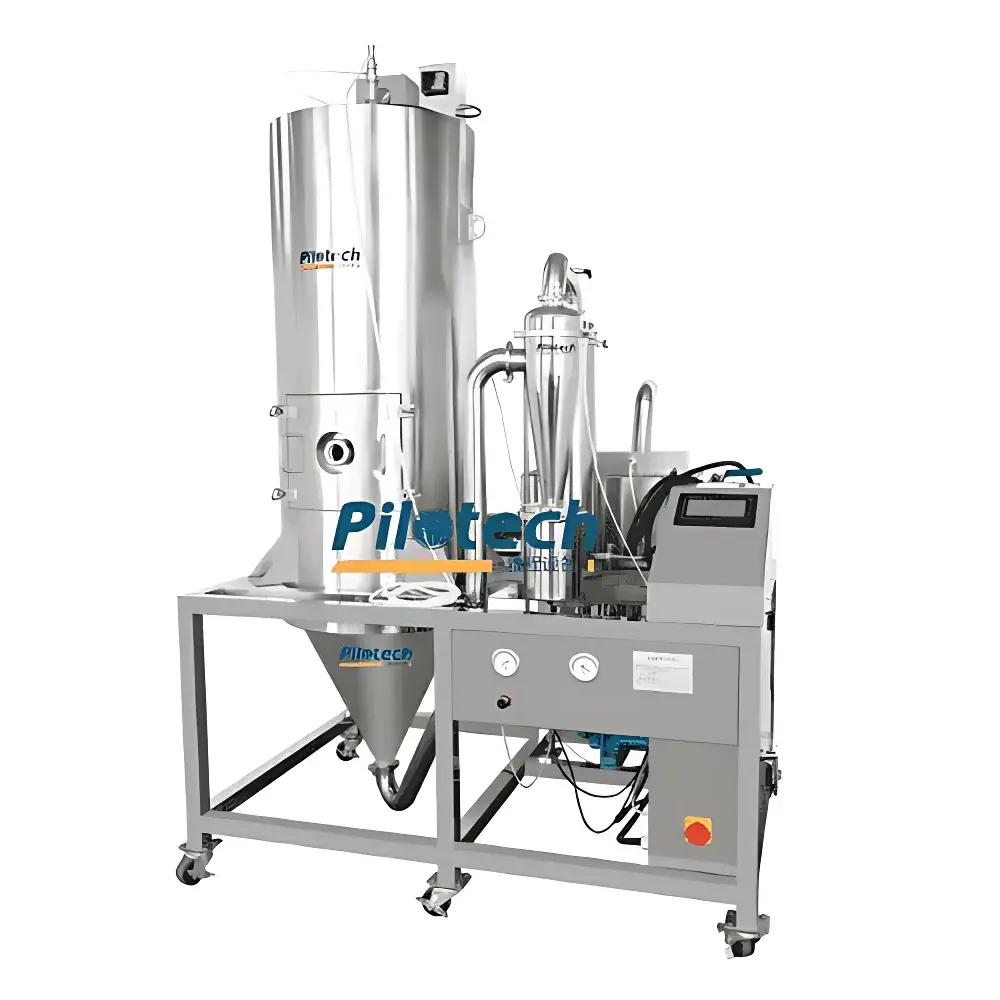
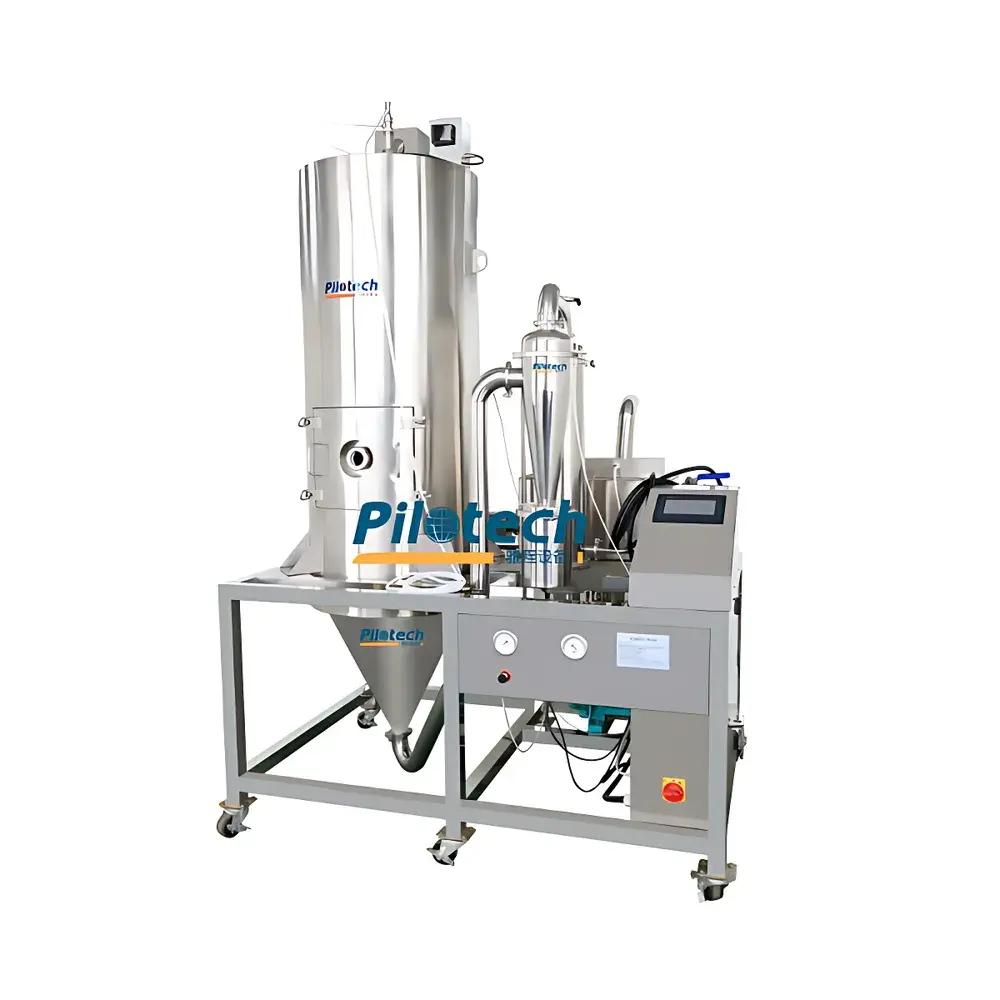
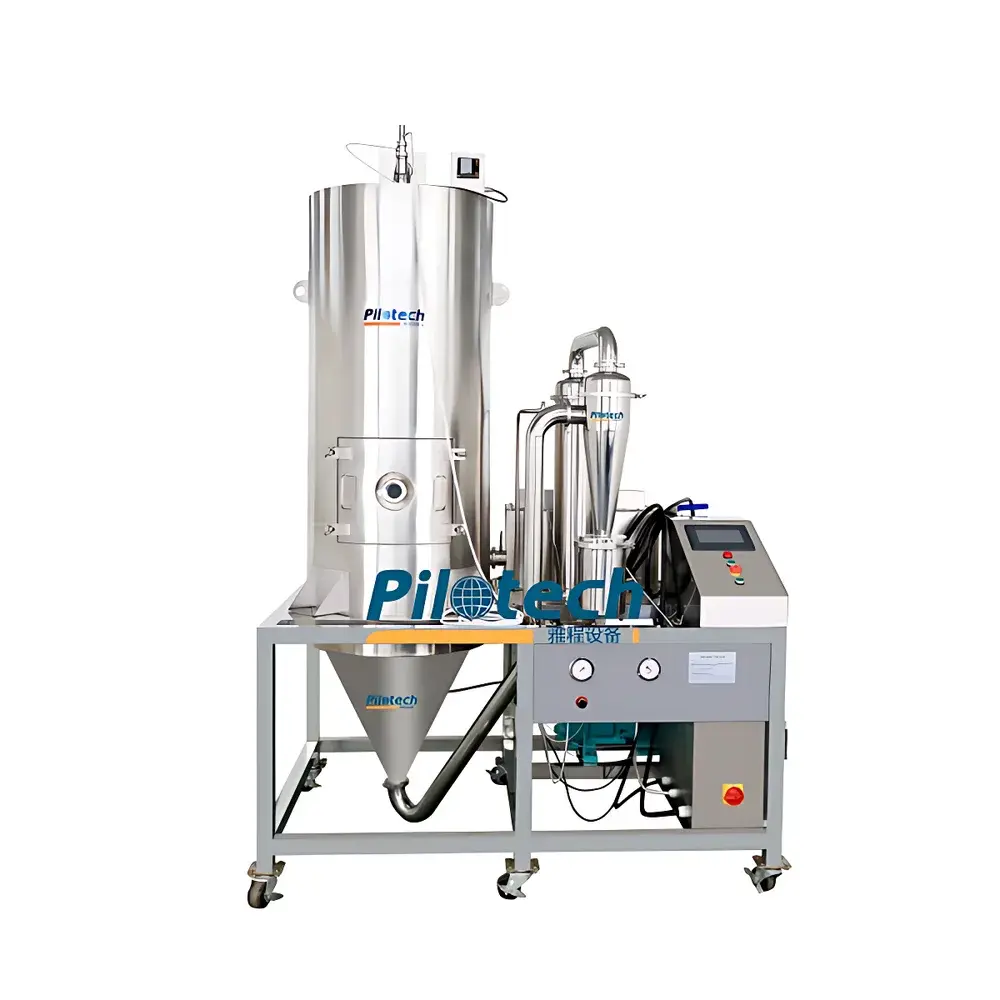
雅程 YC-3100 Pilot-Scale Vacuum Low-Temperature Spray Dryer
| Brand | PILOTECH |
|---|---|
| Origin | Shanghai, China |
| Manufacturer Type | Direct Manufacturer |
| Product Category | Domestic |
| Model | YC-3100 |
| Max Feed Rate | 6–10 L/h (aqueous solutions) |
| Particle Size Range | 1–120 µm |
| Operating Environment | Vacuum, Low-Temperature Mode |
| Temperature Control Accuracy | ±2°C |
| Sample Compatibility | Aqueous solutions only |
| Data Export | USB storage (optional), Touchscreen HMI with data logging (optional) |
Overview
The PILOTECH YC-3100 is a pilot-scale vacuum low-temperature spray dryer engineered for seamless technology transfer from laboratory research to process validation and early-stage production. Unlike conventional atmospheric spray dryers relying on thermal evaporation, the YC-3100 operates under controlled vacuum conditions—typically 5–50 kPa absolute—to depress the boiling point of water and volatile solvents, enabling effective drying at inlet air temperatures as low as 40–80°C. This principle leverages thermodynamic phase behavior to minimize thermal stress on heat-labile compounds. The system employs a two-fluid nozzle atomization mechanism coupled with a coaxial drying chamber geometry optimized for residence time distribution and wall deposition control. Its design bridges the critical gap between benchtop feasibility studies (e.g., YC-2000) and GMP-aligned scale-up, supporting reproducible powder generation under defined process parameters aligned with QbD (Quality by Design) frameworks.
Key Features
- Pilot-scale throughput: Adjustable feed rate from 200 mL/h to 10 L/h aqueous solution, supporting both micro-batch screening and representative process validation runs.
- Vacuum-integrated thermal management: Integrated vacuum pump, pressure-regulated chamber, and PID-controlled heating system maintain drying temperature stability within ±2°C—critical for preserving enzymatic activity, protein conformation, or volatile flavor compounds.
- Modular, clean-in-place (CIP)-ready architecture: All wetted parts—including atomizer assembly, drying chamber, cyclone separator, and collection vessel—are constructed from 316L stainless steel and feature tri-clamp or quick-release fittings for rapid disassembly and inspection.
- Compact footprint: Total height ≤2.6 m; floor space requirement <1.2 m²—designed for integration into ISO Class 7/8 cleanrooms or standard laboratory environments without structural modification.
- Process data integrity: Optional touchscreen HMI with embedded real-time trend logging (temperature, pressure, feed rate, chamber differential pressure); data exportable via USB 2.0 to CSV or PDF formats compliant with ALCOA+ principles.
Sample Compatibility & Compliance
The YC-3100 is validated for aqueous-based feedstocks only—including buffered saline solutions, protein suspensions, polysaccharide dispersions, and emulsified nutraceuticals. It is not rated for organic solvents, corrosive media, or high-viscosity (>500 cP) feeds without pre-dilution or inline homogenization. While not certified to IEC 61000-6-2/4 or UL 61010-1 out-of-the-box, its electrical and mechanical design conforms to CE marking directives for laboratory equipment. Process documentation supports alignment with FDA 21 CFR Part 11 (when equipped with audit-trail-enabled HMI), ISO 9001:2015 quality management systems, and ICH Q5C stability testing protocols for biopharmaceutical intermediates.
Software & Data Management
The optional touch-based human-machine interface (HMI) provides intuitive parameter configuration, real-time monitoring of six key process variables, and automated batch report generation. Each run logs timestamped metadata including setpoints, deviations, alarm events, and final powder yield. Exported files include raw sensor readings and summary statistics (mean particle size, moisture content estimate, recovery rate). Data files are structured for direct import into LIMS platforms or statistical analysis tools (e.g., JMP, Minitab) used in DOE-driven process optimization. No cloud connectivity or remote access functionality is included—ensuring full data sovereignty per institutional IT security policies.
Applications
- Pharmaceutical development: Production of inhalable dry powders, lyophilization-prep intermediates, and stabilized vaccine adjuvants where residual moisture and thermal degradation must remain below ICH Q5C thresholds.
- Functional food & nutraceuticals: Encapsulation of probiotics, omega-3 oils, or anthocyanins into amorphous carbohydrate matrices while retaining >90% bioactivity post-drying.
- Advanced materials synthesis: Generation of uniform ceramic precursors (e.g., LiFePO₄), catalyst supports, or MOF-derived powders requiring oxygen-sensitive handling and narrow PSD control.
- Academic & contract research: Method development for continuous manufacturing workflows, comparative drying kinetics studies, and excipient compatibility screening under controlled vacuum environments.
FAQ
Is the YC-3100 suitable for organic solvent-based feeds?
No. The system is engineered exclusively for aqueous solutions. Use with flammable or chlorinated solvents poses explosion and material compatibility risks and voids warranty.
What particle size distribution can be expected under standard operating conditions?
D50 typically ranges from 15–45 µm depending on feed concentration, nozzle orifice, and vacuum level—validated using laser diffraction (Malvern Mastersizer) per ISO 13320.
Can the unit be integrated into a closed-loop nitrogen environment?
Yes—custom inert gas purging interfaces and O₂ sensors are available as factory-installed options for oxygen-sensitive APIs or nanomaterials.
Does the system comply with Good Manufacturing Practice (GMP) requirements?
It meets foundational GMP engineering principles (e.g., smooth surfaces, drainability, material traceability) but requires site-specific qualification (IQ/OQ/PQ) and procedural SOPs to achieve formal GMP compliance.
What maintenance intervals are recommended for the vacuum pump and atomizer?
Vacuum pump oil replacement every 500 operational hours; nozzle inspection and ultrasonic cleaning after each batch when processing viscous or particulate-laden feeds.



