
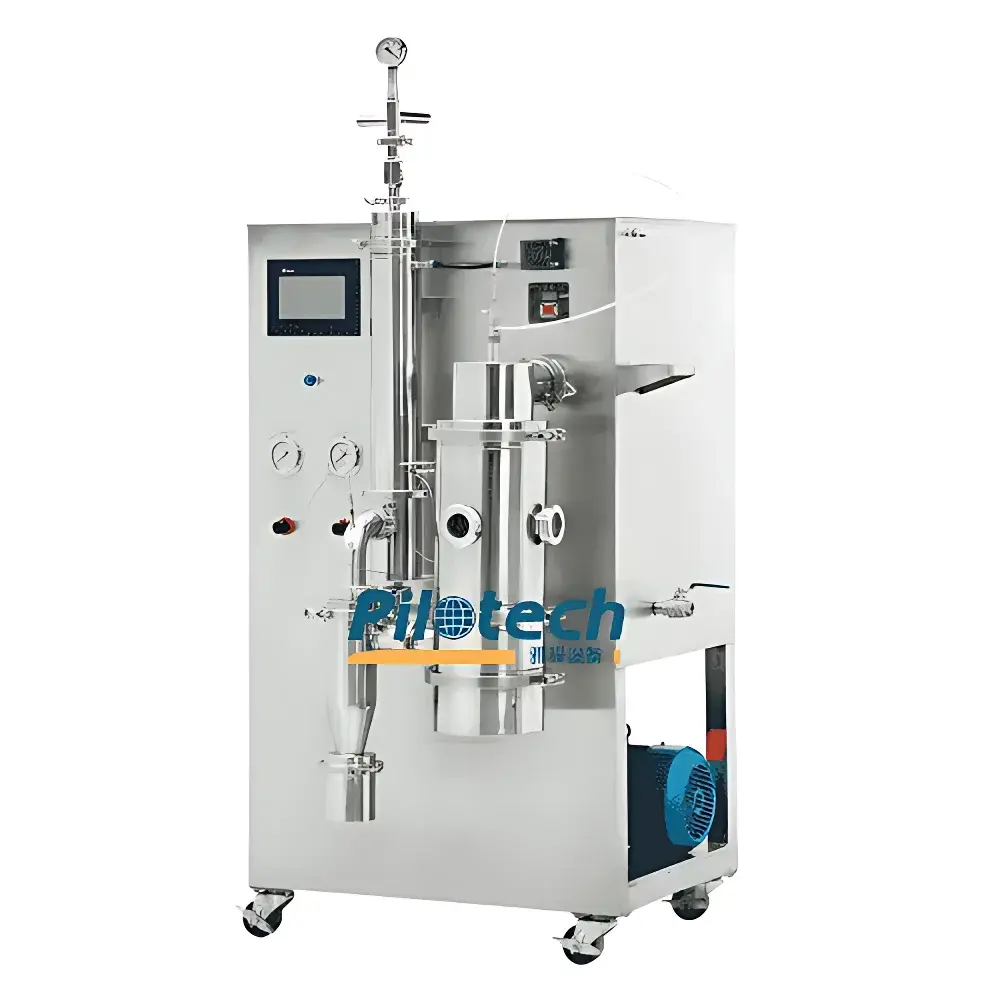
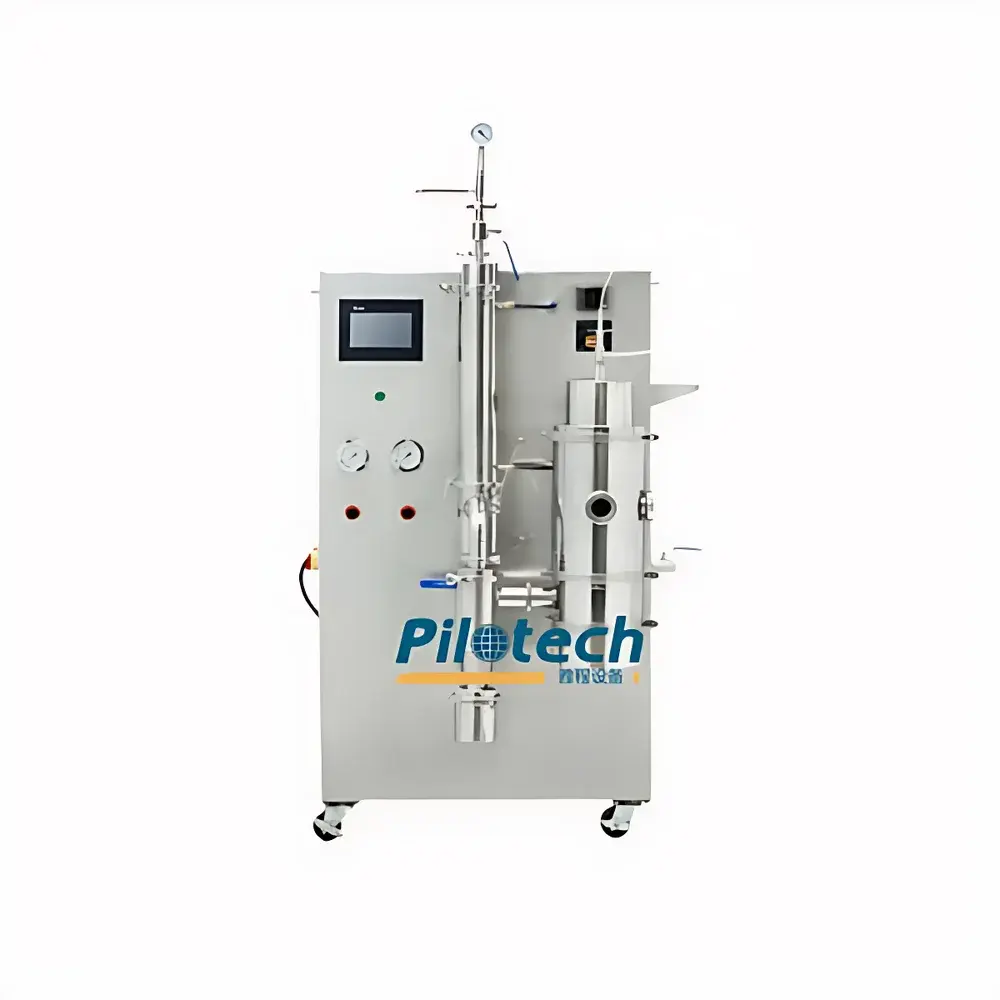
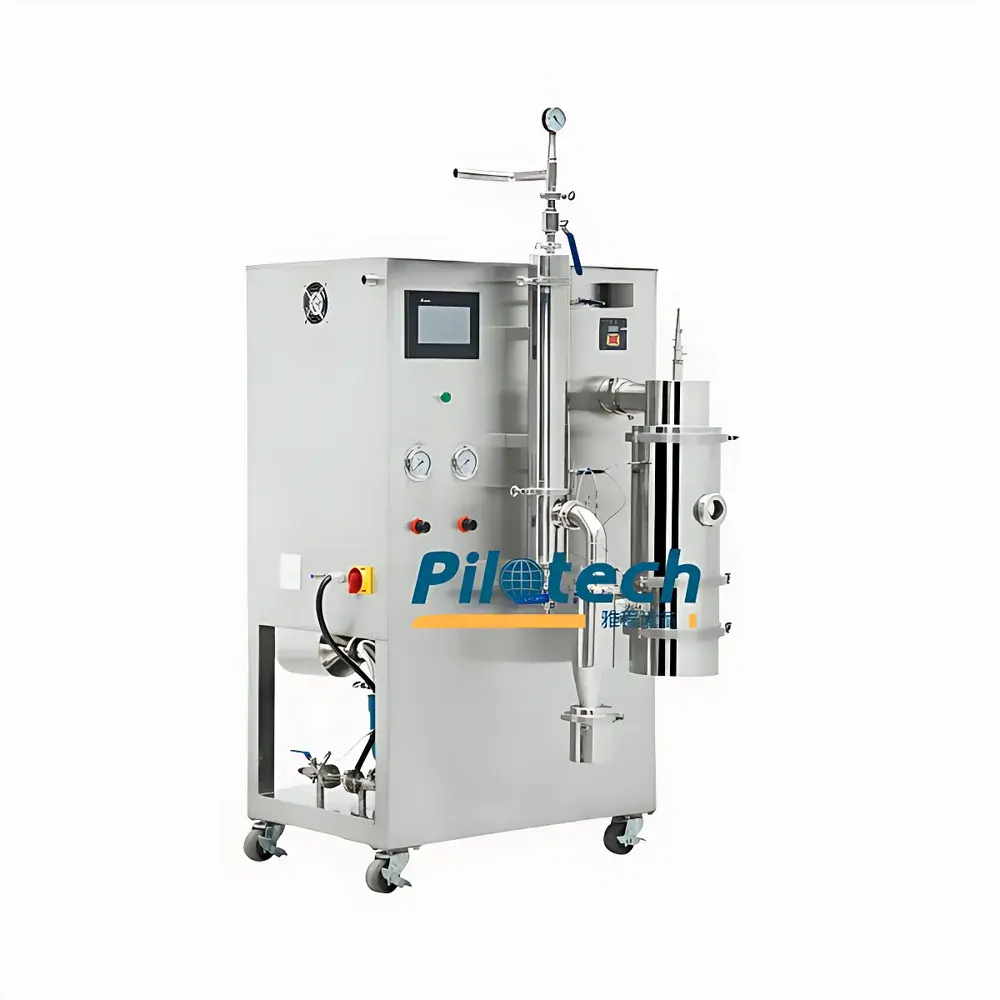
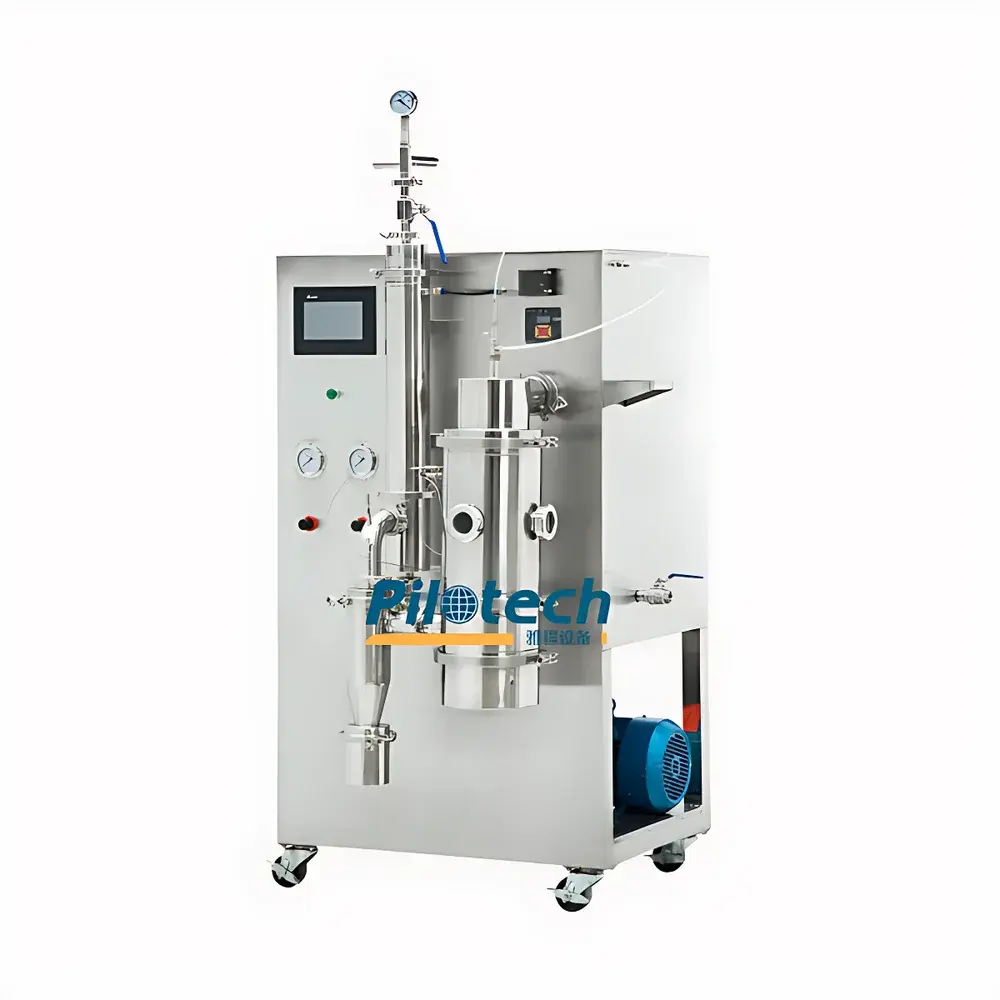
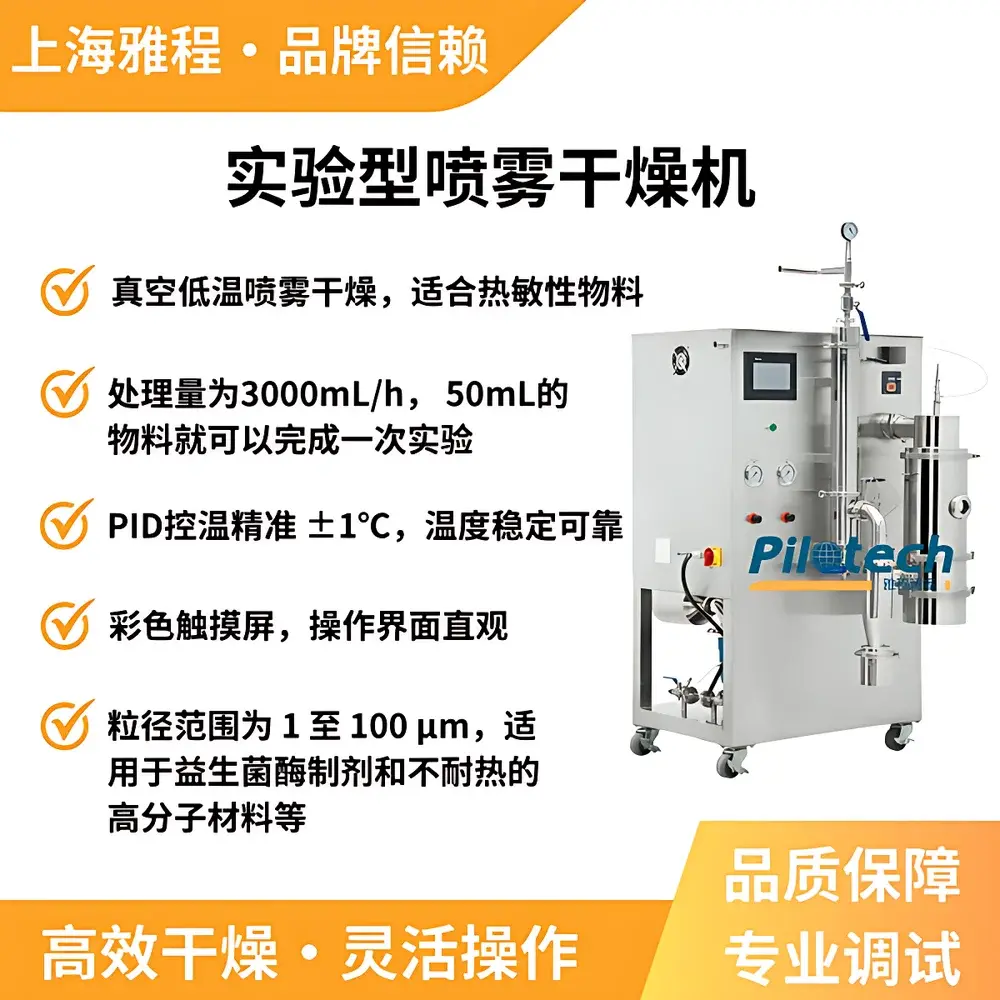
Pilotech YC-2100 Pilot-Scale Vacuum Low-Temperature Spray Dryer
| Brand | Pilotech |
|---|---|
| Origin | Shanghai, China |
| Manufacturer Type | Direct Manufacturer |
| Country of Origin | China |
| Model | YC-2100 |
| Sample Type Compatibility | Aqueous Solutions Only |
| Maximum Feed Rate | 3000 mL/h |
| Temperature Range | 50–200 °C |
| Particle Size Range | 1–100 µm |
| Vacuum Range | −0.05 to −0.08 MPa |
| Heating Control Accuracy | ±1 °C |
| Nozzle Standard Orifice | 2.0 mm (Optional: 0.5 / 0.8 / 1.0 / 1.5 mm) |
| Minimum Sample Volume | 50 mL (dependent on solids content) |
| Power Supply | 9 kW / 380 V / 3-phase 5-wire |
| Construction Material | Full 316L Stainless Steel |
| Display Interface | Color LCD Touchscreen with Chinese GUI |
Overview
The Pilotech YC-2100 is a pilot-scale vacuum spray dryer engineered for controlled, low-temperature drying of thermolabile and oxidation-sensitive materials—including proteins, enzymes, probiotics, polysaccharides, and pharmaceutical actives—without compromising structural integrity or bioactivity. Unlike conventional atmospheric spray dryers, the YC-2100 operates under reduced pressure (−0.05 to −0.08 MPa), enabling rapid solvent evaporation at temperatures as low as 50 °C. This vacuum-assisted process leverages the principle of boiling point depression: lowering ambient pressure reduces the vaporization temperature of aqueous solvents, thereby minimizing thermal stress during droplet-to-particle transition. The system integrates a coaxial two-fluid nozzle design, precision PID-controlled heating, and real-time feed rate modulation via peristaltic pump—making it suitable for scalable process development from lab to pre-GMP manufacturing environments.
Key Features
- Vacuum-enabled low-temperature operation: Achieves complete drying at 50–200 °C with moisture content <1% w/w, preserving heat-sensitive functional groups and conformational stability.
- Coaxial two-fluid nozzle assembly: Precision-machined 316L stainless steel nozzle ensures symmetrical atomization; zero eccentricity prevents wall impingement and improves powder yield uniformity.
- Adjustable nozzle positioning: Vertical translation mechanism allows fine-tuning of spray trajectory relative to drying chamber geometry—critical for optimizing residence time and particle morphology.
- High-fidelity thermal control: Real-time PID algorithm maintains setpoint accuracy within ±1 °C across full operating range, validated per ASTM E2251-22 for thermal uniformity in laboratory drying systems.
- Noise-attenuated mechanical architecture: Integrated vibration-damping mounts and acoustic shielding reduce operational noise from vacuum pump and air compressor—essential for shared laboratory spaces.
- Modular nozzle options: Interchangeable orifices (0.5, 0.8, 1.0, 1.5, and 2.0 mm) support tailored droplet size distribution and throughput optimization without hardware replacement.
Sample Compatibility & Compliance
The YC-2100 is validated for aqueous feedstocks only (e.g., protein solutions, bacterial suspensions, plant extracts, and polymer dispersions). It excludes organic solvents, high-viscosity slurries (>500 cP), or abrasive particulates. All wetted surfaces are electropolished 316L stainless steel, compliant with ISO 8573-1:2010 (compressed air purity) and USP for material biocompatibility. While not certified for GMP production, its design supports GLP-aligned documentation practices—including audit-ready parameter logging, user-access level controls, and timestamped event records—facilitating FDA 21 CFR Part 11 readiness when paired with external data management software.
Software & Data Management
The integrated color LCD touchscreen provides intuitive local control with fully localized Chinese interface. System parameters—including inlet/outlet temperature, vacuum level, feed rate, and runtime—are logged internally at 1-second intervals and exportable via USB to CSV format. Though the onboard UI does not support remote access or cloud synchronization, raw log files are structured for seamless import into LIMS platforms (e.g., LabWare, Thermo Fisher SampleManager) or statistical process analysis tools (JMP, Minitab). Optional RS485/Modbus RTU output enables integration into centralized facility SCADA systems for multi-unit monitoring.
Applications
- Pharmaceutical formulation development: Stabilization of monoclonal antibodies, mRNA-LNPs, and peptide APIs under sub-60 °C drying conditions.
- Food science research: Encapsulation of probiotics, vitamins, and anthocyanins with retained viability and antioxidant capacity.
- Biotechnology: Production of lyophilization-compatible microparticles for downstream freeze-drying or inhalation delivery.
- Materials science: Synthesis of spherical ceramic precursors, metal-organic framework (MOF) powders, and battery cathode active materials with narrow PSD (D50 = 10–50 µm).
- Academic process engineering: Empirical correlation of atomization energy, vacuum level, and residence time with final powder density, flowability, and hygroscopicity.
FAQ
Can the YC-2100 handle organic solvents such as ethanol or acetone?
No. The system is designed exclusively for aqueous solutions. Organic solvent use poses explosion risk under vacuum and exceeds material compatibility limits of standard seals and pumps.
Is the touchscreen interface available in English?
The standard firmware features a Chinese-only GUI. English-language operation requires custom firmware deployment, subject to minimum order quantity and extended lead time.
What is the typical drying residence time inside the chamber?
Under nominal conditions (50 °C inlet, −0.07 MPa vacuum, 3000 mL/h feed), mean droplet residence time ranges from 1.8 to 2.4 seconds—measured via tracer particle imaging and validated against CFD simulations.
Does the system include inert gas purging capability?
Not as standard. An optional nitrogen purge kit (with mass flow controller and sealed chamber inlet/outlet ports) can be added to mitigate oxidation during drying of unsaturated lipids or catecholamines.
How is cleaning validation performed between batches?
The fully drainable, crevice-free chamber and quick-release nozzle assembly support visual inspection and swab-based residue testing per ICH Q5C guidelines. Cleaning protocols must be developed by the end user and qualified per internal SOPs.



