
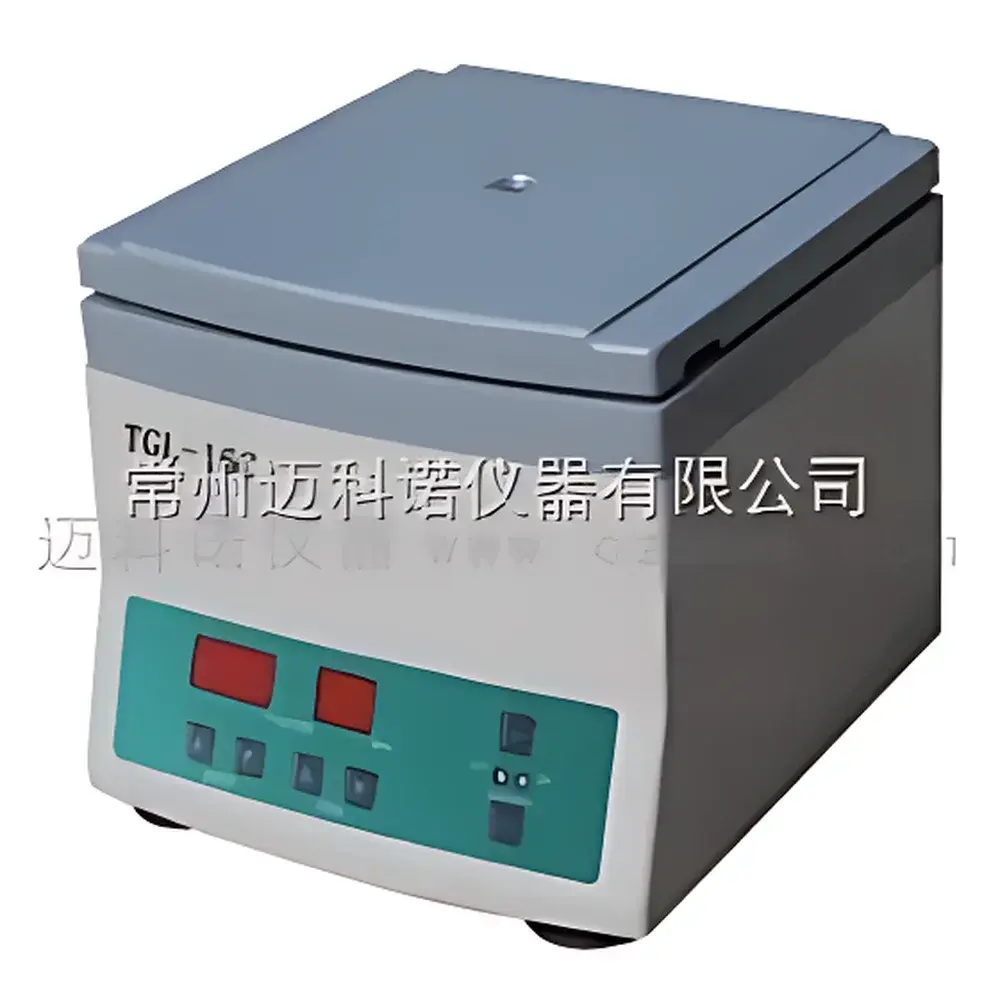
MKN TGL-16C Intelligent Benchtop High-Speed Centrifuge
| Brand | MKN |
|---|---|
| Model | TGL-16C |
| Max Speed | 16,000 rpm |
| RCF | 17,000 × g |
| Capacity | 12 × 1.5 mL / 12 × 0.5 mL / 8 × 5 mL |
| Timer Range | 0–30 min |
| Noise Level | ≤60 dB(A) |
| Power Supply | AC 220 V, 50 Hz, 5 A |
| Drive Type | Brushless DC Motor |
| Control Interface | Touchscreen with Digital Speed & Time Display |
| Rotor Material | Anodized Aluminum Alloy |
| Compliance | Designed for ISO/IEC 17025 laboratory environments, compatible with GLP documentation workflows |
Overview
The MKN TGL-16C Intelligent Benchtop High-Speed Centrifuge is a precision-engineered laboratory instrument designed for rapid, reproducible separation of biological and chemical samples via sedimentation under controlled centrifugal force. It operates on the principle of differential sedimentation—where particles of varying density, size, and shape migrate radially outward at rates proportional to their mass and the square of rotational velocity (ω²r). Engineered for benchtop deployment in space-constrained environments, the TGL-16C delivers up to 17,000 × g relative centrifugal force at its maximum speed of 16,000 rpm, enabling efficient pelleting of cellular components, subcellular organelles, macromolecules, and precipitated analytes. Its compact footprint, low thermal signature (<12 °C ambient rise after 30 min continuous operation), and brushless DC motor architecture ensure stable torque delivery across speed ranges without carbon brush wear or electromagnetic interference—critical for long-term calibration integrity and regulatory traceability.
Key Features
- Intelligent microprocessor-controlled system with real-time digital display of speed (rpm), time remaining, and RCF—accessible via intuitive capacitive touchscreen interface
- Automatic rotor imbalance detection and adaptive speed correction: dynamically adjusts acceleration/deceleration profiles to suppress vibration during transient load conditions
- Anodized aluminum alloy rotor assembly engineered for mechanical rigidity, corrosion resistance, and thermal stability; validated for ≥10,000 operational cycles at rated speed
- Three interchangeable rotor configurations supported: 12-position microtube rotor (1.5 mL and 0.5 mL), and 8-position conical tube rotor (5 mL)—all pre-balanced and certified per ISO 15195
- Passive air-cooling design with optimized internal airflow channels ensures consistent sample temperature control without refrigeration; compliant with IEC 61010-1 safety standards for Class II equipment
- Programmable soft-braking mode minimizes resuspension of delicate pellets; deceleration profile configurable across 4 levels (including “no brake” for gradient preservation)
Sample Compatibility & Compliance
The TGL-16C accommodates standard polypropylene, polycarbonate, and glass microcentrifuge tubes (0.5–5 mL) and is routinely employed in clinical diagnostics (serum/plasma separation), immunoassay preparation, nucleic acid purification workflows, and small-volume protein concentration steps. All rotor geometries comply with ISO 15195:2019 (requirements for centrifuge calibration and verification) and support audit-ready documentation per GLP and GMP Annex 11 principles. While not a refrigerated unit, its thermal performance meets ASTM E2913-13 criteria for non-refrigerated centrifuges used in ambient-temperature analytical sample preparation. The device carries CE marking under Directive 2014/30/EU (EMC) and 2014/35/EU (LVD), and conforms to IEC 61010-2-020 for centrifuge-specific safety requirements.
Software & Data Management
The TGL-16C operates as a standalone instrument with embedded firmware supporting non-volatile storage of up to 20 user-defined protocols—including speed, time, braking mode, and rotor ID. Protocol recall includes timestamped execution history (date/time stamp, run duration, final RCF) accessible via front-panel navigation. For laboratories requiring electronic record retention, optional RS-232 serial output enables integration with LIMS or ELN systems using ASCII-based command-response protocol (e.g., “GET:RUNTIME”, “SET:SPEED=12000”). Audit trail functionality supports FDA 21 CFR Part 11 alignment when paired with validated third-party data capture software that enforces user authentication, electronic signatures, and immutable log archiving.
Applications
- Clinical laboratories: Rapid separation of whole blood into serum or plasma fractions prior to immunochemistry, ELISA, or coagulation assays
- Research labs: Pellet recovery of bacteria, yeast, or mammalian cells from suspension cultures; isolation of nuclei or mitochondria via differential centrifugation
- QC/QA units: Clarification of reagent solutions, filtration bypass validation, and particulate matter analysis per USP
- Biotechnology settings: Concentration of viral vectors, exosomes, or monoclonal antibody intermediates in early-stage process development
- Educational institutions: Teaching core principles of sedimentation kinetics, rotor dynamics, and centrifugal force calculation (RCF = 1.118 × 10⁻⁵ × r × N²)
FAQ
Is the TGL-16C suitable for use with infectious or biohazardous samples?
Yes—when operated with sealed rotors and appropriate biosafety-certified tubes (e.g., O-ring–sealed conical tubes), it meets BSL-2 containment requirements. Always follow institutional biosafety protocols and decontaminate the chamber post-run.
Can I validate the speed accuracy of this centrifuge?
Yes—calibration is performed using a NIST-traceable handheld tachometer (e.g., Extech 461923) against the digital display; deviation must remain within ±100 rpm at 16,000 rpm per ISO 15195 verification criteria.
Does the unit support rotor auto-recognition?
No—rotor identification is manual via front-panel selection; users must confirm rotor type before initiating runs to prevent overspeed conditions.
What maintenance intervals are recommended?
Inspect rotor threads and chuck integrity every 200 runs; clean chamber weekly with 70% ethanol; perform full visual inspection and vibration test annually per manufacturer’s service bulletin SB-TGL16C-2023.
Is there a warranty covering motor failure?
MKN provides a 24-month limited warranty covering defects in materials and workmanship, including the brushless DC motor assembly—excluding damage from improper rotor loading, unbalanced tubes, or unauthorized firmware modification.



