
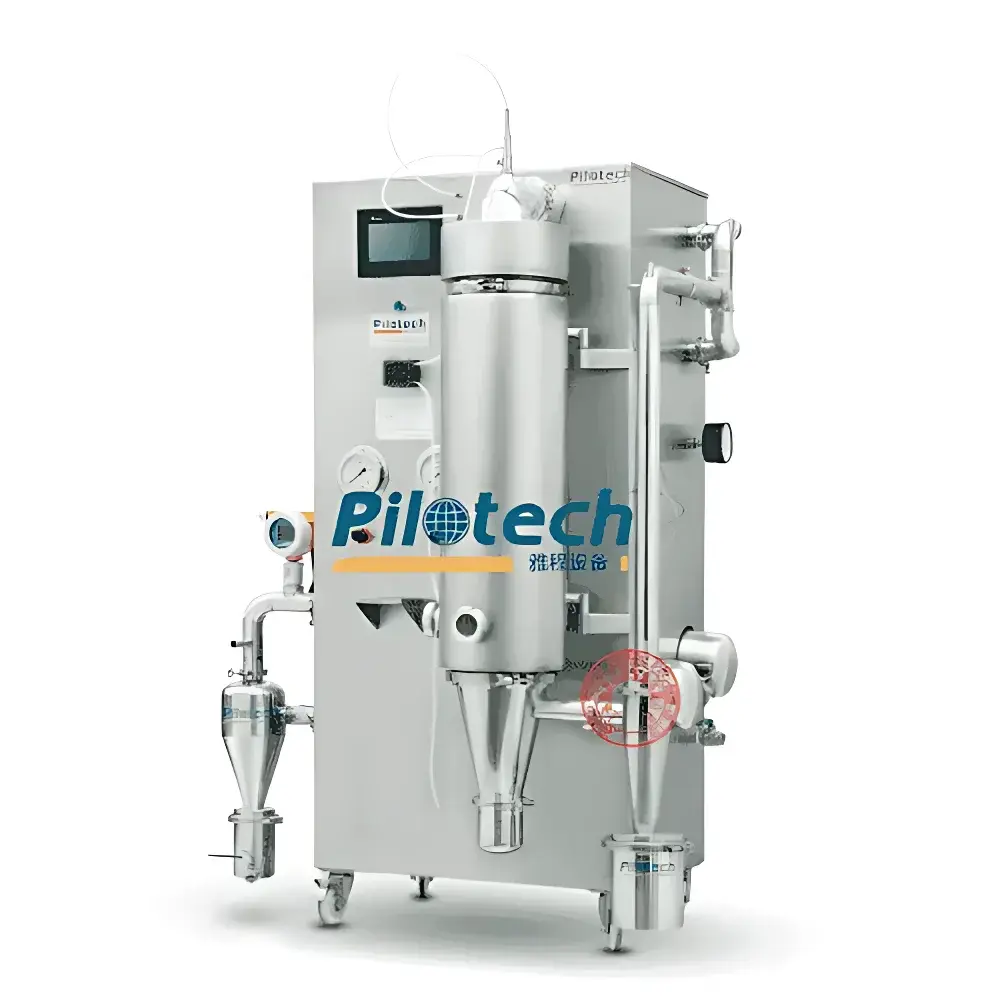
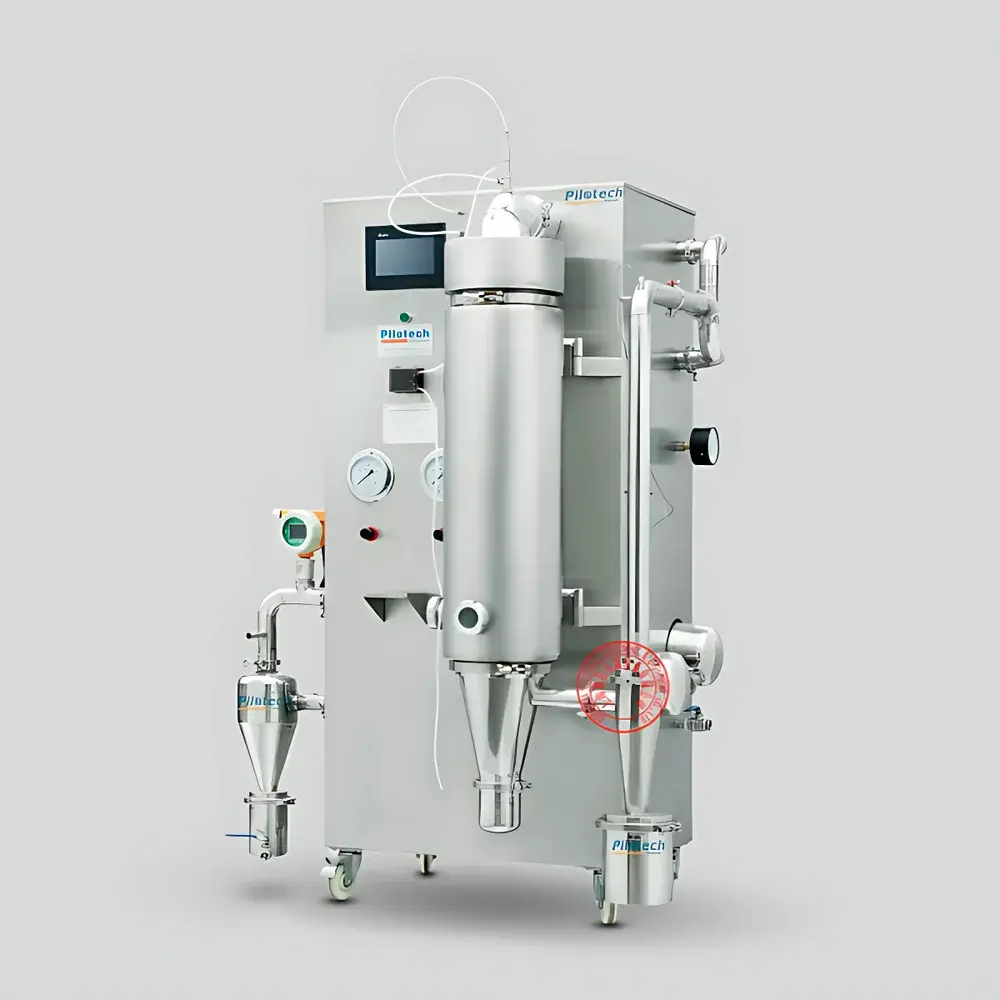
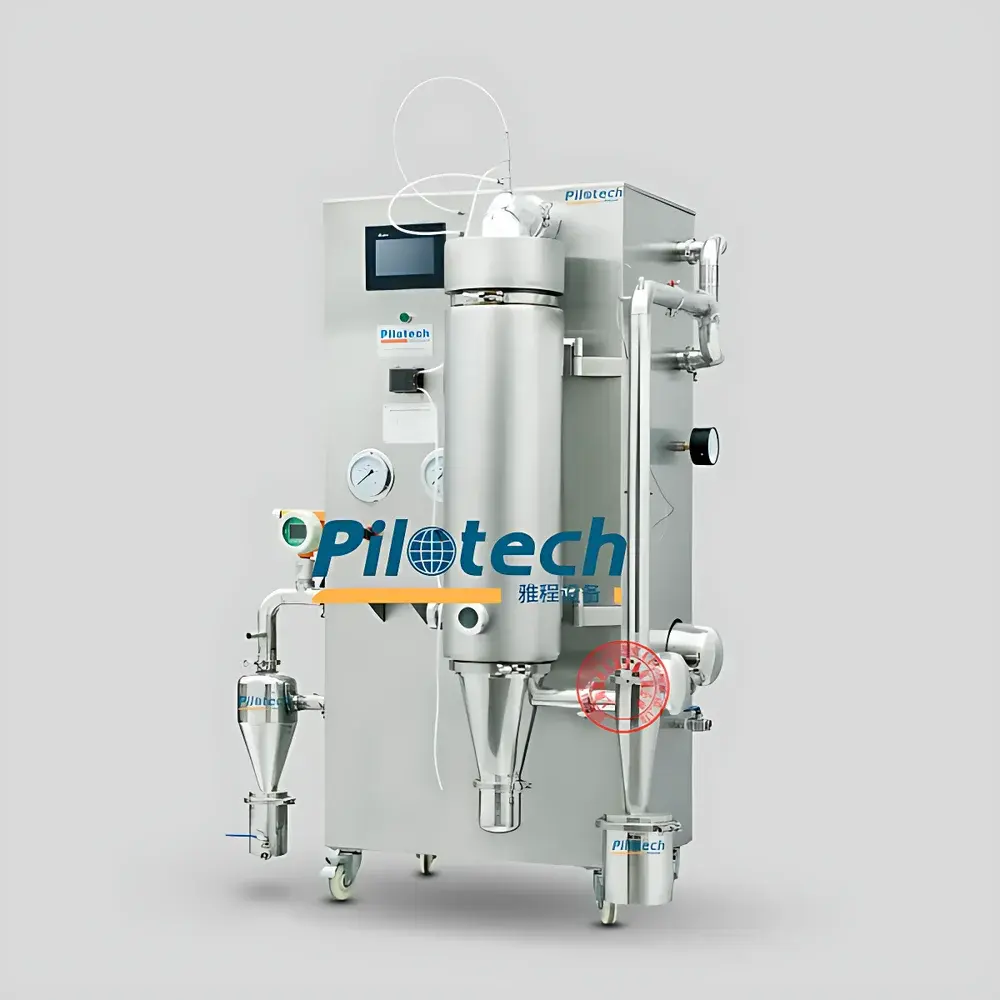
Pilotech YC-019A Closed-Cycle Organic Solvent Spray Dryer (Pilot-Scale)
| Brand | Pilotech |
|---|---|
| Origin | Shanghai, China |
| Manufacturer Type | Direct Manufacturer |
| Model | YC-019A |
| Sample Compatibility | Aqueous, Organic, and Mixed Solvent Systems |
| Max Feed Rate | 5000 mL/h |
| Inlet Air Temperature Range | Up to 280 °C |
| Particle Size Output | 3–100 µm |
| Oxygen Monitoring Threshold | Auto-Shutdown at ≥2.5% O₂ |
| Spray Nozzle | Standard 2.0 mm Coaxial Atomizer (Optional: 0.5/0.8/1.0/1.5 mm) |
| Temperature Control Accuracy | ±2 °C (PID) |
Overview
The Pilotech YC-019A is a pilot-scale, closed-cycle spray dryer engineered for the safe, precise, and reproducible drying of heat-sensitive, oxidation-prone, or hazardous materials dissolved in organic solvents—including acetone, ethanol, methanol, ethyl acetate, dichloromethane, and tetrahydrofuran. Unlike conventional open-loop spray dryers, the YC-019A operates under an inert nitrogen atmosphere with real-time oxygen concentration monitoring (95% solvent recovery—enabling compliance with VOC emission regulations and reducing operational cost per batch.
Key Features
- Full closed-loop nitrogen recirculation system with integrated oxygen sensor and automatic emergency shutdown at ≥2.5% O₂—certified for Class I, Division 1 hazardous area compatibility when configured per local electrical codes.
- Coaxial concentric nozzle design ensures symmetrical atomization; no wall impingement, consistent droplet size distribution, and high powder recovery (>90% typical for 5–50 µm fractions).
- 7-inch color touchscreen HMI with PLC-based control logic: intuitive navigation, real-time display of inlet temperature, peristaltic pump speed (0.1–100 rpm), needle purge frequency, and O₂ concentration (0–21% range, ±0.1% accuracy).
- Robust thermal architecture: stainless-steel heating elements, corrosion-resistant N₂ blower housing (316L SS or PTFE-coated aluminum), and post-drying cooling protocol—fan continues operation until chamber temperature drops below 60 °C, preventing thermal stress on seals and electronics.
- Modular scalability: minimal sample requirement of 100 mL supports early-stage formulation screening; maximum throughput of 5000 mL/h enables process development aligned with GMP-compliant scale-up pathways.
- Standard 2.0 mm nozzle with optional interchangeable tips (0.5/0.8/1.0/1.5 mm) allows systematic optimization of specific surface area, residual solvent content, and flowability—critical for amorphous solid dispersion (ASD) and nanoparticle formulation.
Sample Compatibility & Compliance
The YC-019A accommodates thermolabile actives including peptides, monoclonal antibody fragments, enzyme inhibitors, and volatile natural extracts—materials incompatible with conventional hot-air drying. Its solvent flexibility extends to low-boiling-point systems (e.g., diethyl ether, bp 34.6 °C) when paired with an optional low-temperature chiller (−20 °C to +10 °C operating range). All wetted surfaces comply with USP Class VI biocompatibility requirements. The system supports audit-ready documentation: electronic log files include timestamped parameter sets, alarm history, and cycle completion reports—fully traceable for GLP/GMP environments. While not intrinsically certified for ATEX/IECEx, its design meets foundational requirements for integration into ISO 9001- and ISO 13485-certified laboratories conducting preclinical API drying, excipient engineering, or nanocarrier synthesis.
Software & Data Management
The embedded control firmware records all critical process parameters at 1-second intervals to internal flash memory (≥10,000 cycles retained). Export formats include CSV and PDF summary reports compatible with LIMS integration. Optional Ethernet/Wi-Fi connectivity enables remote monitoring via secure HTTPS interface—supporting multi-user role-based access (operator, supervisor, QA auditor). Audit trail functionality complies with FDA 21 CFR Part 11 requirements: all parameter changes are time-stamped, user-identified, and non-erasable. No cloud storage is enabled by default; data residency remains fully on-device unless explicitly configured otherwise per institutional IT policy.
Applications
- Pharmaceutical R&D: Production of amorphous solid dispersions for enhanced bioavailability; stabilization of labile biologics via rapid solvent removal without aggregation.
- Agrochemical development: Encapsulation of photosensitive pesticides and pheromones into microcapsules with controlled release profiles.
- Materials science: Synthesis of metal-organic framework (MOF) precursors, conductive polymer nanoparticles, and battery cathode active materials (e.g., LiFePO₄) requiring oxygen-free calcination precursors.
- Food & nutraceuticals: Microencapsulation of omega-3 oils, anthocyanins, and probiotic strains using GRAS-approved solvents (e.g., ethanol/water mixtures).
- Academic research: Fundamental studies on droplet evaporation kinetics, glass transition behavior of amorphous powders, and solvent–polymer interaction thermodynamics.
FAQ
Can the YC-019A handle chlorinated solvents such as chloroform or DCM?
Yes—provided the optional corrosion-resistant blower and condenser components are selected. Standard configuration uses 316L stainless steel and fluoropolymer seals rated for intermittent exposure to halogenated solvents.
Is solvent recovery efficiency validated across different boiling points?
Recovery rates exceed 92% for solvents with boiling points between 35 °C and 120 °C (tested per ASTM D1353); lower-boiling solvents require chiller integration to maintain condensation delta-T >15 °C.
Does the system support continuous operation mode?
No—the YC-019A is designed for discrete batch processing only. Continuous feed is not supported due to safety-critical interlocks governing nitrogen purge cycles and O₂ reset protocols.
What validation documentation is provided upon delivery?
Factory acceptance test (FAT) report, IQ/OQ protocol templates, calibration certificates for O₂ sensor and temperature probes (NIST-traceable), and material compliance declarations (RoHS, REACH, UL 61010-1).
Can particle morphology be tuned via process parameters?
Yes—by adjusting inlet temperature, feed rate, and atomizing gas pressure, users can systematically influence surface roughness, porosity, and crystallinity—as confirmed by SEM, BET, and XRD correlation studies published in International Journal of Pharmaceutics (2023, Vol. 632, 122547).



