
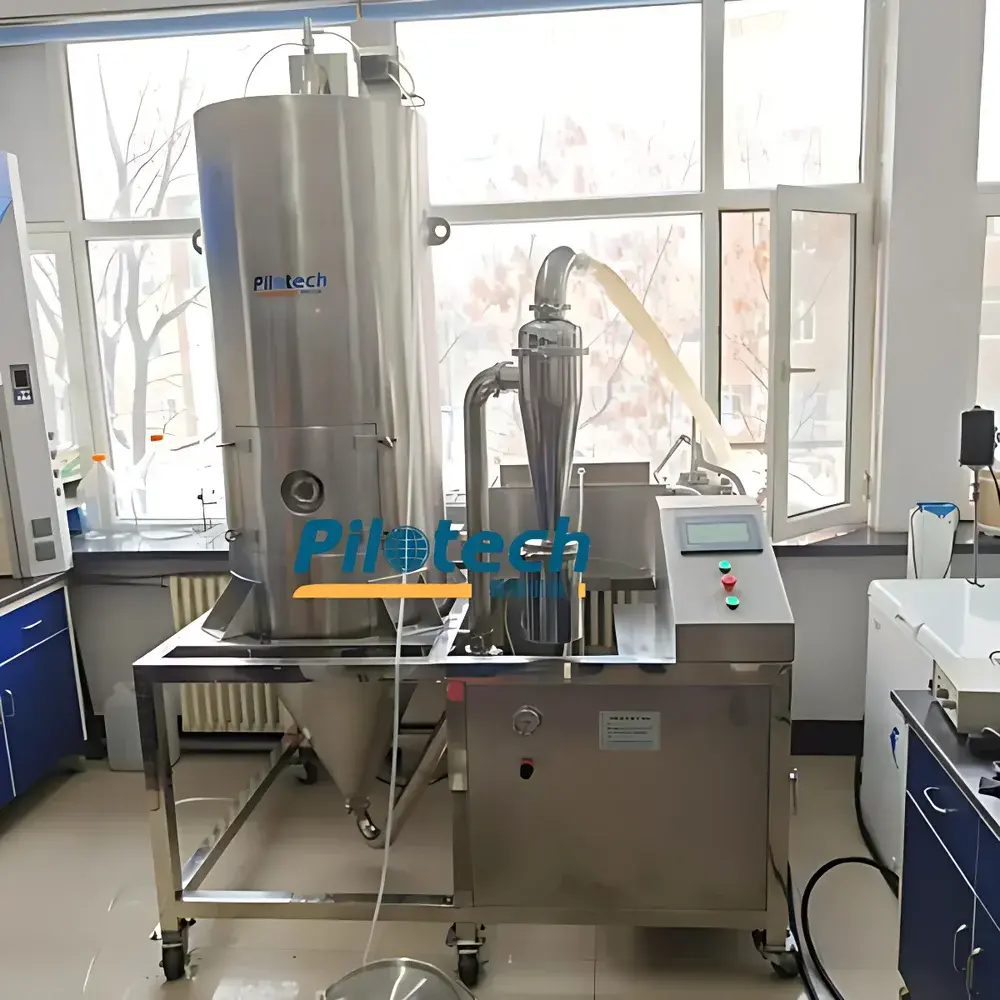
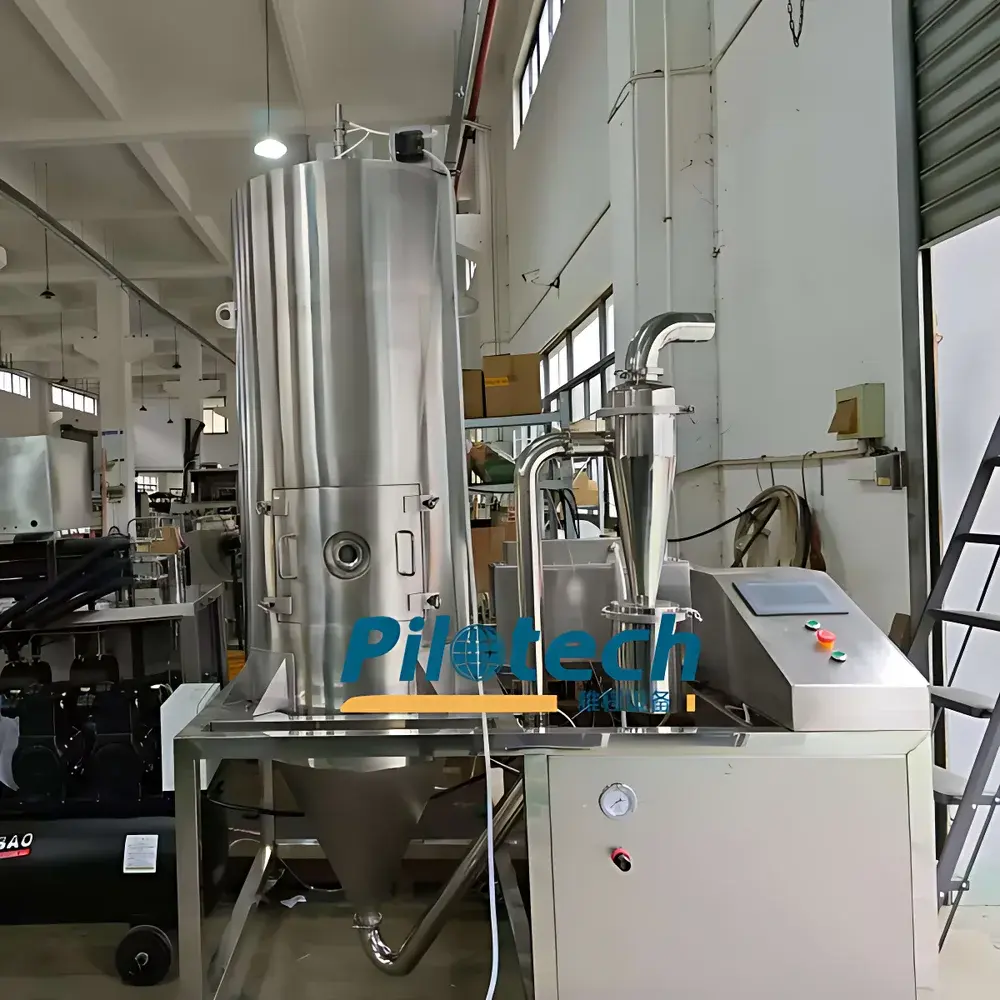
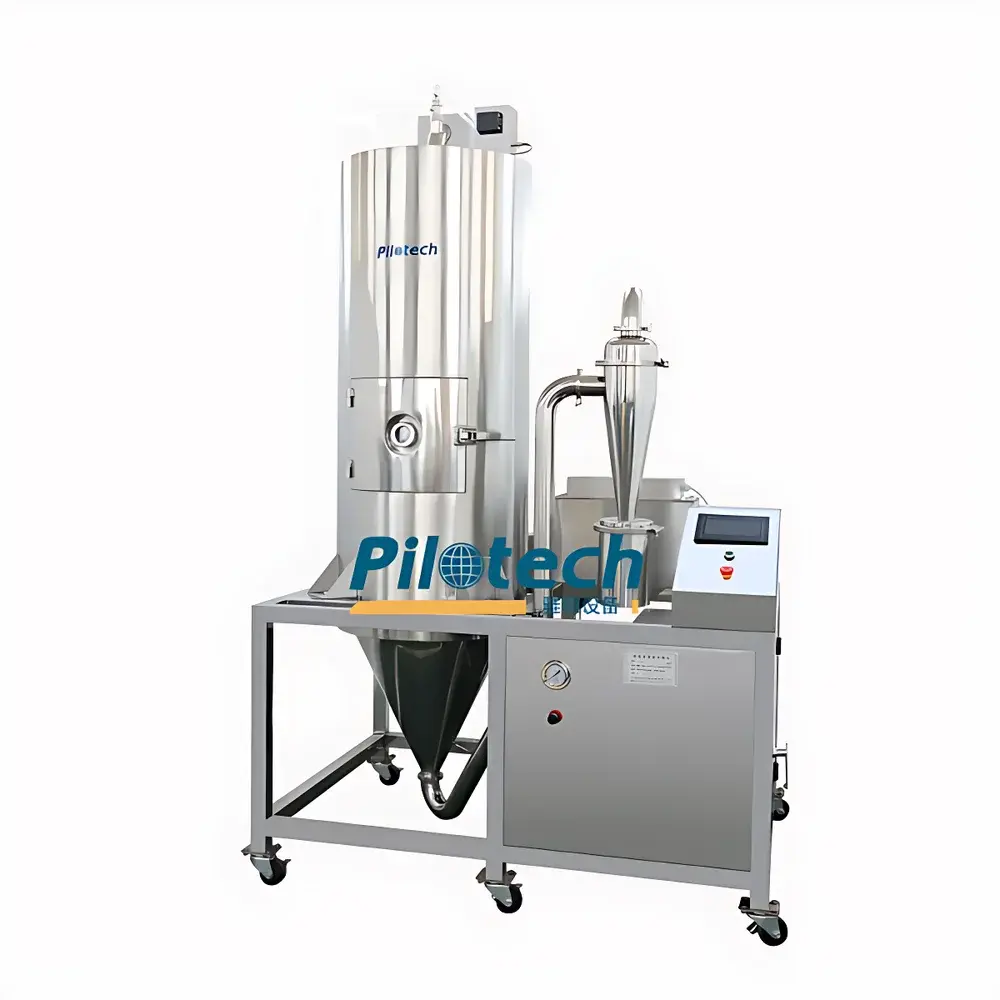
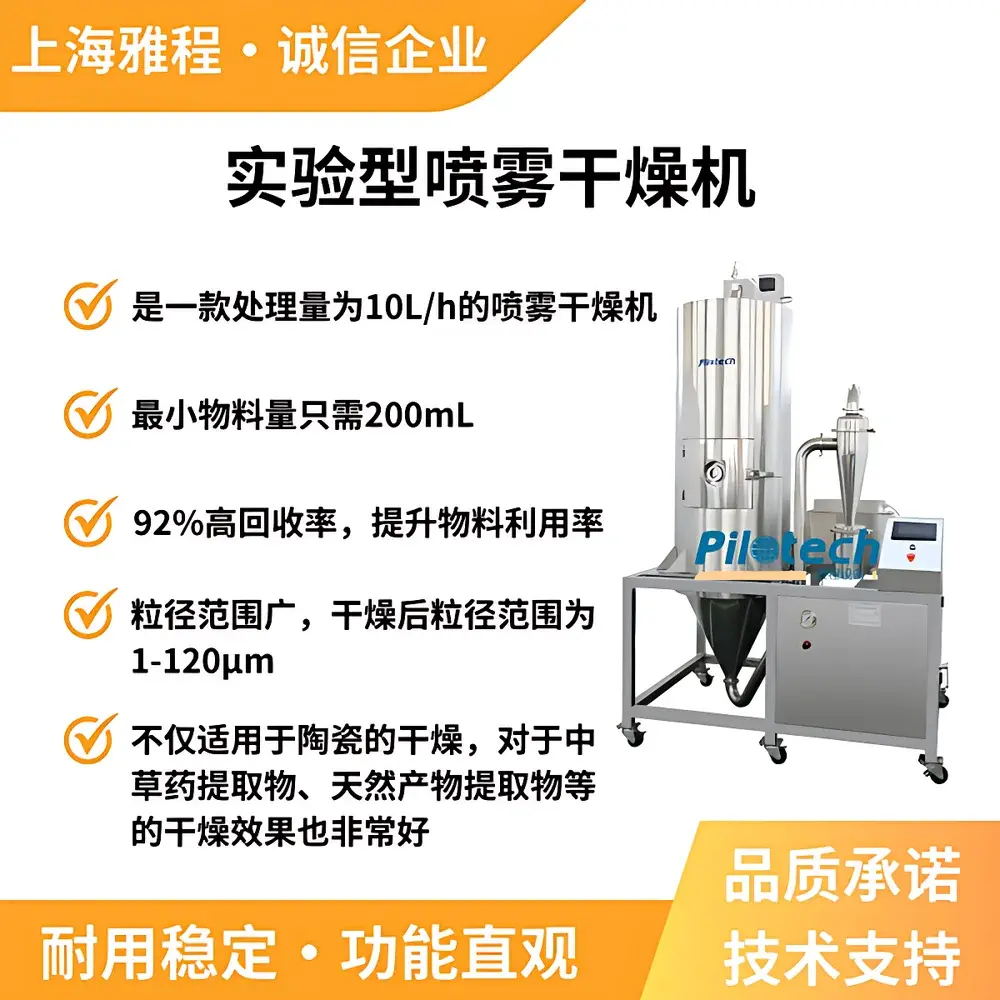
雅程10L/H喷雾干燥机YC-029
| Brand | PiloTech |
|---|---|
| Origin | Shanghai, China |
| Manufacturer Type | OEM/ODM Manufacturer |
| Country of Origin | China |
| Model | YC-029 |
| Max Feed Rate | 10,000 mL/h |
| Inlet Air Temperature Range | 105–300 °C |
| Particle Size Output | 1–120 µm |
| Sample Compatibility | Aqueous Solutions Only |
| Heating Power | 20 kW |
| Noise Level | <60 dB(A) |
| Control Interface | Bilingual (English/Chinese) Touchscreen LCD |
| Construction Material | AISI 304 Stainless Steel (Drying Chamber, Cyclone, Collection Vessel & Tubing) |
| Temperature Control Accuracy | ±2 °C (PID-based) |
| Nozzle Orifice | 3.0 mm (optional) |
| Minimum Sample Volume | 200 mL |
| Real-time Display | Inlet Temp, Peristaltic Pump Speed, Fan Frequency |
Overview
The PiloTech YC-029 is a pilot-scale spray dryer engineered for laboratory and pre-production development of free-flowing, spherical particulates from aqueous feedstocks. It operates on the principle of rapid solvent evaporation via atomization—where liquid feed is dispersed into fine droplets using a concentric nozzle, then exposed to controlled hot air in a co-current drying chamber. This process enables continuous conversion of solutions, suspensions, or emulsions into dry powders with predictable morphology, narrow particle size distribution, and high bulk density—critical for downstream processing in pharmaceutical, materials science, and functional food applications. Designed for reproducibility across scale-up studies, the YC-029 bridges the gap between benchtop feasibility testing and industrial process validation, supporting GMP-aligned development workflows without requiring full-scale infrastructure investment.
Key Features
- Wide operational inlet air temperature range (105–300 °C), enabling optimization of thermal sensitivity for heat-labile biologics or high-melting-point ceramics
- Precision PID-controlled heating system with ±2 °C stability, ensuring consistent thermal history for each batch
- Adjustable concentric nozzle (standard 3.0 mm orifice; optional extended-length variant ≥310 mm) to eliminate off-center spray deposition and maximize wall-free drying efficiency
- Full-color touchscreen HMI with real-time dynamic visualization of process parameters: inlet temperature, peristaltic pump RPM, and cyclone fan frequency
- Low-noise engineering design (<60 dB[A]) suitable for shared laboratory environments and compliance with ISO 14040 ambient noise guidelines
- Energy-efficient architecture: 20 kW nominal power draw at maximum 10 L/h throughput—optimized for lab-grade utility infrastructure
- Fail-safe shutdown protocol: automatic cessation of heater and pump upon “Stop” command, while maintaining fan operation to prevent thermal damage to heating elements
- AISI 304 stainless steel wetted parts (drying chamber, cyclone separator, collection vessel, and transfer tubing) meeting ASTM A240 standards for corrosion resistance and cleanability
Sample Compatibility & Compliance
The YC-029 is validated for aqueous-based feedstocks only—including ceramic slurries, herbal extracts, protein solutions, mineral suspensions, and polymer dispersions—without requirement for excipients or bulking agents. Its design supports GLP-compliant documentation through timestamped parameter logging (inlet temp, feed rate, airflow) and operator-accessible audit trails. While not certified to FDA 21 CFR Part 11 out-of-the-box, the system’s deterministic control logic, non-volatile parameter storage, and password-protected configuration layers facilitate qualification under ICH Q5C, USP , and ISO 20933 for analytical method development and formulation screening. All structural components conform to ASME BPE-2021 surface finish requirements (Ra ≤ 0.8 µm) where applicable.
Software & Data Management
The embedded control firmware records all critical process variables at 1-second intervals during operation, exporting data in CSV format via USB interface for post-run analysis in MATLAB, JMP, or Python-based statistical platforms. The HMI includes customizable alarm thresholds (e.g., inlet temp deviation >±5 °C), event logging (start/stop times, parameter changes), and user-level access control (admin/operator/guest). Optional Ethernet connectivity enables integration with LabVantage or Thermo Fisher SampleManager LIMS systems via Modbus TCP, supporting traceable sample lifecycle management aligned with ISO/IEC 17025 accreditation requirements.
Applications
- Ceramic powder synthesis: production of sinterable zirconia, alumina, and silicon carbide microspheres with tunable 1–120 µm Dv50 for thermal barrier coatings and additive manufacturing feedstock
- Phytochemical stabilization: direct drying of aqueous plant extracts (e.g., curcuminoids, flavonoids) preserving antioxidant activity without surfactant addition
- Biopolymer microencapsulation: fabrication of chitosan- or alginate-based carriers for controlled release of enzymes or probiotics
- Inorganic pigment development: scalable synthesis of iron oxide, titanium dioxide, and copper chromite pigments with batch-to-batch color consistency
- Functional food ingredient engineering: conversion of whey protein hydrolysates or dietary fiber dispersions into free-flowing agglomerates for dry-blend formulations
FAQ
Can the YC-029 handle organic solvents?
No. The system is strictly rated for aqueous feed solutions only. Solvent-based feeds require explosion-proof certification, nitrogen inerting, and condensate recovery—features not included in this configuration.
Is particle size distribution adjustable within a single run?
Particle size is primarily governed by feed concentration, inlet temperature, and atomization pressure—all independently controllable. While Dv50 shifts continuously during a run due to evolving solution viscosity, repeatable targeting of specific ranges (e.g., 5–15 µm vs. 70–90 µm) is achieved via pre-defined SOPs.
What maintenance intervals are recommended?
Daily wipe-down of stainless surfaces; weekly inspection of nozzle orifice integrity and cyclone seal compression; biannual calibration of thermocouples and flow sensors using NIST-traceable references.
Does the system support IQ/OQ documentation?
Yes. PiloTech provides vendor-executed Installation Qualification (IQ) templates and Operational Qualification (OQ) test protocols—including temperature mapping, feed rate linearity verification, and particle size correlation studies—compatible with Annex 15 and ASTM E2500 frameworks.
Related Products



