
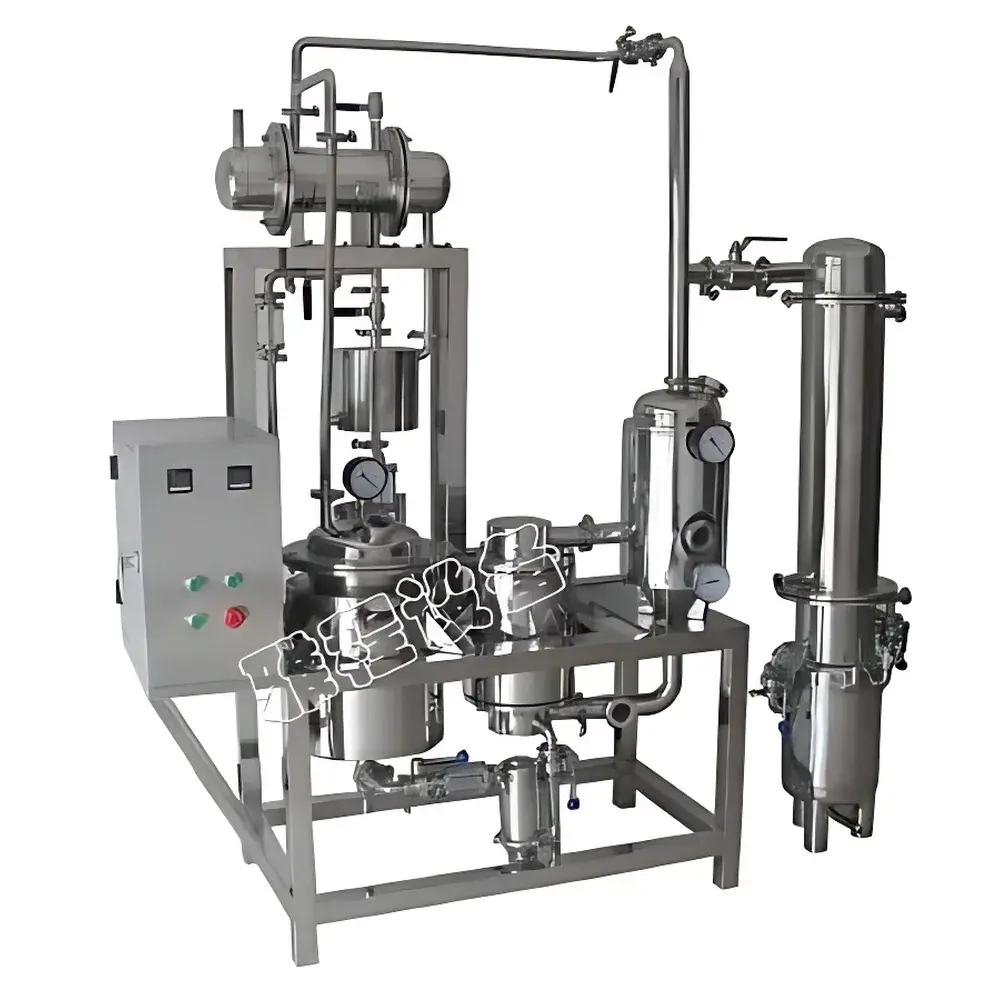
YaCheng YC-020 20L Benchtop Multifunctional Extraction and Concentration System
| Key | Brand: YaCheng / PILOTECH |
|---|---|
| Origin | Shanghai, China |
| Manufacturer Type | Direct Manufacturer |
| Model | YC-020 |
| Volume | 20 L (0.025 m³) |
| Batch Feed Capacity | 0.3–5 kg |
| Heating Power | 4.5 kW @ 380 V |
| Temperature Control Accuracy | ±2 °C |
| Vacuum Level | –0.08 MPa |
| Evaporation Rate (Water) | 4–6 kg/h |
| Concentrate Density Range | 1.10–1.38 g/mL |
| Construction Material | SUS304 Stainless Steel |
| Footprint | ~2.4 m² (1500 × 800 mm base) |
| Overall Dimensions | 1500 × 800 × 1900 mm |
| Cooling Water Consumption | 1 t/h @ <0.3 MPa |
| Heating Method | External Thermal Oil Circulation (Jacketed, Pressure-Free) |
Overview
The YaCheng YC-020 20L Benchtop Multifunctional Extraction and Concentration System is an integrated, closed-loop laboratory-scale unit engineered for reproducible solid–liquid extraction, solvent recovery, and vacuum-assisted concentration of heat-sensitive botanical matrices. Designed in accordance with fundamental principles of mass transfer and thermodynamic equilibrium, the system supports both static maceration and dynamic reflux extraction under controlled thermal and pressure conditions. Its modular architecture integrates jacketed extraction, condensate phase separation, external forced-circulation evaporation, and low-temperature solvent recovery—enabling seamless transition between aqueous, alcoholic, or organic solvent-based protocols. The absence of internal pressure in the heating jacket—achieved via external thermal oil circulation—eliminates explosion risk during flammable solvent handling, aligning with OSHA 1910.106 and IEC 60079-0 intrinsic safety considerations for lab-scale volatile processing.
Key Features
- Compact footprint (≤2.4 m²) with full functionality: extraction, concentration, and solvent recovery in a single skid-mounted assembly.
- Thermal oil–heated, pressure-free jacketed extraction vessel (SUS304, 20 L capacity) ensures uniform temperature distribution and eliminates steam-pressure hazards.
- Dual-mode operation: atmospheric reflux extraction with integrated condenser/cooling train and oil–water separator for volatile aromatic oil recovery; plus vacuum-assisted concentration (down to –0.08 MPa absolute) to preserve thermolabile compounds.
- Forced-circulation external evaporator with adjustable flow rate enables dynamic film evaporation—maintaining high heat-transfer coefficients even at elevated viscosities (up to 1.38 g/mL density).
- Full stainless-steel wetted path (SUS304), compliant with FDA CFR 21 Part 11 traceability-ready instrumentation interface, and compatible with GLP/GMP documentation workflows.
- Programmable PID temperature controller (±2 °C accuracy) with real-time logging, coupled with pressure transducers and flow meters calibrated per ISO/IEC 17025 traceable standards.
Sample Compatibility & Compliance
The YC-020 accommodates powdered, granulated, or chopped plant materials—including dried herbs, tea leaves, fruit pomace, and fungal biomass—with batch loading flexibility from 0.3 kg (minimum effective charge) to 5 kg. It meets material compatibility requirements for USP , EP 2.2.57, and Chinese Pharmacopoeia IV (2020) extraction validation protocols. All fluid-contact surfaces conform to ASTM A240/A240M for austenitic stainless steel and are electropolished to Ra ≤ 0.6 µm. The system operates across pressure regimes—from ambient (101.3 kPa) to deep vacuum (20 kPa abs)—and supports cleaning-in-place (CIP) validation per ASME BPE-2022 Annex C. Documentation packages include Factory Acceptance Test (FAT) reports, material certificates (EN 10204 3.1), and EU Declaration of Conformity for Machinery Directive 2006/42/EC.
Software & Data Management
The control panel features a 7-inch HMI touchscreen with embedded data-logging firmware supporting CSV export, time-stamped event records, and configurable alarm thresholds. Optional integration with LabArchives ELN or Thermo Fisher SampleManager LIMS is supported via Modbus TCP or OPC UA. Audit trails comply with 21 CFR Part 11 requirements—including electronic signatures, user role-based access control, and immutable record retention. All sensor outputs (temperature, pressure, flow, level) are sampled at ≥2 Hz and stored with NIST-traceable timestamps. Calibration logs and maintenance history are archived within the onboard database and exportable for regulatory inspection readiness.
Applications
This system serves as a scalable bridge between analytical-scale extraction (e.g., ASE, Soxhlet) and pilot production. Typical use cases include: isolation of polyphenols and flavonoids from Camellia sinensis under nitrogen-purged reflux; ethanol-based alkaloid extraction from Catharanthus roseus followed by rotary evaporation replacement; vacuum concentration of anthocyanin-rich berry juice to 1.25 g/mL density without enzymatic degradation; recovery of limonene and citral from citrus peel distillates using the integrated oil–water separator; and process development for GMP-compliant botanical active ingredient (BAI) manufacturing per ICH Q5C and WHO TRS 1019 guidelines. Universities utilize it for teaching unit operations in chemical engineering curricula, while QC labs deploy it for method transfer studies supporting USP monograph compliance.
FAQ
What solvents are compatible with the YC-020 system?
The system is validated for water, ethanol, methanol, acetone, ethyl acetate, and hexane—provided flash point and vapor pressure fall within ASME B31.3 allowable limits for thermal oil–heated jacket operation.
Can the unit be validated for GMP environments?
Yes. IQ/OQ documentation templates, DQ support files, and calibration certificates aligned with ISO/IEC 17025 are provided. Full traceability of all critical process parameters satisfies Annex 15 and EU GMP Chapter 4 requirements.
Is remote monitoring supported?
Standard Ethernet port enables SNMP-based network health monitoring; optional 4G LTE module available for cloud-based telemetry and predictive maintenance alerts.
What maintenance intervals are recommended?
Thermal oil analysis every 1,000 operating hours; gasket inspection prior to each solvent batch; vacuum pump oil change every 500 hours or per manufacturer specifications.
Does the system include CIP capability?
Yes—integrated spray-ball nozzles and dedicated CIP inlet/outlet ports enable automated cleaning cycles with conductivity and pH endpoint detection.





