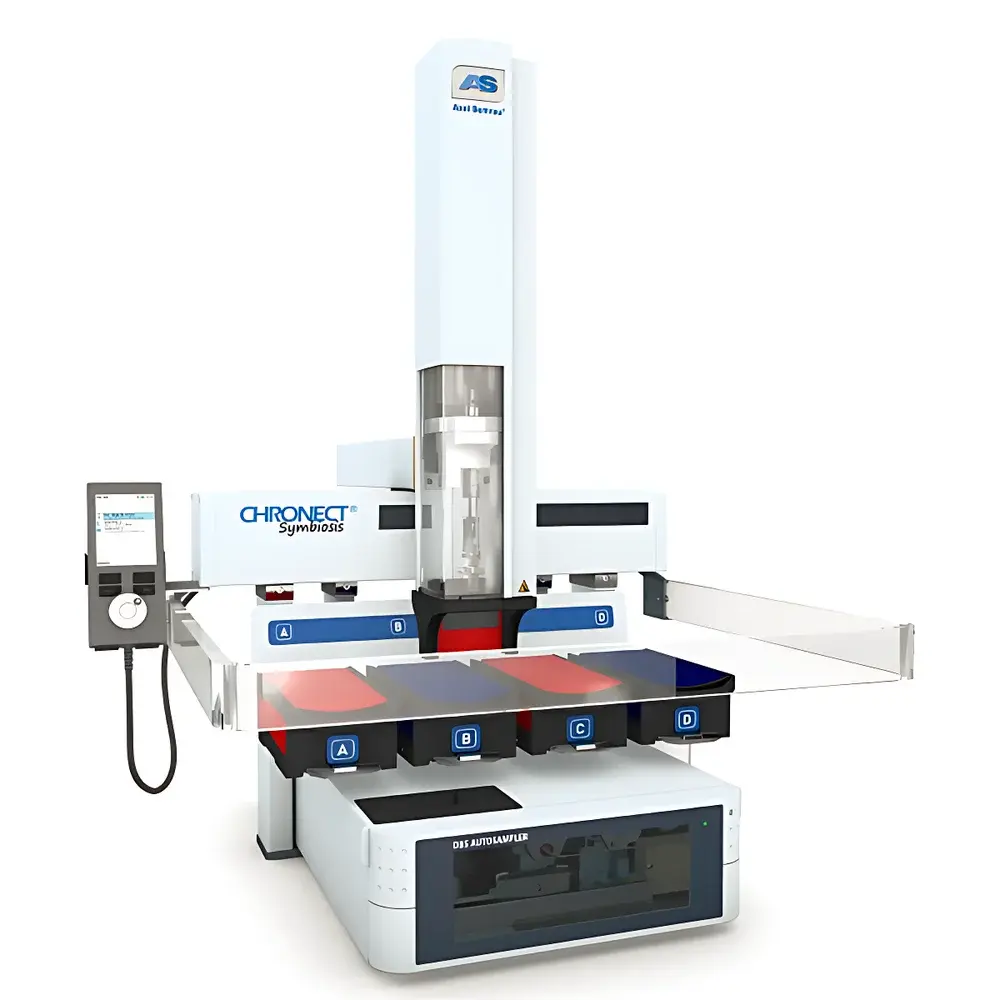
Axel Semrau Chronect DBS AS Automated Dry Blood Spot Sampler
| Brand | Axel Semrau |
|---|---|
| Origin | Germany |
| Model | Chronect DBS AS |
| Sample Capacity | 96 DBS cards (384 spots) |
| Compatible Cards | Whatman™ / PerkinElmer™ DBS cards |
| Sealing Pressure | up to 200 bar (2–6 mm punches), 100 bar (8 mm punch) |
| Punch Diameter Options | 2 mm (standard), 4 mm, 6 mm, 8 mm |
| Integrated Visual Camera (IVC™) | barcode scanning, full-card imaging, spot localization & missing-card detection |
| Internal Standard Addition (AISA™) | 20 µL loop volume, pump speed up to 95 µL/s |
| Flow-Through Desorption (FTD™) | closed-loop, needle-free, on-line elution directly to LC-MS/MS |
| HotCap™ heating | temperature-controlled desorption assist |
| Wash & Dry Cycle | automated line and chuck cleaning with compressed air drying |
| Positioning Accuracy | ±0.2 mm |
| Software | CHRONOS v3.x, FDA 21 CFR Part 11 compliant audit trail, vendor-neutral MS interface (SCIEX, Thermo, Waters, Agilent) |
Overview
The Axel Semrau Chronect DBS AS is an engineered solution for fully automated dry blood spot (DBS) sample preparation in regulated bioanalytical laboratories. It implements flow-through desorption (FTD™), a closed-system, needle-free technique that eliminates manual punching, solvent transfer, and offline extraction—key bottlenecks in high-throughput DBS workflows. Unlike conventional DBS handling requiring centrifugation, vortex mixing, or solid-phase extraction (SPE) cartridges, the Chronect DBS AS performs on-line desorption directly from the card matrix into the LC-MS/MS system via a pressurized, hermetically sealed fluidic path. This architecture ensures quantitative recovery of analytes—including small molecules, peptides, and metabolites—while minimizing carryover, adsorptive loss, and operator-induced variability. Designed for compliance-critical environments, the system operates within defined process parameters validated per ICH M10 and aligned with USP method validation principles.
Key Features
- Flow-Through Desorption (FTD™): Patented stainless-steel (SS316) contact chucks form leak-tight seals with DBS cards, enabling direct on-card elution under pressures up to 200 bar (2–6 mm) or 100 bar (8 mm), ensuring reproducible mass transfer without mechanical disruption.
- High-Density Sample Handling: Accommodates 96 standard DBS cards (e.g., Whatman 903™ or PerkinElmer DMPK cards), supporting up to 384 discrete spots per run—scalable for population-scale newborn screening or clinical trial cohorts.
- Intelligent Visual Control (IVC™): Integrated high-resolution camera captures full-card images, decodes 2D barcodes, validates spot presence/position, detects missing cards, and logs spatial metadata for full traceability—critical for GLP/GCP audits.
- Automated Internal Standard Addition (AISA™): Precise 20 µL loop injection at programmable rates (up to 95 µL/s) ensures stoichiometric spiking prior to desorption, correcting for inter-spot heterogeneity and matrix effects.
- HotCap™ Thermal Assist: Peltier-controlled heating of the contact chuck (range: ambient to 60 °C) enhances desorption kinetics for low-abundance analytes and viscous matrices without compromising hemoglobin integrity.
- Self-Cleaning Architecture: Post-run, the system executes multi-solvent wash cycles followed by compressed-air drying of all fluidic paths and chucks—validated to reduce carryover to <0.01% across 100+ consecutive injections.
Sample Compatibility & Compliance
The Chronect DBS AS is validated for use with cellulose-based DBS cards conforming to ISO 15197:2013 and CLSI EP23-A guidelines. It supports both whole-blood and plasma-spotted cards, including those treated with anticoagulants (EDTA, K₂EDTA) or preservatives (e.g., sodium heparin). All hardware and software components comply with IEC 61010-1 safety standards. CHRONOS software includes full 21 CFR Part 11 functionality: electronic signatures, role-based access control, immutable audit trails, and data integrity logging—enabling deployment in FDA-, EMA-, and PMDA-regulated settings. System qualification documentation (IQ/OQ/PQ protocols) is provided per GAMP 5 v5.2.
Software & Data Management
Controlled exclusively via CHRONOS v3.x, the platform provides a deterministic, script-driven workflow engine. Methods define desorption time, solvent gradient, chuck temperature, internal standard volume, and image acquisition parameters—all stored as version-controlled XML files. Raw image data (TIFF), desorption chromatograms, and metadata are archived in a relational database with configurable retention policies. The software exposes RESTful APIs for integration with LIMS (e.g., LabWare, STARLIMS) and third-party CDS platforms. Audit trails record every user action, parameter change, and hardware event with timestamp, IP address, and operator ID—meeting ALCOA+ (Attributable, Legible, Contemporaneous, Original, Accurate, Complete, Consistent, Enduring, Available) requirements.
Applications
The Chronect DBS AS delivers validated performance in applications demanding high specificity and low detection limits: newborn metabolic screening (e.g., amino acids, acylcarnitines), therapeutic drug monitoring (TDM) of immunosuppressants and antiepileptics, anti-doping analysis per WADA Technical Document TD2023DL, virological load quantification (HIV, HBV, HCV), pharmacokinetic/pharmacodynamic (PK/PD) studies in decentralized trials, and serological surveillance for emerging pathogens. Its compatibility with online DBS-SPE-LC-MS/MS upgrade paths enables seamless transition to hybrid workflows requiring phospholipid removal or analyte enrichment.
FAQ
Does the Chronect DBS AS require manual punching or cutting of DBS cards?
No. The system uses non-invasive, pressure-sealed contact chucks to perform flow-through desorption without physical perforation.
Can it interface with my existing LC-MS/MS platform from Thermo or SCIEX?
Yes. CHRONOS supports vendor-neutral trigger signals and data ingestion via standard ASCII/CSV export; no proprietary drivers required.
Is method validation support available for regulatory submissions?
Axel Semrau provides application notes, system suitability test protocols, and PQ templates aligned with ICH M10 and FDA Bioanalytical Method Validation Guidance.
What maintenance is required for long-term reliability?
Routine tasks include quarterly calibration of the IVC™ camera focus, biannual replacement of SS316 chucks (wear-dependent), and daily verification of seal integrity using blank card runs.
How is data integrity ensured during unattended overnight runs?
All acquisitions are timestamped, digitally signed, and backed up in real time to redundant NAS storage—with checksum validation performed post-run.