
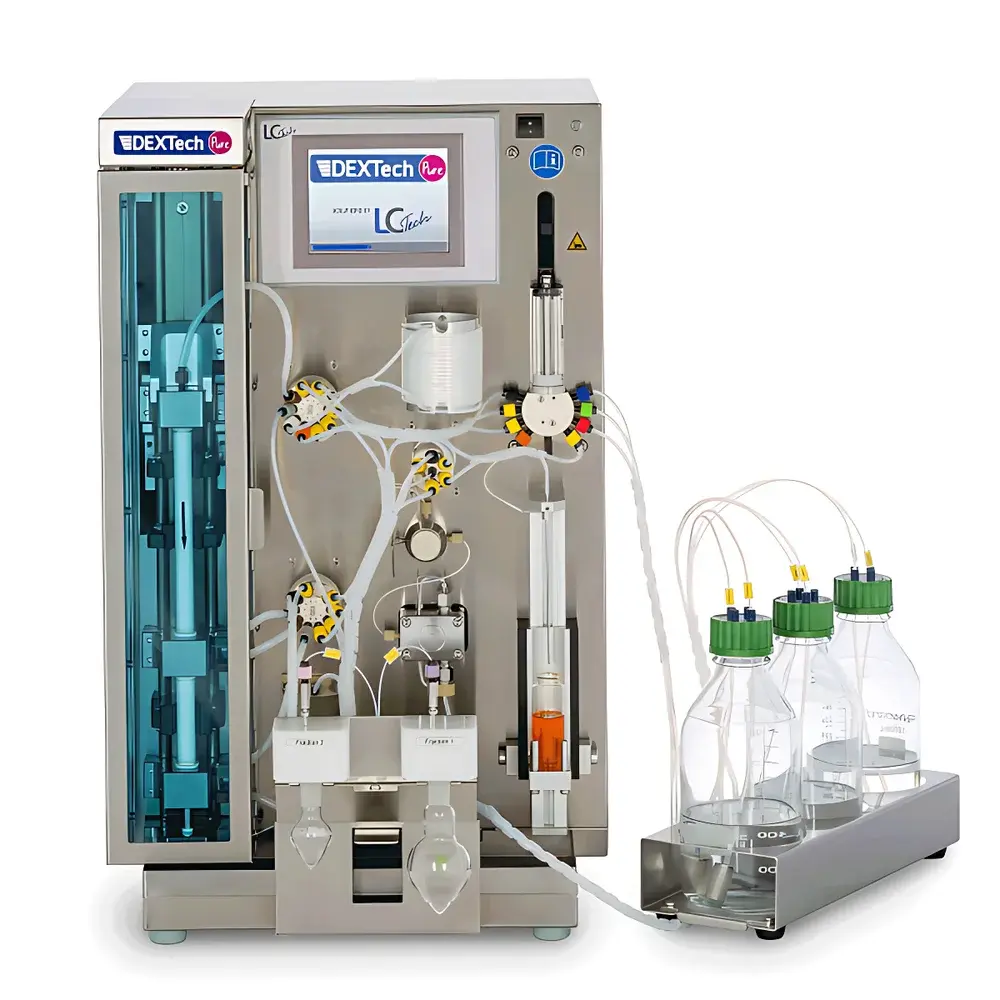
LCTech DEXTech Pure Automated Dioxin and PCBs Cleanup System
| Brand | LCTech |
|---|---|
| Origin | Germany |
| Model | DEXTech Pure |
| Weight | 40 kg |
| Compliance | GB 5009.205–2013, GB 5009.190–2014, GB/T 28643–2012, HJ 77.1–2008, HJ 77.2–2008, HJ 77.3–2008, HJ 77.4–2008 |
Overview
The LCTech DEXTech Pure Automated Dioxin and PCBs Cleanup System is a fully integrated, high-precision sample preparation platform engineered for the selective fractionation and purification of polychlorinated dibenzo-p-dioxins (PCDDs), polychlorinated dibenzofurans (PCDFs), and polychlorinated biphenyls (PCBs) from complex environmental and food matrices. Designed around the principles of solid-phase extraction (SPE) and multi-column chromatographic cleanup—specifically leveraging silica, alumina, and carbon-based sorbents—the system implements standardized, method-driven workflows aligned with internationally recognized regulatory protocols. It operates on a closed, pressure-controlled fluidic architecture to ensure reproducible elution profiles, minimal analyte loss, and strict avoidance of cross-contamination between samples. The DEXTech Pure is not an analytical instrument per se, but a critical front-end automation solution that directly supports high-resolution gas chromatography coupled with high-resolution mass spectrometry (HRGC-HRMS) analysis—particularly under isotope dilution quantification schemes mandated by EPA Method 1613, EN 1948, and the Chinese HJ and GB series standards.
Key Features
- Three-column sequential cleanup configuration: dedicated silica, alumina, and activated carbon columns enable orthogonal separation of PCDD/Fs and non-ortho/mono-ortho PCB congeners into discrete, matrix-depleted fractions.
- Patented automatic column locking mechanism: ensures rapid, leak-free column engagement under precise pressure control (up to 12 bar), eliminating manual clamping and reducing operator variability.
- Pre-conditioned, QC-verified disposable columns: shipped ready-to-use with full traceable performance certification; no pre-equilibration or solvent priming required.
- Non-contact sample handling: syringe pump and sample vial remain physically isolated throughout aspiration, loading, and elution—preventing carryover and preserving integrity of low-level target analytes.
- Integrated vial rinsing during sample loading: programmable post-aspiration wash cycles guarantee quantitative transfer of viscous or adsorptive extracts (e.g., lipid-rich food digests).
- Optimized solvent economy: typical method runtime ≤ 90 min with total solvent consumption < 120 mL per sample, significantly lowering operational cost and waste disposal burden.
- Intuitive 10.1-inch capacitive touchscreen interface: preloaded with validated methods per GB, HJ, and EU standards; supports user-defined gradient timing, flow rate, and fraction collection logic.
- Comprehensive safety architecture: includes real-time pressure monitoring, solvent level sensors, emergency venting pathways, and hardware interlocks compliant with IEC 61000-6-2/6-4 EMC requirements.
Sample Compatibility & Compliance
The DEXTech Pure accommodates a broad range of sample types requiring stringent cleanup prior to HRGC-HRMS analysis—including lipid-extracted matrices such as animal fats, dairy products, fish oils, and feedstuffs; solid-phase digests of soils, sediments, fly ash, and sewage sludge; and liquid-phase extracts from water, wastewater, and air particulate filters (e.g., PUF/XAD cartridges). All automated workflows are fully traceable and support audit-ready documentation in accordance with GLP principles. The system meets the procedural requirements of GB 5009.205–2013 (food), GB 5009.190–2014 (PCBs in food), GB/T 28643–2012 (dioxin analysis in feed), and the full HJ 77 series (water, air, soil, and waste matrices). Its method execution fidelity enables compliance with ISO/IEC 17025 accreditation criteria for testing laboratories performing POPs analysis.
Software & Data Management
The embedded firmware supports method versioning, electronic signature capture, and time-stamped audit trails for all critical actions—including column installation, method selection, run initiation, and fraction collection events. Raw log files export in CSV format for integration with LIMS environments. While the DEXTech Pure does not include proprietary data analysis software, its output fractions are fully compatible with commercial HRMS data systems (e.g., Thermo TraceFinder, Agilent MassHunter, Waters TargetLynx) and support 21 CFR Part 11-compliant configurations when deployed within validated IT infrastructures. Remote diagnostics and firmware updates are accessible via secure HTTPS connection with authenticated user credentials.
Applications
The DEXTech Pure serves as a core component in accredited dioxin laboratories conducting routine monitoring for regulatory compliance, food safety surveillance, and environmental impact assessment. Typical use cases include: purification of lipid extracts from meat, eggs, milk powder, and aquaculture products prior to congener-specific quantification; cleanup of Soxhlet or ASE extracts from contaminated soils and industrial sludges; preparation of airborne particulate matter extracts collected on quartz fiber filters; and isolation of PCB homolog groups from human serum or adipose tissue biopsies in biomonitoring studies. Its modular design also supports method adaptation for other persistent organic pollutants (POPs), including polybrominated diphenyl ethers (PBDEs) and hexachlorobenzene (HCB), provided appropriate sorbent chemistry and elution gradients are validated.
FAQ
Does the DEXTech Pure require method development for each new matrix?
No—pre-validated application notes and SOP templates are provided for common matrices (e.g., pork fat, river sediment, municipal wastewater sludge) aligned with GB and HJ standards. Matrix-specific optimization (e.g., lipid removal tuning) may be required for atypical samples.
Can the system be integrated into an unattended overnight workflow?
Yes—fully autonomous operation is supported via scheduled start times, automatic fraction collection indexing, and end-of-run notifications. Up to 24 samples can be processed sequentially without intervention.
Is column reuse permitted?
No—columns are single-use, factory-qualified consumables. Reuse compromises method robustness and violates GLP traceability requirements for regulated testing.
What maintenance is required?
Routine tasks include weekly solvent line flushing, quarterly pump calibration verification, and annual pressure sensor validation—documented in the included Maintenance Logbook and supported by LCTech’s certified service network in EMEA and APAC regions.
Related Products







