
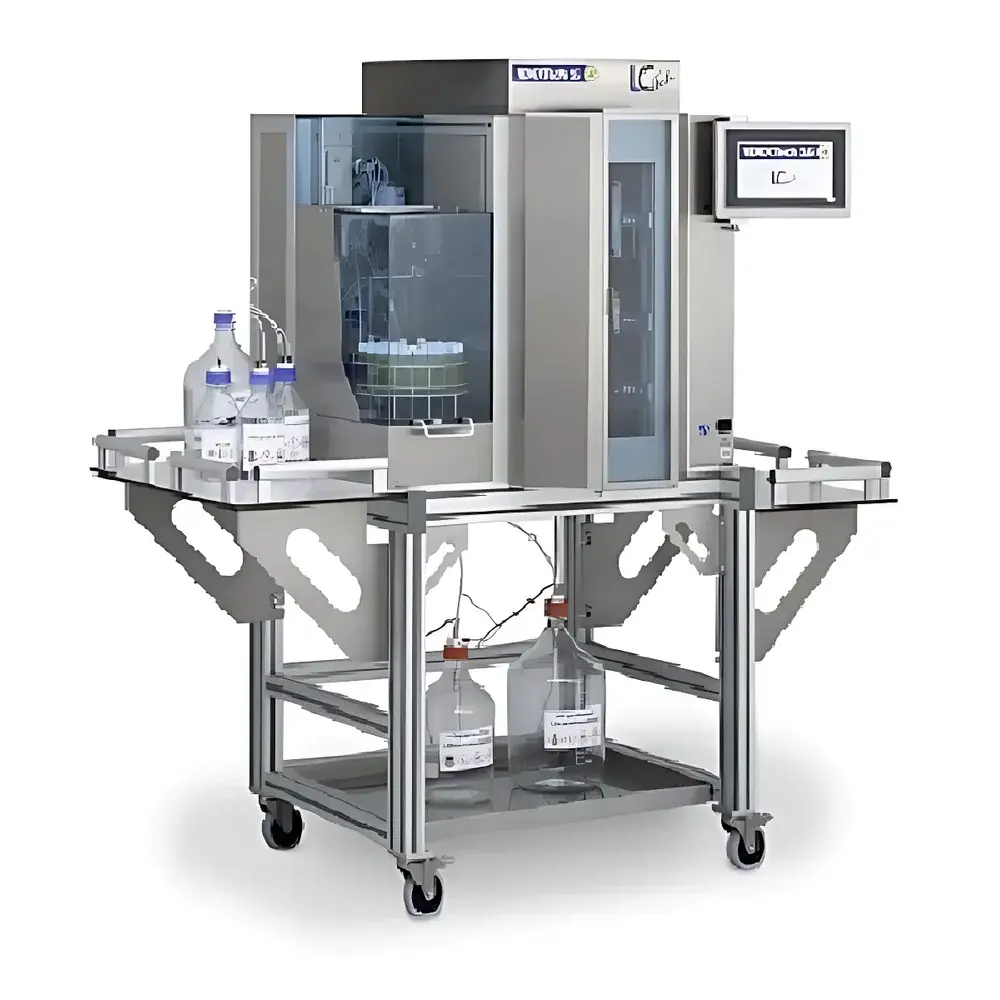
LCTech DEXTech 16 Automated 16-Position High-Throughput Cleanup System for Dioxins and PCBs
| Brand | LCTech |
|---|---|
| Origin | Germany |
| Model | DEXTech 16 |
| Weight | 280 kg |
| Compliance Standards | GB 5009.205–2013, GB 5009.190–2014, GB/T 28643–2012, HJ 77.1–2008, HJ 77.2–2008, HJ 77.3–2008, HJ 77.4–2008 |
Overview
The LCTech DEXTech 16 is an automated, high-throughput sample cleanup system engineered specifically for the rigorous purification of complex environmental and biological matrices prior to dioxin (PCDD/Fs) and indicator polychlorinated biphenyl (PCB) analysis. Based on solid-phase extraction (SPE), gel permeation chromatography (GPC), and multi-layer silica/alumina column fractionation—core techniques mandated by international standard methods—the DEXTech 16 implements fully programmable, unattended sequential processing of up to 16 samples per run. Its architecture integrates fluidic precision, thermal stability control, and inert gas management to preserve labile congeners during cleanup, minimizing analyte degradation, breakthrough, and co-extraction of interfering lipids or sulfur compounds. Designed for laboratories performing routine regulatory monitoring under GLP or ISO/IEC 17025 frameworks, the system delivers reproducible recovery rates (>70% for 2,3,7,8-substituted PCDD/Fs; >65% for non-ortho PCBs) across diverse sample types including food, feed, soil, sediment, fly ash, wastewater, and human serum.
Key Features
- True 16-position automation: Full walk-away operation from sample loading through fraction collection—no manual intervention required between runs.
- Dynamic real-time process visualization: Integrated graphical interface displays solvent flow paths, valve positions, column status, and elapsed time per step.
- Intelligent solvent management: On-board solvent level sensors, leak detection, and automatic purge/refill cycles ensure consistent elution strength and reduce operator oversight.
- Barcode-driven sample tracking: Integrated scanner reads tube barcodes at load-in, auto-populating sequence metadata and linking raw data files to physical sample IDs.
- Prioritization workflow engine: Enables urgent samples to interrupt ongoing sequences without compromising audit trail integrity or method validation status.
- Immutable electronic records: All method parameters, instrument events, and result logs are stored in a tamper-evident database compliant with FDA 21 CFR Part 11 requirements for electronic signatures and audit trails.
- Role-based user access control: Configurable permission levels (Administrator, Analyst, Reviewer) enforce separation of duties and prevent unauthorized configuration changes.
- Multi-layer safety architecture: Includes pressure monitoring, over-temperature cutoff, solvent vapor detection, emergency stop circuitry, and fail-safe valve actuation protocols.
Sample Compatibility & Compliance
The DEXTech 16 supports standardized cleanup workflows aligned with major national and international regulatory protocols. It is validated for use with lipid-rich matrices (e.g., fish tissue, dairy fat, poultry liver), particulate-laden solids (soil, fly ash, sewage sludge), and aqueous extracts (wastewater, leachates). The system accommodates sample volumes ranging from 1–50 mL (liquid) or 0.5–10 g (solid), with optional derivatization modules available for sulfur removal. All pre-programmed methods adhere strictly to the procedural specifications outlined in GB 5009.205–2013 (food), GB 5009.190–2014 (indicator PCBs), HJ 77.1–77.4–2008 (water, air, solid waste, soil), and GB/T 28643–2012 (dioxin congener-specific reporting). Method validation reports—including linearity, LOD/LOQ, spike recovery, and inter-day precision—are provided with each software release and support ISO/IEC 17025 accreditation documentation.
Software & Data Management
Control and data acquisition are managed via LCTech’s CleanSoft v5.x platform—a Windows-based application built on Microsoft .NET Framework with embedded SQLite relational database. The software enables method creation using drag-and-drop workflow builder, supports version-controlled method libraries, and exports structured CSV and XML outputs compatible with third-party GC-HRMS data systems (e.g., Thermo TraceFinder, Agilent MassHunter). All instrument events—including pump actuation, fraction switching, temperature setpoints, and sensor alarms—are timestamped and archived with cryptographic hashing to guarantee data integrity. Audit trail functionality meets GLP and GMP requirements, logging user identity, action type, timestamp, and pre-/post-change values for every configuration modification.
Applications
The DEXTech 16 serves as a critical front-end solution in accredited environmental and food safety laboratories conducting dioxin and PCB analysis per regulatory mandates. Primary applications include: routine surveillance of animal feed and dairy products for EU Directive 2002/32/EC compliance; monitoring industrial emissions and municipal waste incinerator outputs against national air quality standards; forensic analysis of contaminated sites under EPA Region 4 or EEA guidelines; and biomonitoring studies involving human blood or breast milk for WHO/IPCS exposure assessments. Its robustness extends to emerging POPs such as polybrominated dibenzo-p-dioxins (PBDDs), brominated flame retardants (e.g., BDE-209), and novel chlorinated paraffins when coupled with appropriate column chemistries and fractionation schemes.
FAQ
Does the DEXTech 16 require dedicated exhaust ventilation or fume hood integration?
Yes—operation must occur within a certified chemical fume hood or connected to a centralized solvent exhaust system meeting DIN EN 14175 Class I requirements due to use of hexane, toluene, and DCM.
Can legacy cleanup methods be imported into CleanSoft?
Method templates can be manually recreated using the workflow editor; however, direct import of proprietary vendor scripts is not supported.
Is remote monitoring supported?
CleanSoft includes optional OPC UA server module enabling secure read-only access to real-time status and historical logs via corporate intranet.
What maintenance intervals are recommended?
Pump seals and column switching valves require inspection every 500 runs; GPC columns should be regenerated after 200 injections or replaced after 1,000 injections depending on matrix load.
How is system suitability verified before sample analysis?
A daily system suitability test (SST) is performed using a certified dioxin surrogate mixture (e.g., ¹³C₁₂-2,3,7,8-TCDD) to confirm retention time stability, peak symmetry, and fraction purity prior to initiating any regulated sequence.







