
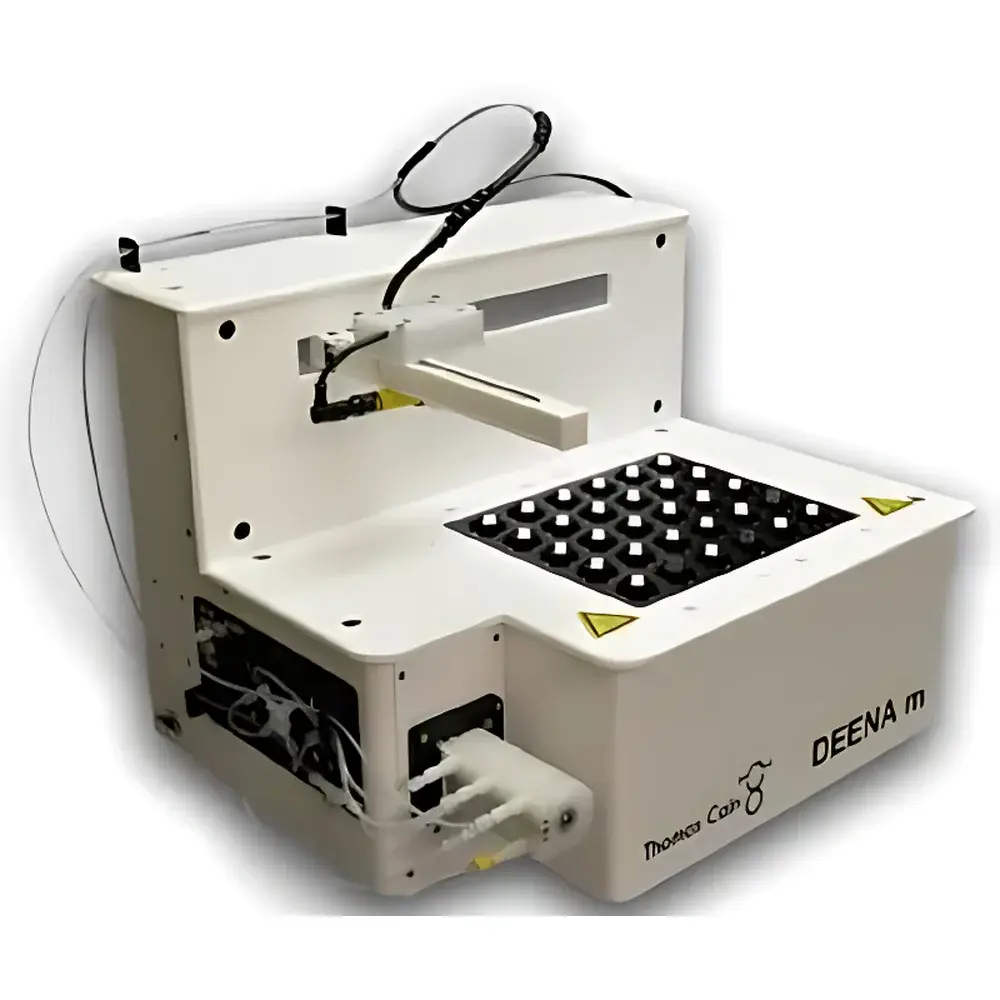
Thomas Cain DEENA m Automated Graphite Block Digestion and Sample Preparation System
| Brand | Thomas Cain |
|---|---|
| Origin | Imported |
| Manufacturer Type | Authorized Distributor |
| Model | DEENA m |
| Instrument Type | Graphite Digestion System |
| Automation Level | Fully Automatic |
| Sample Positions | 60 (2 × 30-position racks) |
| Temperature Range | Ambient to 240 °C |
| Temperature Control Accuracy | ±0.1 °C |
| Heating Mechanism | PTFE-coated Graphite Block |
| Reagent Channels | 9 (with ≤1% volumetric accuracy, ≤0.025 mL or 1% precision, max. delivery rate 4 mL/s) |
| Final Volume Adjustment Precision | <1% at 50 mL |
| Digestion Vessel Capacity | 30 × 50 mL |
| Communication Interface | RS-232 or USB |
| Power Supply | 120–240 V AC, 15 A |
Overview
The Thomas Cain DEENA m is a fully automated graphite block digestion and sample preparation system engineered for high-throughput, trace-metal analysis in environmental, food safety, and wastewater laboratories. It operates on the principle of controlled conductive heating via a PTFE-coated graphite heating block, enabling precise, uniform thermal energy transfer across all digestion vessels. Unlike open-vessel hot plates or microwave systems, the DEENA m employs a closed, programmable thermal environment with real-time temperature monitoring at the block surface—ensuring reproducible decomposition of organic matrices while minimizing analyte loss or contamination. Designed specifically for compatibility with downstream atomic absorption (AA) and inductively coupled plasma (ICP-OES/MS) instrumentation, the system integrates digestion, reagent addition, homogenization, endpoint detection (via colorimetric sensing), and final volume adjustment into a single unattended workflow. Its architecture supports GLP-compliant operation through full digital audit trails, method versioning, and electronic signature-ready reporting.
Key Features
- Fully automated sample handling via X-Y robotic arm with integrated high-precision peristaltic pumps for reagent dispensing (9 independent channels, ≤1% CV)
- PTFE-coated graphite heating block (ambient to 240 °C) with ±0.1 °C temperature stability and spatial uniformity ≤±1.5 °C across all 60 positions
- Dual 30-position digestion racks (2 × 15-slot carriers), each compatible with standard 50 mL PTFE digestion tubes
- Micro-ultrasonic sensor-based volumetric final adjustment (≤1% error at 50 mL) and optical color-sensing module for redox endpoint detection during oxidation steps
- Motorized rack lift-and-shake mechanism enabling programmable agitation during digestion and post-digestion homogenization
- Corrosion-resistant stainless-steel chassis with multi-layer PTFE coating, rated for continuous exposure to concentrated HNO₃, HCl, HF, and H₂O₂ vapors
- Integrated ventilation hood adapter kit—enabling benchtop installation without dedicated fume hood occupancy
Sample Compatibility & Compliance
The DEENA m accommodates solid and semi-solid matrices including soil, sediment, biological tissue, food composites, and sludge, as well as aqueous samples such as wastewater and leachates. It supports EPA Methods 3050B, 3051A, 3052, and ASTM D5762 for trace metal extraction, and aligns with ISO 11047 and ISO 17294-2 requirements for digestion consistency and blank control. All liquid-handling operations meet ISO 8655-6 gravimetric accuracy standards for piston-type dispensers. The system’s electronic record-keeping—including timestamps, setpoint logs, reagent lot tracking, and operator ID—fulfills FDA 21 CFR Part 11 data integrity requirements when configured with user authentication and audit trail activation. Calibration certificates and system suitability reports are generated automatically upon completion of scheduled verification protocols.
Software & Data Management
The DEENA m is operated via a Windows-based graphical interface supporting intuitive drag-and-drop method building, parameter sequencing (ramp/hold profiles, reagent addition timing, agitation cycles), and multi-step conditional logic (e.g., “if color shift detected → proceed to cooling; else → extend oxidation step”). All methods are stored with metadata (version, author, date, instrument ID) and exportable in .csv or .xml format. Raw process data—including real-time temperature curves, pump actuation events, sensor readings, and volume confirmation signals—are archived with SHA-256 checksums. Optional LIMS integration is available via ASTM E1467-compliant HL7 or direct SQL database push. Software validation documentation (IQ/OQ/PQ templates) and electronic signature configuration are provided for regulated environments.
Applications
The DEENA m is routinely deployed in accredited environmental testing labs performing routine heavy metal screening (Pb, Cd, As, Cr, Ni, Cu, Zn) in compliance with national regulatory frameworks (e.g., China’s GB 5085.3, US EPA SW-846). Its 60-position capacity and parallel reagent delivery enable batch processing of large sample sets from soil monitoring networks or municipal wastewater surveillance programs. In food safety labs, it supports rapid mineral profiling in infant formula, cereals, and seafood per ISO 6497 and AOAC 999.10. The system’s low-temperature capability (down to ambient ramping) and gentle acid reflux control make it especially suitable for volatile element preservation (e.g., Hg, Se) where microwave digestion may induce losses. It also serves as a front-end automation platform for labs transitioning from manual digestion to ICP-MS multi-element quantification workflows requiring strict contamination control and inter-batch reproducibility.
FAQ
What types of digestion vessels are supported?
Standard 50 mL PTFE (Teflon®) digestion tubes with conical or flat-bottom geometries; custom vessel adapters available upon request.
Can the DEENA m perform closed-vessel high-pressure digestion?
No—it is designed exclusively for open-vessel, atmospheric-pressure graphite block digestion; not compatible with microwave or high-pressure bomb systems.
Is remote monitoring or unattended overnight operation supported?
Yes—system status, temperature profiles, and method progress can be viewed remotely via secure VNC or web dashboard; full walk-away operation up to 72 hours is validated.
How is reagent carryover prevented between samples?
Each reagent channel uses dedicated, chemically inert tubing with air-gap aspiration and post-delivery purge cycles; tip-wash functionality is configurable per method step.
Does the software support method transfer between DEENA m units?
Yes—methods are portable across instruments via encrypted .dea file export/import; calibration offsets are retained per unit ID to maintain cross-platform comparability.



