
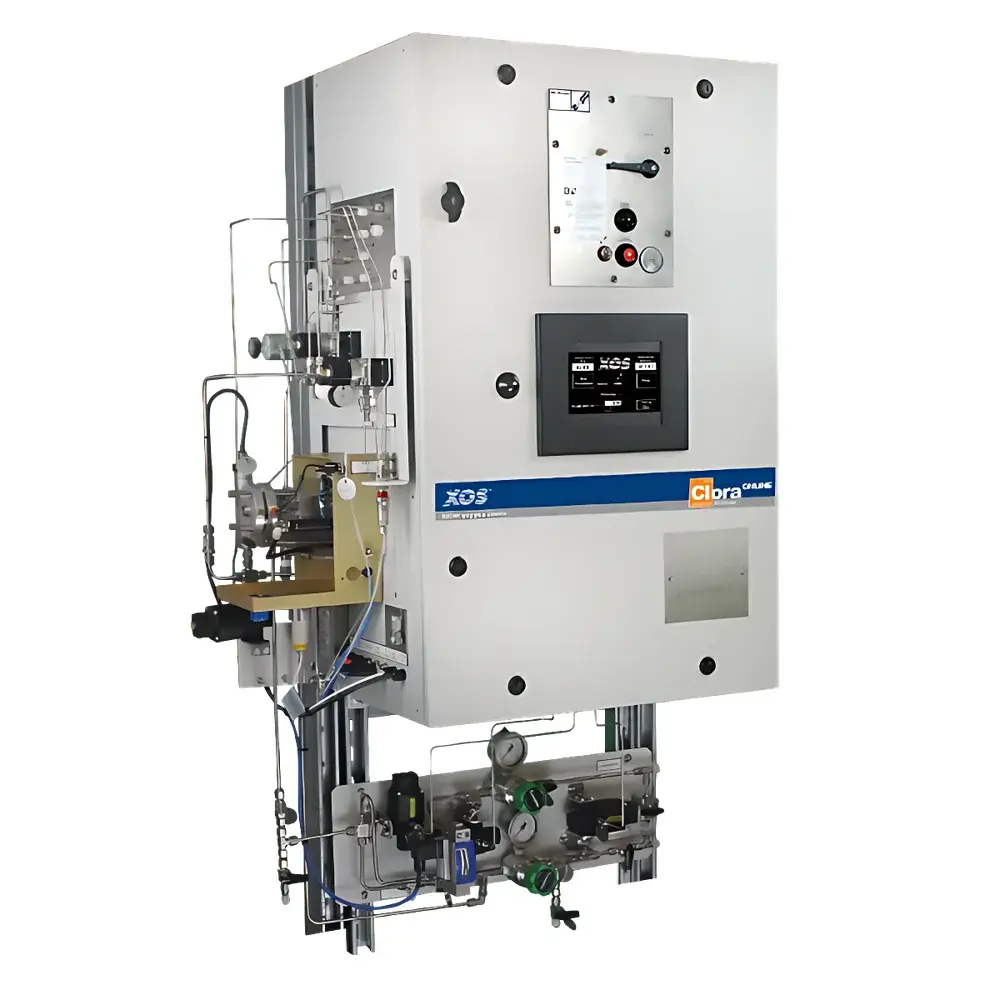
XOS Clora Online Monochromatic Wavelength-Dispersive X-ray Fluorescence (MWD-XRF) Online Total Chlorine Analyzer
| Brand | XOS |
|---|---|
| Model | Clora Online |
| Measurement Principle | Monochromatic Wavelength-Dispersive X-ray Fluorescence (MWD-XRF) |
| Detection Limit | 0.2 ppm (in hydrocarbon matrix), 0.6 ppm (in aqueous matrix) |
| Measurable Range | 0.2 ppm – 3000 ppm |
| Compliance | ASTM D7536-16, ASTM D4929-19 (Method C), SH/T 0977-2019 |
| Sample Types | Crude oil, naphtha, gasoline, diesel, and other liquid petroleum streams |
| Installation Options | Freestanding or wall-mounted |
| Explosion Protection | Configurable to ATEX Zone 1/21 or NEC Class I Div 1/2, Groups B–D, T4 |
| Optical System | Dual hyperbolic curved crystal monochromator |
| Detector Type | High-resolution silicon drift detector (SDD) |
| Excitation Source | Low-power sealed-tube X-ray source |
| Analysis Spot Size | < 5 mm diameter |
| Calibration Requirement | Single-point calibration sufficient for full-range quantification across crude oil and distillates |
Overview
The XOS Clora Online is an industrial-grade, online total chlorine analyzer engineered for continuous, real-time monitoring of chlorine concentration in liquid hydrocarbon streams using monochromatic wavelength-dispersive X-ray fluorescence (MWD-XRF) spectroscopy. Unlike conventional energy-dispersive XRF systems, the Clora Online employs a dual hyperbolic curved crystal optical architecture to isolate and deliver a highly monochromatic primary beam at 0.473 nm — precisely tuned to excite the K-shell electrons of chlorine atoms. This selective excitation minimizes spectral interference from sulfur, iron, nickel, and other common matrix elements, enabling high specificity and ultra-low background detection. The instrument is designed for permanent integration into refinery process lines, pipeline transfer points, and storage tank interfaces, delivering stable, drift-free measurements without sample digestion, chemical reagents, carrier gases, or elevated temperature operation. Its robust mechanical design — featuring a fixed-optics path, no moving parts within the analyzer head, and a pneumatically actuated dynamic window — ensures long-term operational reliability under demanding process conditions.
Key Features
- Monochromatic excitation via dual hyperbolic curved crystal optics, eliminating spectral overlap and delivering exceptional signal-to-background ratio
- Detection limit of 0.2 ppm Cl in hydrocarbon matrices and 0.6 ppm in aqueous phases — validated per ASTM D7536-16 and D4929-19 Method C
- Full dynamic range coverage from 0.2 ppm to 3000 ppm with single-point calibration; eliminates need for multi-point curve fitting across crude, naphtha, or diesel
- Dynamic window technology enables autonomous flow-through sample presentation with minimal residence time and zero sample consumption
- ATEX-certified and NEC-compliant configurations available for hazardous area deployment (Zone 1/21, Class I Div 1/2)
- Modular mechanical architecture supports both floor-standing and wall-mounted installation with standard 4–20 mA, Modbus TCP, and OPC UA interface options
- Zero consumables: no gas cylinders, no filters, no lamps, and no heated zones — resulting in <2 hours/year maintenance downtime
Sample Compatibility & Compliance
The Clora Online is validated for direct analysis of undiluted, unprocessed liquid petroleum samples including waxy crudes, heavy naphthas, reformulated gasoline, and hydrotreated diesel. Its non-contact, low-energy X-ray interrogation avoids thermal degradation or phase separation issues common in viscous or paraffinic feeds. The analyzer complies with three internationally recognized standard test methods: ASTM D7536-16 (for aromatic solvents), ASTM D4929-19 Method C (for organic chloride quantification in crude oil), and SH/T 0977-2019 (for light distillates). All calibration protocols and data reporting structures are aligned with GLP and refinery QA/QC requirements. Raw spectral data, peak integration parameters, and calibration metadata are retained with full audit trail capability to support FDA 21 CFR Part 11 and ISO/IEC 17025 traceability frameworks.
Software & Data Management
The embedded Clora Control Suite provides real-time spectral acquisition, automated peak deconvolution, and adaptive background subtraction using proprietary iterative least-squares algorithms. Process data — including raw counts, net Cl-Kα intensity, calculated concentration, and system health diagnostics — are timestamped and exported via configurable communication protocols. The software supports scheduled automatic verification checks using reference standards, generates calibration stability reports, and flags deviations exceeding user-defined control limits. Historical datasets integrate seamlessly with DCS, MES, and LIMS platforms through native OPC UA server implementation. All configuration changes, operator logins, and result modifications are logged with immutable timestamps and user attribution to satisfy regulatory audit requirements.
Applications
The Clora Online serves critical roles across upstream, midstream, and downstream petroleum operations. In pipeline custody transfer, it detects chlorinated contaminant breakthrough during product switching, preventing corrosion in downstream units. Within refineries, it monitors effluent from hydrotreaters and hydrocrackers to ensure chloride levels remain below catalyst poisoning thresholds (<1 ppm). It supports real-time blending control in gasoline and jet fuel formulation by verifying additive-derived chloride contributions. At terminal storage facilities, it identifies saltwater ingress or carryover from desalting units by detecting sudden spikes in total chlorine — often preceding visible emulsion formation. Its ability to analyze high-wax crudes without preheating or dilution makes it uniquely suited for Arctic and deepwater production logistics.
FAQ
Does the Clora Online require sample conditioning or dilution before analysis?
No. The analyzer accepts raw, undiluted liquid hydrocarbons directly from the process stream. No heating, filtration, or solvent addition is required.
How frequently must the instrument be calibrated?
A single-point calibration using a certified reference material is sufficient for full-range accuracy across crude oil and distillates. Recalibration is recommended only after major hardware service or if QC check standards deviate by >5% of target value.
Can the system operate in explosive atmospheres?
Yes. Factory-configured versions meet ATEX II 2G Ex db IIB T4 Gb and NEC Class I Division 1 Group B–D T4 requirements, with intrinsically safe signal interfaces.
What is the typical response time for a measurement cycle?
Analysis cycle time is programmable from 30 seconds to 10 minutes, depending on required precision and process dynamics. Typical default is 2 minutes for <5% RSD at 1 ppm Cl.
Is spectral data export supported for third-party chemometric analysis?
Yes. Full-resolution spectral files (including raw pulse-height spectra and processed peak integrals) are accessible via FTP or USB and conform to ASTM E1318 spectral data interchange format.
Related Products






