
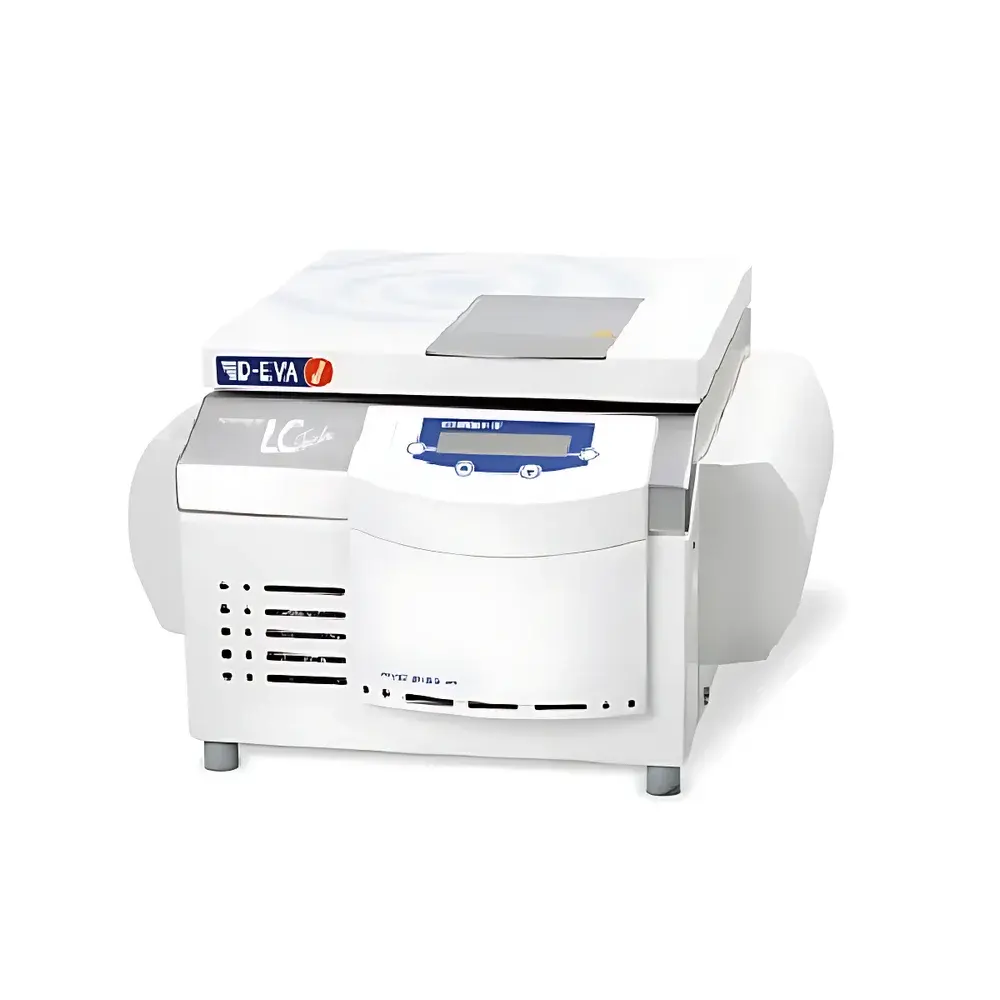
LCTech D-EVA Vacuum Centrifugal Concentrator for Dioxin and PCB Analysis
| Brand | LCTech |
|---|---|
| Origin | Germany |
| Model | D-EVA |
| Instrument Type | Vacuum Centrifugal Concentrator |
| Temperature Control Accuracy | ±0.1 °C |
| Maximum Sample Volume per Position | 85 mL |
| Parallel Processing Capacity | 1–47 samples |
| Final Volume Control Range | 30–100 µL |
| Solvent Recovery | Cryogenic Cold Trap (−50 °C typical) |
| Rotor Compatibility | Multiple interchangeable rotors for vials, tubes, and microplates |
Overview
The LCTech D-EVA Vacuum Centrifugal Concentrator is an engineered solution for the precise, reproducible, and safe concentration of trace-level dioxin and polychlorinated biphenyl (PCB) extracts in environmental, food, and feed testing laboratories. Designed explicitly for compliance with stringent analytical workflows—such as those defined in EPA Method 1613, EN 1948, and ISO 18073—the D-EVA integrates vacuum evaporation, controlled centrifugation, and real-time liquid-level sensing to deliver consistent final volumes without sample loss or degradation. Its operation relies on simultaneous application of reduced pressure (typically 0.1–5 mbar), regulated heating (up to 60 °C, adjustable in 0.1 °C increments), and continuous rotational force (up to 1,500 × g), enabling gentle yet efficient solvent removal from thermally labile analytes. Unlike generic concentrators, the D-EVA’s architecture prioritizes analyte integrity: low-temperature cold trapping (−50 °C) ensures near-complete condensation of halogenated solvents (e.g., toluene, hexane, DCM), eliminating vapor release into the laboratory environment and supporting OSHA-compliant air quality management.
Key Features
- Intelligent optical/pressure-based endpoint detection: Automatically terminates concentration at user-defined final volumes between 30 µL and 100 µL—critical for preserving ultra-trace dioxin congeners prior to GC-HRMS analysis.
- Parallel processing capability: Accommodates 1–47 samples simultaneously using modular rotors compatible with 1.5 mL–85 mL containers, including GC vials with integrated inserts, culture tubes, and 96-well plates.
- Stable centrifugal field generation: Brushless DC motor maintains constant rotational speed throughout the run, minimizing vortex formation and preventing bumping or splashing during high-boiling-point solvent removal.
- No-dry-out protection: Integrated sensor feedback loop halts vacuum and heating before complete solvent evaporation—eliminating risk of analyte decomposition or residue crystallization.
- Cryogenic solvent recovery: Integrated −50 °C cold trap achieves >99.5% capture efficiency for chlorinated and aromatic solvents, complying with local emissions regulations and reducing fume hood dependency.
- Minimal maintenance design: No internal seals requiring periodic replacement; no consumable filters; rotor autoclavable; fully compatible with GLP documentation requirements.
Sample Compatibility & Compliance
The D-EVA supports a broad range of sample matrices following cleanup via LCTech’s DEXTech series (e.g., gel permeation chromatography, silica/alumina column fractionation, or automated sulfuric acid treatment). It accepts extracts in toluene, n-hexane, dichloromethane, and acetone—solvents commonly used in dioxin/PCB isolation protocols. All wetted parts are chemically inert (PTFE-coated chamber, stainless-steel rotor, borosilicate glass viewports), ensuring compatibility with aggressive decontamination procedures. The system meets essential regulatory expectations for validated analytical environments: full audit trail logging (time-stamped events, parameter changes, error codes), password-protected method storage, and electronic signature support aligned with FDA 21 CFR Part 11 readiness. It is routinely deployed in laboratories accredited to ISO/IEC 17025 and operating under EU Regulation (EC) No 1881/2006 monitoring frameworks.
Software & Data Management
Controlled via LCTech’s proprietary D-Soft software (Windows-based), the D-EVA enables method-driven operation with up to 99 programmable protocols. Each method stores temperature ramp profiles, vacuum setpoints, rotation speed, endpoint volume thresholds, and cold trap activation logic. Software logs all operational parameters with UTC timestamps and links directly to LIMS via CSV export or OPC UA interface. Built-in diagnostics monitor cold trap temperature stability, vacuum integrity, and rotor imbalance—triggering automatic shutdown if deviations exceed preconfigured tolerances. Data files are digitally signed and tamper-evident, satisfying traceability requirements for regulatory submissions to EFSA, BfR, or USDA-FSIS.
Applications
- Final concentration of dioxin/PCB extracts prior to GC-HRMS quantification (EPA 1613B, EN 1948-1)
- Post-cleanup concentration of fish oil, milk powder, soil, and sediment extracts
- Pre-concentration of TCDD, OCDD, and non-ortho PCB congeners at sub-pg/mL levels
- Parallel processing in routine monitoring labs handling >500 samples/month
- Integration into fully automated DEXTech workflow lines for unattended 24/7 operation
FAQ
Does the D-EVA require external cooling water or compressed air?
No—its cryogenic cold trap uses a closed-cycle Peltier system; no ancillary utilities are needed.
Can it be validated for GMP environments?
Yes—IQ/OQ documentation packages are available; system supports 21 CFR Part 11-compliant user access control and electronic records.
What is the typical concentration time for 10 mL of toluene to 50 µL?
Approximately 45–60 minutes at 40 °C and 1.5 mbar, depending on ambient humidity and initial sample temperature.
Is rotor balancing required before each run?
No—the system includes automatic dynamic imbalance compensation and will pause if vibration exceeds safety thresholds.
How often does the cold trap require defrosting?
Typically once every 3–5 runs when processing 20 mL × 40 samples; defrost cycle is fully automated and takes <8 minutes.



