
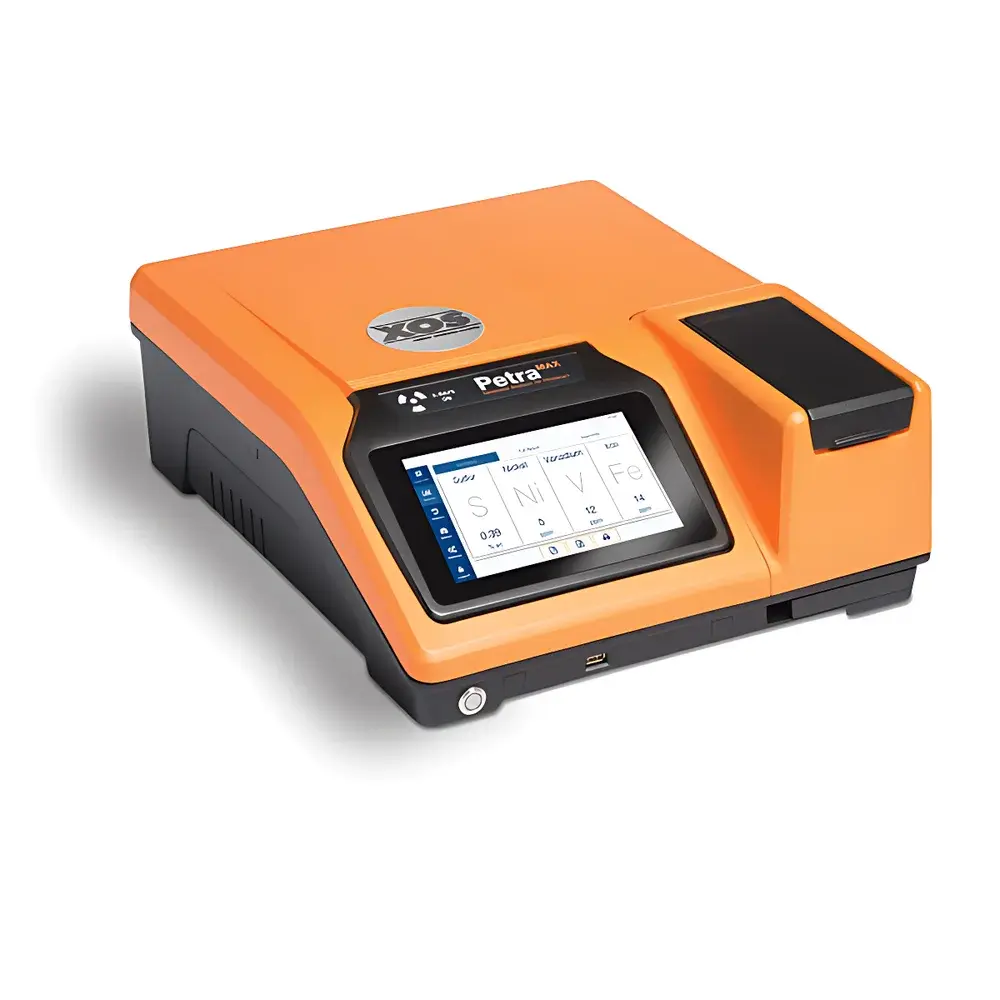
XOS Petra MAX High-Performance Energy Dispersive X-Ray Fluorescence (ED-XRF) Multi-Element Analyzer
| Brand | XOS |
|---|---|
| Origin | Imported |
| Manufacturer Type | Authorized Distributor |
| Instrument Type | Benchtop/Lab-Floor Standing |
| Configuration | Standard Model |
| Application Sector | Energy & Petrochemicals |
| Elemental Range | S, P, Cl, K, Ca, V, Cr, Mn, Fe, Co, Ni, Cu, Zn |
| Quantification Range | 5.7 ppm – 10 wt% |
| Energy Resolution | <140 eV (Mn Kα) |
| Repeatability | ≤2% RSD (at 100 ppm level) |
| Detector | Silicon Drift Detector (SDD) |
Overview
The XOS Petra MAX is a high-precision, benchtop-to-floor-standing Energy Dispersive X-Ray Fluorescence (ED-XRF) spectrometer engineered for quantitative multi-element analysis in demanding petrochemical and energy applications. Leveraging High-Definition X-Ray Fluorescence (HDXRF) technology, the system delivers ultra-low background spectra and exceptional peak-to-background ratios—enabling reliable detection and quantification of light to mid-Z elements (P to Zn) in complex hydrocarbon matrices. Unlike combustion-based or wet-chemistry methods, the Petra MAX operates on a non-destructive, ambient-temperature principle: incident X-rays excite characteristic fluorescence emissions from sample atoms, which are resolved and quantified by a high-resolution silicon drift detector (SDD). Its design prioritizes regulatory compliance, operational robustness, and analytical traceability—making it suitable for routine QC/QA, refinery process control, and third-party certification labs requiring adherence to ASTM, ISO, IP, and GB/T standard test methods.
Key Features
- High-definition ED-XRF optics with <140 eV energy resolution (Mn Kα), enabling precise spectral deconvolution of overlapping peaks (e.g., S Kα/V Kβ, Ni Kα/Fe Kβ)
- Optimized excitation geometry and vacuum-compatible sample chamber for enhanced sensitivity to light elements (P, S, Cl) without helium purge
- Patented vertical sample cup orientation with integrated spill containment tray—diverts accidental liquid overflow away from optical path, detector housing, and electronics
- No consumables required: zero gas usage, no filament replacement, no high-temperature furnace operation
- Fixed-optics architecture: no moving parts in the analyzer head—minimizing mechanical drift and long-term calibration instability
- Intuitive touchscreen interface with pre-loaded, method-specific calibration curves compliant with ASTM D4294, D8252, ISO 8754, IP 336, GB/T 17040, and GB/T 17606
- Optional QR-code–enabled sample cups for automated metadata capture (sample ID, operator, batch, date/time)
- Scalable platform: supports future integration of robotic autosamplers for unattended batch analysis
Sample Compatibility & Compliance
The Petra MAX accommodates both liquid and solid samples—including crude oil, distillates (gasoline, diesel, jet fuel, kerosene), biofuels (biodiesel, ethanol blends), lubricants, residual fuels, coal slurries, and catalyst powders—using standard 10 mL low-background XRF cups. Sample preparation is limited to homogenization and filling; no digestion, dilution, or derivatization is required. All measurement protocols are fully traceable to internationally recognized standards: ASTM D4294-16 (sulfur in petroleum products), ASTM D8252-19 (V/Ni in crude/resid), ISO 8754 (sulfur in petroleum products), IP 336 (sulfur in gas oils), and Chinese national standards GB/T 17040 and GB/T 17606. The instrument’s firmware supports audit-ready data logging aligned with GLP and GMP principles, including user authentication, electronic signatures, and immutable measurement history.
Software & Data Management
XOS SmartAnalysis™ software provides full control over acquisition parameters (voltage, current, filter selection, counting time), real-time spectrum visualization, and automated peak fitting using fundamental parameter (FP) and empirical calibration algorithms. Up to 50 independent calibration models can be stored onboard, each configurable with matrix-matched standards, interference corrections, and uncertainty estimation per element. All results include full spectral archives, measurement metadata, and statistical summaries (mean, SD, RSD, % recovery). Data export complies with ASTM E1382-compliant CSV and XML formats; optional LIMS connectivity via OPC UA or secure FTP enables seamless integration into enterprise laboratory informatics systems. Software updates are delivered through encrypted firmware channels and validated per IEC 62304 requirements.
Applications
The Petra MAX serves as a primary analytical tool across the hydrocarbon value chain: upstream (crude assay, corrosion monitoring), midstream (pipeline specification verification), downstream (refinery feedstock screening, product release testing), and regulatory compliance (EPA Tier 3, Euro 6, China VI sulfur limits). It is routinely deployed for sulfur speciation in gasoline and diesel, vanadium/nickel quantification in heavy fuel oils and catalysts, chlorine monitoring in feedstocks to prevent alkylation unit poisoning, and calcium/phosphorus screening in lubricant additives. Its sub-ppm LOD for sulfur (5.7 ppm @ 600 s) and robust repeatability (<2% RSD) meet stringent internal QA targets and external accreditation requirements (e.g., ISO/IEC 17025).
FAQ
Does the Petra MAX require helium or vacuum for light-element analysis?
No. Its optimized X-ray tube and SDD detector configuration enable reliable P, S, and Cl detection under air atmosphere—eliminating gas supply infrastructure.
Can it analyze solid samples such as coal or catalyst powders?
Yes. With appropriate pelletization or direct loose-powder loading in XRF cups, the system delivers reproducible results for heterogeneous solids per ASTM D7349 and ISO 20884 protocols.
Is method validation support available for regulatory submissions?
XOS provides full method transfer documentation, system suitability test (SST) templates, and IQ/OQ/PQ protocol guidance aligned with FDA 21 CFR Part 11 and ISO/IEC 17025 requirements.
What is the typical maintenance interval?
Annual preventive maintenance is recommended; detector performance and tube output are monitored continuously via built-in diagnostics—no scheduled recalibration is required between validations.
How does the vertical sample handling reduce downtime?
By directing spills vertically into a removable drip tray—away from the collimator, detector window, and X-ray tube—the design prevents contamination-induced signal degradation and avoids costly cleaning or component replacement.






