
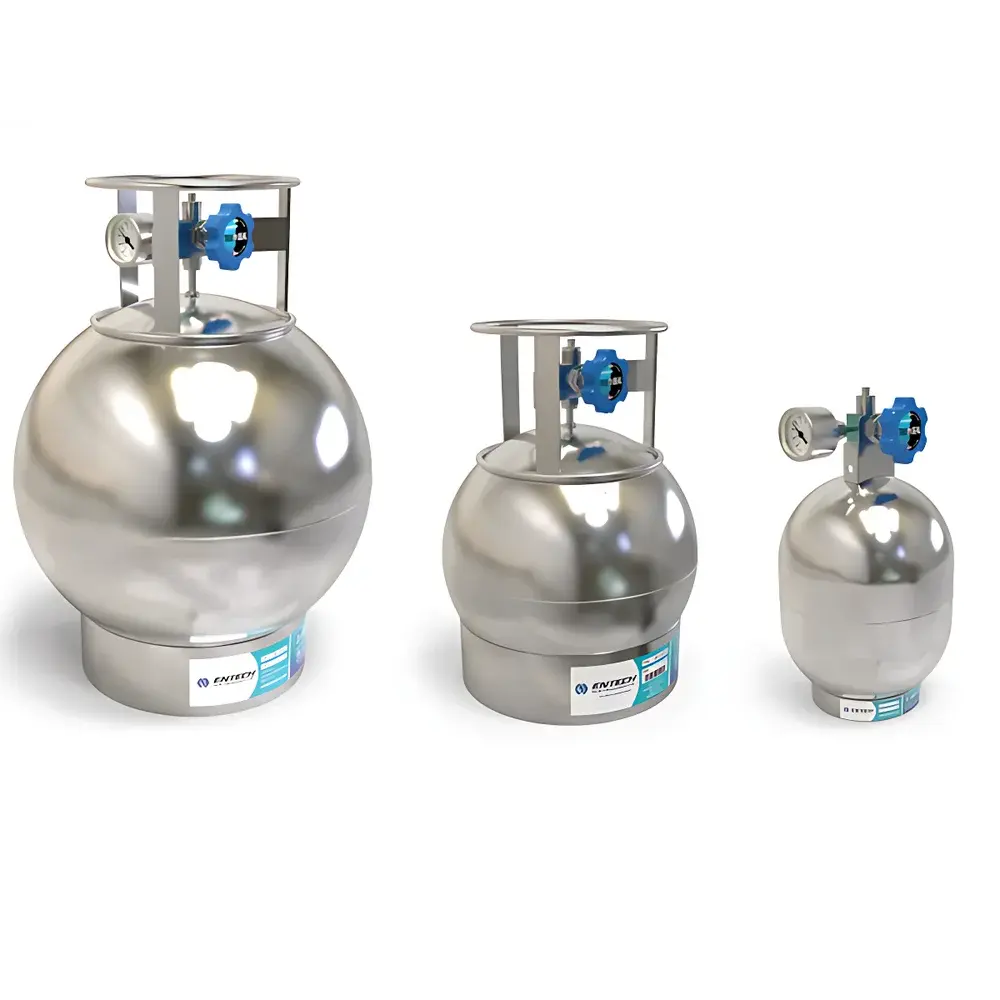
Entech Silonite® Vacuum Summa Canisters
| Brand | Entech |
|---|---|
| Origin | Imported |
| Model | Silonite® Vacuum Summa Canister |
| Capacity Options | 400 mL to 15 L |
| Maximum Pressure Rating | 40 psi |
| Internal Surface Treatment | Electropolished &熔融石英 (Silonite®) Coating |
| Valve Type | CS1200ESx with True Seal™ Dual-Stage Valve (Nickel Inner Seal + Fluoroelastomer O-Ring) |
| Compliance | EPA TO-14A, TO-15, Method 8261B |
| Storage Stability | ≥30 days for reactive sulfur compounds |
| Recovery Rate (PPB-level spikes, 7-day hold) | >85% |
| Reproducibility | ≥99% RSD |
| Cleaning Protocol | Passivated stainless steel, validated inertness per ASTM D6196 Annex A2 |
Overview
Entech Silonite® Vacuum Summa Canisters are high-fidelity, passivated stainless steel sampling vessels engineered for the quantitative collection, transport, and storage of volatile organic compounds (VOCs), semi-volatile organic compounds (SVOCs), and reactive inorganic species—including sulfides, nitrogen oxides, aldehydes, alcohols, ketones, esters, ethers, and halogenated hydrocarbons—from ambient air, indoor air, stack emissions, and fugitive sources. Unlike conventional Tedlar® or SilcoCan®-type canisters, Silonite® canisters employ a proprietary fused-silica coating technology applied via thermal vapor deposition to create an atomically smooth, chemically inert interior surface. This eliminates active sites responsible for adsorption, catalytic decomposition, or surface-mediated oxidation—critical for preserving trace-level analytes at parts-per-trillion (pptv) concentrations over extended holding periods. The canisters operate under vacuum (typically <10 mTorr) and are filled via passive (diffusion-driven) or active (pump-assisted) sampling, making them suitable for both fixed-site monitoring and remote field deployments.
Key Features
- Inert Silonite® Surface Technology: Fused-silica coating yields ultra-low surface energy and near-zero adsorption capacity, surpassing electropolished stainless steel and silanized alternatives in recovery performance for polar and reactive compounds.
- True Seal™ Dual-Stage Valve (CS1200ESx): Combines a nickel-based soft-metal seat for hermetic sample isolation with a fluorocarbon O-ring for external environmental sealing—reducing leakage rates to <1×10⁻⁸ atm·mL/s and enabling long-term integrity verification per EPA Method TO-15 Appendix B.
- Controlled Manufacturing & Validation: Each canister undergoes a mandatory 7-day inertness qualification test under low-humidity (0% RH) conditions using certified ppb-level standards (bromochloromethane, 1,2,4-trichlorobenzene, dodecane); only units demonstrating >85% average recovery across all analytes are released.
- Scalable Volume Range: Available in standardized volumes from 400 mL to 15 L, allowing optimization for target concentration ranges—from sub-ppbv ambient monitoring to high-concentration industrial source testing.
- Regulatory-Ready Design: Compliant with U.S. EPA Methods TO-14A, TO-15, and 8261B; OSHA ID-253; and NIOSH Methods 1501 and 1600. Meets GLP audit requirements for chain-of-custody documentation and method validation records.
Sample Compatibility & Compliance
Silonite® canisters demonstrate exceptional compatibility with thermally labile and highly polar VOCs that degrade or adsorb irreversibly in non-inert media. Verified performance includes quantitative retention of hydrogen sulfide, carbonyl sulfide, methyl mercaptan, formaldehyde, acetaldehyde, methanol, ethanol, acetone, methyl ethyl ketone, and methyl tert-butyl ether (MTBE) for up to 30 days at ambient temperature. All units conform to ISO/IEC 17025:2017 requirements for sampling device validation and are routinely referenced in regulatory submissions under 40 CFR Part 63, Part 60, and EU Directive 2008/50/EC. Batch-specific Certificate of Analysis (CoA) and inertness test reports are provided with every shipment.
Software & Data Management
While the Silonite® canister itself is a passive sampling device, it integrates seamlessly into Entech’s full analytical workflow—including the 7100 Series Pre-concentrators and 4700 Auto-Sampling Systems. Entech’s SummaTrack™ software supports barcode-linked sample tracking, automated calibration sequence generation, audit trail logging compliant with FDA 21 CFR Part 11, and electronic chain-of-custody documentation. Raw GC-MS data files generated from canister analysis can be imported into third-party platforms (e.g., Thermo Fisher Chromeleon, Agilent MassHunter) for statistical evaluation, including precision assessment (RSD ≤1.5% across triplicate injections) and detection limit verification (MDL ≤5 pptv for C2–C12 hydrocarbons).
Applications
- Ambient air monitoring networks (EPA SLAMS, NCore)
- Indoor air quality assessments (LEED IAQ, ASHRAE Standard 62.1)
- Industrial hygiene exposure studies (OSHA PEL compliance)
- Fugitive emission detection and quantification (LDAR programs)
- Source apportionment modeling using speciated VOC profiles
- Method validation and inter-laboratory comparison exercises
- Forensic air evidence preservation for regulatory enforcement actions
FAQ
What is the maximum recommended storage time for reactive sulfur compounds?
Reactive sulfur species—including H₂S, CH₃SH, and COS—retain ≥90% recovery for up to 30 days when stored at 20–25°C in Silonite® canisters conditioned per EPA TO-15 Section 8.2.
Can Silonite® canisters be reused, and what cleaning protocol is required?
Yes—each canister is designed for ≥100 sampling cycles when cleaned using Entech’s validated bake-out procedure (150°C for 4 hours under high-purity helium purge) followed by vacuum evacuation to <5 mTorr and inertness requalification.
How does Silonite® compare to standard electropolished canisters for aldehyde recovery?
Independent inter-laboratory studies show 25–40% higher average recovery for C1–C5 aldehydes after 7-day holds, attributed to suppression of aldol condensation and surface-catalyzed oxidation pathways.
Is certification documentation available for regulatory audits?
Yes—each lot includes a Certificate of Conformance, batch-specific inertness test report, valve leak-test record, and traceable calibration certificate aligned with ISO/IEC 17025 and NIST SRM traceability requirements.



