
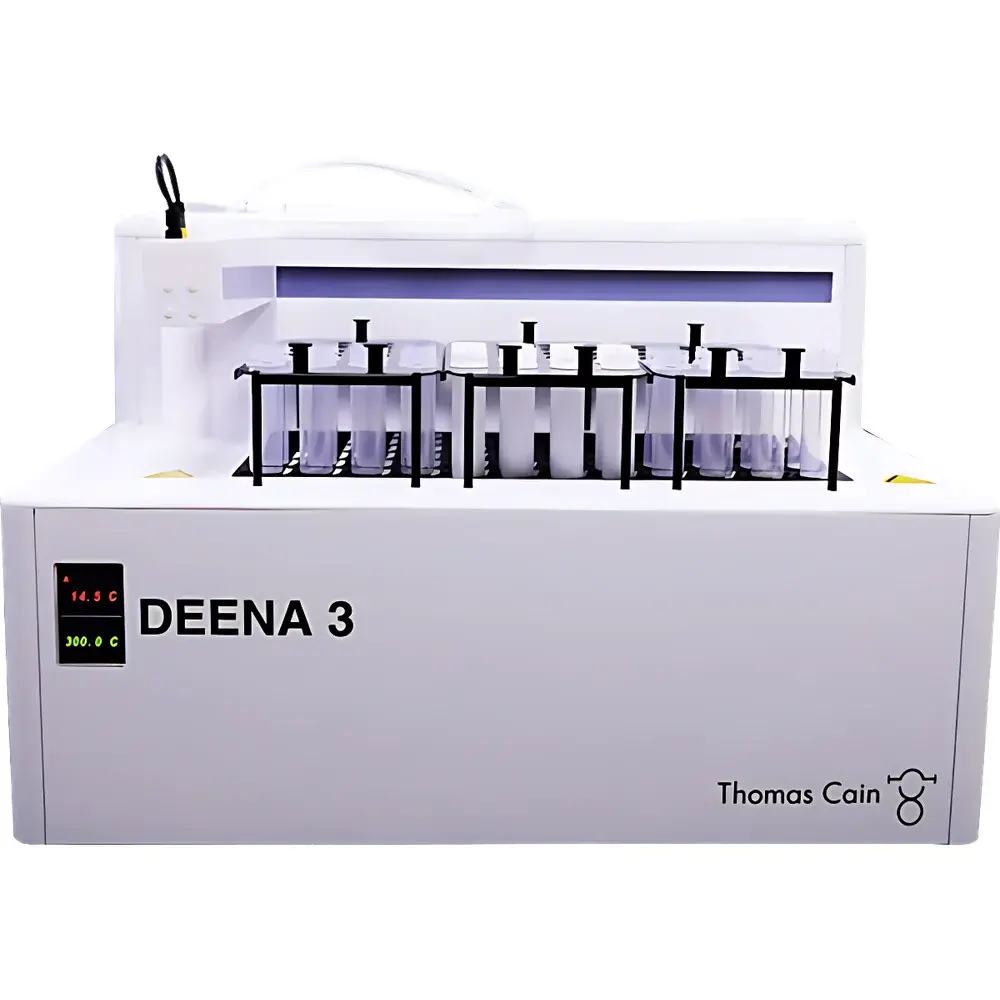
Thomas Cain DEENA3 Fully Automated Graphite Block Digestion and Sample Preparation System
| Brand | Thomas Cain |
|---|---|
| Origin | Imported |
| Manufacturer Type | Authorized Distributor |
| Model | DEENA 3 |
| Instrument Type | Graphite Block Digestion System |
| Automation Level | Fully Automated |
| Sample Capacity | 72 positions |
| Max Operating Temperature | ≥260 °C (rated up to 300 °C) |
| Temperature Control Accuracy | ±0.1 °C |
| Heating Principle | Uniform graphite block heating |
| Reagent Channels | 10 |
| Construction | Carbon-fiber-reinforced robotic arm, corrosion-resistant housing |
| Compliance | Designed for ISO/IEC 17025-compliant laboratories |
Overview
The Thomas Cain DEENA3 Fully Automated Graphite Block Digestion and Sample Preparation System is an engineered solution for high-throughput, trace-metal-grade sample digestion in environmental, food safety, clinical toxicology, and regulatory testing laboratories. It operates on the principle of controlled conductive heating via a high-density, isotropic graphite block—ensuring uniform thermal distribution across all 72 sample positions. Unlike open-vessel or microwave-assisted systems, the DEENA3 employs sealed-tube digestion under programmable temperature ramping and pressure-relief venting, minimizing analyte loss and cross-contamination while enabling complete matrix decomposition for ICP-MS, ICP-OES, and AAS analysis. Its design addresses long-standing operational constraints in automated digestion—including reagent corrosion, positional temperature drift, and volumetric imprecision—through material science–driven architecture and closed-loop fluidic control.
Key Features
- Fully automated workflow: sequential reagent addition (10 independent channels), vortex-assisted mixing, programmable temperature ramping (up to 300 °C), timed digestion cycles, post-digestion acid evaporation (“acid fuming”), and final volumetric dilution to precise endpoints (±0.5% RSD).
- Corrosion-resilient construction: graphite heating block with PTFE-coated cavity liners; carbon-fiber-reinforced robotic arm with chemically inert grippers; housing fabricated from electropolished 316L stainless steel and fluoropolymer-sealed joints.
- Precision thermal management: dual-zone PID-controlled graphite block with embedded Pt100 sensors at multiple depth layers; real-time temperature feedback ensures ±0.1 °C stability over 8-hour continuous operation.
- Intelligent liquid handling: peristaltic pumps with pulse-compensation and air-gap aspiration; integrated gravimetric calibration for each reagent channel prior to every run; automatic tip washing and waste evacuation.
- Modular expandability: optional integration with autosamplers (e.g., Gilson XYZ or CTC PAL), barcode-driven sample tracking, and LIMS-compatible output protocols (ASTM E1384, HL7 v2.x).
Sample Compatibility & Compliance
The DEENA3 accommodates standard 50 mL quartz or PFA digestion tubes, as well as custom tube geometries (15–60 mL volume range). It supports solid matrices including soil, sediment, biological tissue, plant matter, and polymer composites—validated per EPA Method 3050B, 3051A, 3052, and ASTM D5511/D5512 for heavy metal extraction. All fluidic pathways comply with USP extractables profiling, and surface materials meet FDA 21 CFR 177.2400 for food-contact suitability. The system’s electronic logbook meets ALCOA+ data integrity principles and supports 21 CFR Part 11-compliant user authentication, electronic signatures, and immutable audit trails when paired with validated software modules.
Software & Data Management
Controlled via DEENA-Suite v4.2 (Windows 10/11 64-bit), the software provides method-based workflow scripting, real-time thermal and reagent consumption dashboards, and automated report generation in PDF/A-1b and CSV formats. Each digestion run generates a timestamped metadata package—including ambient humidity/temperature logs, individual tube thermal profiles, reagent lot traceability, and deviation alerts—with SHA-256 hashing for forensic data verification. Raw instrument data exports conform to ASTM E1461 (Standard Practice for Data Exchange in Analytical Chemistry) and are compatible with Thermo Fisher Qtegra, Agilent MassHunter, and PerkinElmer Syngistix platforms.
Applications
- Regulatory compliance testing: Pb, Cd, As, Hg quantification in consumer products (CPSIA, RoHS, REACH).
- Environmental monitoring: total recoverable metals in wastewater sludge (EPA 6010D), airborne particulate filters (NIOSH 7300), and leachate analysis (TCLP/SPLP).
- Food and feed safety: multi-element screening in infant formula, seafood, and fortified cereals per EU Commission Regulation (EC) No 1881/2006.
- Clinical and forensic toxicology: whole blood, hair, and urine digestion for antimony, thallium, and uranium speciation prior to HR-ICP-MS.
- Geochemical research: silicate rock dissolution (HF-HNO₃-HClO₄) with internal standard recovery tracking (Sc, Y, In, Bi).
FAQ
What sample throughput can be achieved per 24-hour cycle?
With parallel processing of 72 samples and typical 90-minute digestion protocols (including cool-down and dilution), the DEENA3 supports up to 576 samples/day using staggered batch scheduling.
Is HF acid compatible with the DEENA3 system?
Yes—when used with PFA digestion tubes and enabled HF-safe firmware mode, which activates extended dwell times for glassware passivation and restricts maximum temperature to 220 °C during HF exposure.
How is temperature uniformity verified across the 72-position block?
Each unit undergoes factory validation using NIST-traceable infrared thermography and 12-point thermocouple mapping per ISO/IEC 17025 Annex A.4; users may rerun this protocol via built-in calibration assistant.
Does the system support remote monitoring and intervention?
Yes—via encrypted HTTPS API interface and optional VPN tunneling; real-time status, alarm notifications, and emergency hold/resume commands are accessible through authenticated web dashboard.
What maintenance intervals are recommended for long-term reliability?
Graphite block recalibration every 6 months; reagent pump tubing replacement every 3,000 cycles; full fluidic path cleaning with 10% nitric acid monthly; annual third-party performance verification per ASTM E2919.



