
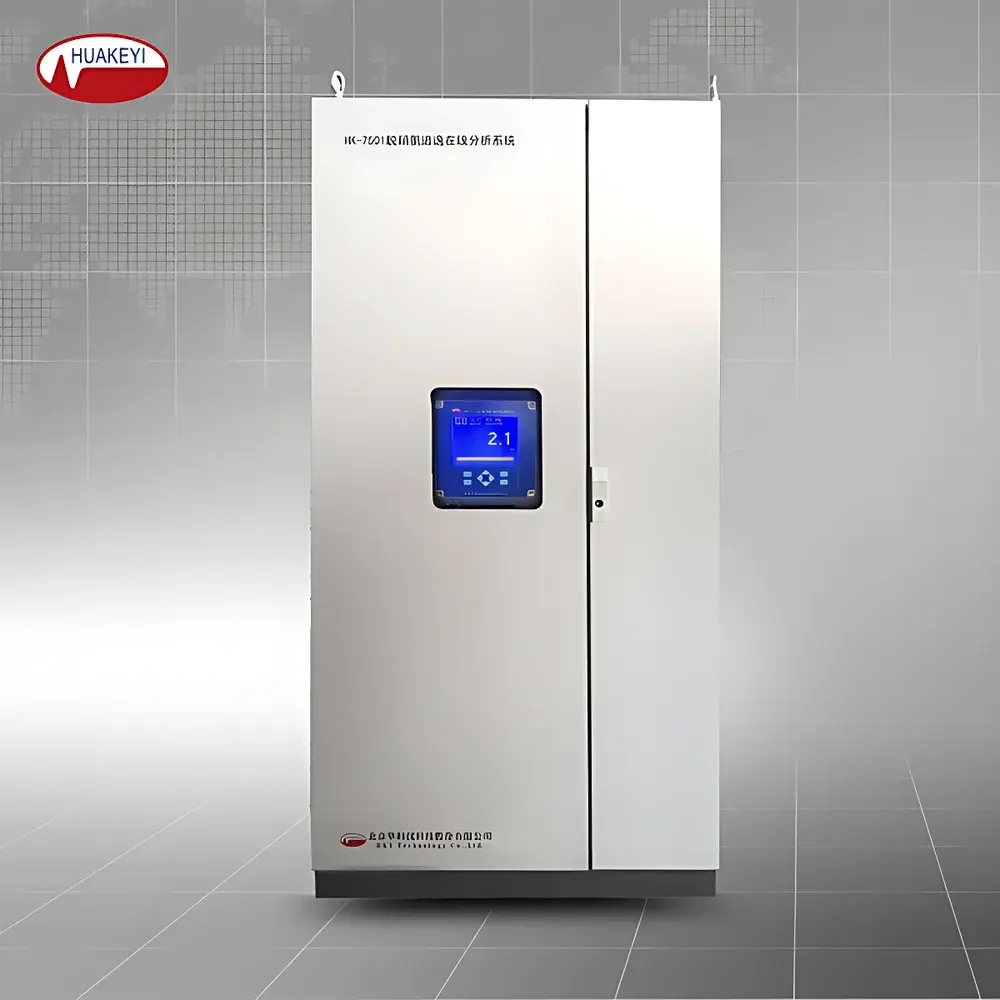
HK-7501 Huakeyi Chemical-Method Online Ammonia Slip Analyzer
| Brand | Huakeyi |
|---|---|
| Origin | Beijing, China |
| Manufacturer Type | Authorized Distributor |
| Origin Category | Domestic (China-made) |
| Model | HK-7501 |
| Price Range | USD 14,000 – 42,000 |
| Instrument Type | Online Analyzer |
| Measurement Method | Nessler Reagent Spectrophotometry |
| Measurement Range | 0–10 mg/m³ (customizable) |
| Detection Limit | 0.05 mg/m³ |
| Zero Drift | ±1% FS/month |
| Cycle Time | 5 min |
| Heating Temperature | 180–240 °C |
| Sample Flow Rate | 4–5 L/min |
| Reagent Consumption | Nessler Reagent 1 L/month, Potassium Sodium Tartrate Solution 0.5 L/month |
| Ambient Temperature | −10 to 50 °C |
| Power Supply | AC 200–240 V |
| Power Consumption | ≤1 kW |
| Compressed Air | 0.6–0.8 MPa |
| Enclosure Dimensions | 850 × 600 × 1780 mm (L×W×H) |
| Analog Output | 1 channel (0–10 mA / 0–20 mA / 4–20 mA, isolated, max load 750 Ω) |
| Relay Outputs | 3 channels |
| Communication Interface | RS485 |
| Filtration Precision | 2 µm (metal-ceramic composite membrane) |
Overview
The HK-7501 Huakeyi Online Ammonia Slip Analyzer is an industrial-grade, continuous emission monitoring system (CEMS) engineered for precise quantification of residual ammonia (NH₃) in flue gas downstream of selective catalytic reduction (SCR) or selective non-catalytic reduction (SNCR) denitrification units. It operates on the principle of high-temperature extractive sampling coupled with chemical derivatization and spectrophotometric detection—specifically, the Nessler reagent method per GB/T 18204.25–2000 and DL/T 260–2012 Annex B. Unlike optical or electrochemical alternatives, this analyzer leverages stoichiometric colorimetric reaction kinetics to convert gaseous NH₃ into stable ammonium–Nessler complexes, enabling trace-level detection with robust interference rejection in complex coal-fired or waste-to-energy flue streams.
Key Features
- High-temperature extractive sampling system with zone-specific thermal control (180–240 °C), preventing ammonium bisulfate (ABS) condensation and line blockage in low-temperature zones;
- Two-stage liquid absorption module using heated quartz-lined absorption cells, ensuring quantitative transfer of NH₃ from gas phase to aqueous phase under controlled residence time and pH;
- 2 µm metal-ceramic composite filter with thin-wall geometry and surface-modified membrane, delivering long service life (>6 months) in high-dust, high-acid gas environments (e.g., ESP or baghouse outlet ducts);
- Vacuum-driven sampling architecture with no moving parts in the gas path—eliminating pump wear, flow pulsation, and calibration drift associated with diaphragm or rotary vane pumps;
- Integrated reagent management system with dual peristaltic dosing, temperature-stabilized reaction chamber (±0.5 °C), and automatic blank correction to minimize baseline drift;
- Modular electronics cabinet compliant with IP54 ingress protection, equipped with redundant power conditioning and surge-protected I/O interfaces for plant-wide integration.
Sample Compatibility & Compliance
The HK-7501 is validated for use in flue gases containing up to 15% O₂, <100 ppm SO₂, <50 ppm NOₓ, and particulate loadings up to 50 mg/Nm³. It meets the analytical performance requirements of GB/T 18204.25–2000 (public space air) and DL/T 260–2012 (power plant SCR commissioning and operational verification). While not certified to EPA Method 7E or ISO 11564, its measurement uncertainty (<±3% RSD at 0.5 mg/m³) aligns with typical CEMS QA/QC protocols under Chinese HJ 75–2017 and HJ 76–2017 framework. The system supports audit-ready data logging with timestamped event records (e.g., zero checks, calibrations, maintenance alerts) suitable for GLP-aligned operations.
Software & Data Management
Embedded firmware provides local HMI operation via 7-inch resistive touchscreen with multilingual UI (English/Chinese). All measurement data—including raw absorbance values, calculated NH₃ concentration, temperature profiles, pressure differentials, and reagent consumption—are stored internally for ≥90 days. Data export is supported via RS485 Modbus RTU to DCS/SCADA systems. Optional OPC UA gateway enables secure cloud telemetry and remote diagnostics. Audit trail functionality logs user actions (login/logout, parameter changes, manual zero/calibrate) with SHA-256 hashing—meeting basic requirements for 21 CFR Part 11 compliance when deployed with external identity management.
Applications
- Real-time ammonia slip monitoring at SCR/SNCR exit ducts in coal-, biomass-, and waste-fired power plants;
- Performance validation during commissioning and periodic testing per DL/T 260–2012;
- Process optimization of ammonia injection grid control to minimize excess reagent use and ABS fouling;
- Compliance reporting for provincial environmental protection bureaus under China’s “Ultra-Low Emission” policy (Guo Fa [2018] No. 33);
- Research applications in pilot-scale denitrification studies requiring sub-0.1 mg/m³ resolution with chemical specificity.
FAQ
What is the recommended calibration frequency for routine operation?
A full two-point calibration (zero and span) is advised every 7 days; daily automated zero checks are performed using purified nitrogen or instrument air.
Can the HK-7501 be integrated with existing DCS platforms?
Yes—via RS485 Modbus RTU (standard) or optional Profibus DP/Modbus TCP gateways with pre-configured register mapping.
Is field maintenance training available for plant technicians?
Huakeyi offers on-site commissioning support and a 2-day operator certification course covering sample system troubleshooting, reagent replacement, and error code interpretation.
Does the system require external cooling water or chiller units?
No—all thermal management is self-contained via PID-controlled cartridge heaters and insulated ductwork; ambient air convection suffices for cabinet heat dissipation.
How is cross-sensitivity to other nitrogen-containing compounds addressed?
The Nessler method exhibits negligible response to NO, NO₂, or NH₄⁺ salts in the gas phase; rigorous pre-filtration and acid scrubbing upstream eliminate volatile amines and organic nitrogen interferences.
Related Products







