
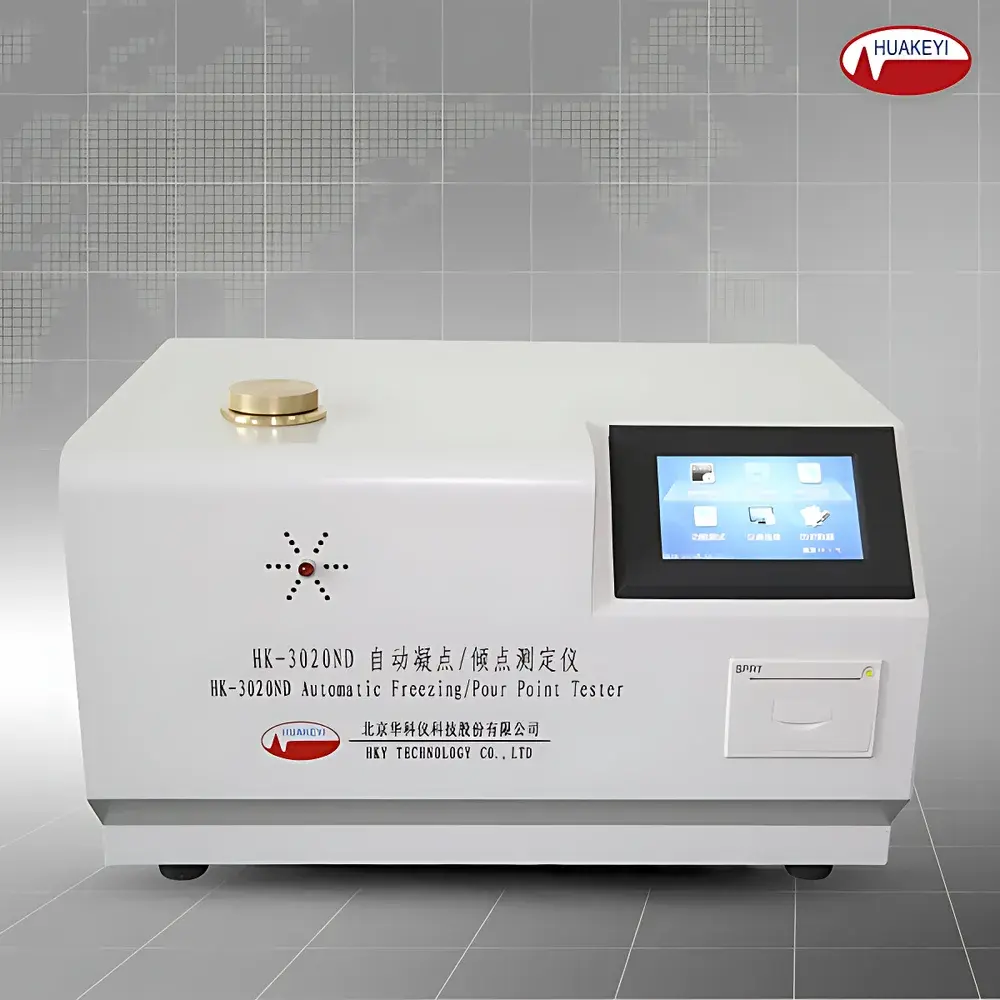
Huake Instrument HK-3020ND Automatic Cloud Point and Pour Point Tester
| Brand | Huake Instrument |
|---|---|
| Origin | Beijing, China |
| Manufacturer Type | Authorized Distributor |
| Regional Classification | Domestic (China) |
| Model | HK-3020ND |
| Price Range | USD 4,200 – 7,000 |
Overview
The Huake Instrument HK-3020ND Automatic Cloud Point and Pour Point Tester is a fully automated, microprocessor-controlled instrument engineered for precise determination of cloud point (CP) and pour point (PP) in petroleum products according to internationally harmonized test standards—including ASTM D2500 / D5949 (cloud point) and ASTM D97 / D5853 (pour point)—as well as Chinese national standards GB/T 510–1983 and GB/T 3535–2006. It operates on the principle of controlled stepwise cooling combined with optical detection and mechanical tilt assessment to identify thermally induced phase transitions: cloud point is defined as the highest temperature at which wax crystals first become visually detectable under standardized cooling conditions, while pour point is the lowest temperature at which the sample exhibits flow under gravity after specified cooling and hold intervals. The system employs Peltier-based multi-stage semiconductor refrigeration for rapid, stable thermal control across a wide operational range (ambient to –65 °C), eliminating reliance on cryogenic fluids or external chillers. Its sealed, vibration-damped thermal chamber ensures high reproducibility (<1 °C repeatability) and long-term measurement stability—critical for quality control laboratories subject to ISO/IEC 17025 accreditation requirements.
Key Features
- High-resolution color TFT-LCD touchscreen interface with bilingual (English/Chinese) menu navigation—no physical buttons; all parameter inputs, method selection, and real-time status monitoring are executed via intuitive touch prompts.
- Multi-stage thermoelectric (Peltier) cooling system enabling ≥40 °C temperature drop within 5 minutes—optimized for rapid cycle times without compromising thermal uniformity or sensor accuracy.
- Integrated safety interlocks: automatic power cutoff upon refrigeration unit overtemperature or insufficient coolant pressure (<0.5 kg/cm²) or flow (<1.5 L/min), compliant with IEC 61010-1 electrical safety requirements.
- Self-diagnostic firmware that continuously monitors sensor calibration, cooling performance, tilt actuator function, and optical detection integrity—alerts operators via on-screen codes and log entries.
- Intelligent adaptive temperature ramping and dwell logic: dynamically adjusts cooling rate and inspection interval based on sample thermal history, minimizing false negatives and reducing operator dependency.
- Dual-mode operation: supports standalone cloud point testing, standalone pour point testing, or sequential dual-parameter analysis in a single run—maximizing throughput in refinery QC and lubricant formulation labs.
- Onboard thermal printer (miniature direct thermal) with configurable auto-print or manual-trigger output; supports date/time-stamped reports compliant with GLP documentation practices.
Sample Compatibility & Compliance
The HK-3020ND is validated for use with transparent and opaque petroleum-based liquids including turbine oils, insulating oils, diesel fuels, base stocks, and dark distillates. Sample volume requirement is fixed at 30 mL per test—compatible with standard ASTM D97/D2500 sample tubes. All hardware components contacting samples (sample cup, tilt mechanism, optical window) are constructed from corrosion-resistant stainless steel and borosilicate glass to prevent catalytic interference or surface adsorption. The instrument meets electromagnetic compatibility (EMC) requirements per EN 61326-1 and conforms to environmental operating limits per IEC 60068-2 (10–35 °C ambient, ≤85% RH, 98.0–104.7 kPa). Data integrity safeguards include non-volatile memory storage (500 test records with timestamp, operator ID, and method parameters) and audit-ready export via USB 2.0 port.
Software & Data Management
Firmware v3.2+ supports time-stamped data logging with embedded metadata (test method, sample ID, ambient conditions, operator code). Test records are stored in CSV-compatible format and can be exported to LIMS or QA databases via USB mass storage mode. Optional Ethernet connectivity (RJ45) enables remote firmware updates, centralized calibration management, and integration into plant-wide SCADA systems. Audit trail functionality complies with FDA 21 CFR Part 11 principles: all critical actions (method changes, calibration events, result overrides) generate immutable logs with user authentication and timestamp. No proprietary software installation is required—data retrieval uses standard file transfer protocols.
Applications
This instrument serves routine and R&D applications across upstream, midstream, and downstream petroleum operations: cold flow property verification of jet fuel (Jet A-1, JP-8) per DEF STAN 91-91; specification compliance testing of transformer oils per IEC 60296; low-temperature performance validation of marine diesel (ISO 8217); and formulation screening of synthetic lubricants for wind turbine gearboxes. It is routinely deployed in third-party testing labs accredited to ISO/IEC 17025, power generation maintenance facilities adhering to IEEE C57.106, and aviation fuel quality assurance programs aligned with ATA SPEC 103.
FAQ
What standards does the HK-3020ND support for cloud point and pour point testing?
It fully implements GB/T 510–1983, GB/T 3535–2006, ASTM D97, ASTM D5853, ASTM D2500, and ASTM D5949—including all required cooling rates, tilt angles, hold times, and observation criteria.
Can the instrument operate without external cooling water?
No—it requires a continuous supply of deionized or softened water at ≥0.5 kg/cm² pressure and ≥1.5 L/min flow rate for heat rejection from the Peltier modules.
Is method customization possible for non-standard test protocols?
Yes—advanced users may define custom cooling ramps, dwell temperatures, and tilt intervals via password-protected engineering mode, subject to internal safety limits.
How is calibration traceability maintained?
The system supports two-point NIST-traceable reference thermometer calibration using certified PT100 probes; calibration certificates and verification logs are stored internally and exportable.
Does the instrument meet cybersecurity requirements for networked lab environments?
All network interfaces implement TLS 1.2 encrypted communication; firmware updates require signed digital signatures, and default credentials must be changed on first boot per NIST SP 800-171 guidance.






