
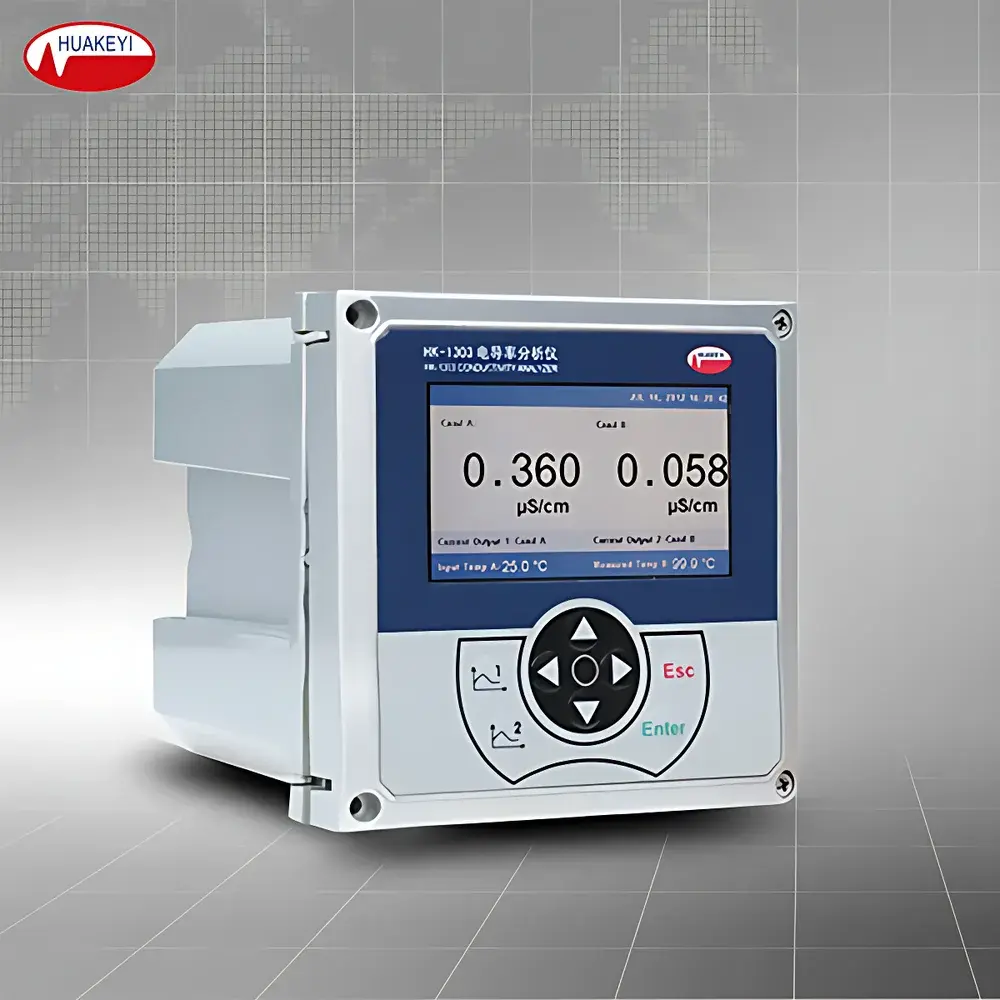
Huake Instrument HK-1305 Dual-Channel Multiparameter Water Quality Analyzer
| Brand | Huake Instrument |
|---|---|
| Origin | Beijing, China |
| Model | HK-1305 |
| Instrument Type | Online Water Quality Analyzer |
| Measurable Parameters | Conductivity, pH, Dissolved Oxygen (DO) |
| Display Resolution | 0.01 NTU (Turbidity), 0.1 °C (Temperature) |
| Measurement Accuracy | ±5% of reading (turbidity), ±0.5 °C (temperature) |
| Output Signals | Dual isolated 4–20 mA (or 0–10/0–20 mA), max. 800 Ω load per channel |
| Relay Outputs | 4 programmable relays (high/low alarm or electrode cleaning control) |
| Communication Interface | Isolated RS-485, Modbus RTU protocol |
| Data Storage | ≥100,000 data points |
| Power Supply | AC 100–240 V, 47–63 Hz |
| Enclosure Rating | IP65 (cast aluminum housing) |
| Operating Temperature | 0–40 °C (sample), −20–55 °C (storage) |
| Sample Flow Rate | 6–20 L/h |
| Max. Suspended Solid Size | ≤5 µm (no colloids or oils) |
| Response Time | ≤30 s |
| Power Consumption | ≤12 W |
| Weight | 6 kg |
| Mounting Options | Panel-mount, wall-mount, pipe-clamp |
Overview
The Huake Instrument HK-1305 Dual-Channel Multiparameter Water Quality Analyzer is an industrial-grade online monitoring system engineered for continuous, simultaneous measurement of critical water quality parameters—including conductivity, pH, and dissolved oxygen—across two independent sensor channels. Based on potentiometric (pH), galvanic/electrochemical (DO), and conductometric (conductivity) sensing principles, the analyzer delivers stable, high-reproducibility readings under dynamic process conditions. Its dual-channel architecture supports either cross-parameter monitoring (e.g., pH + DO in one loop) or redundant single-parameter verification (e.g., dual-pH monitoring across inlet and outlet streams), making it especially suitable for performance validation of filtration, demineralization, and wastewater treatment systems. Designed for integration into centralized SCADA and DCS environments, the HK-1305 complies with fundamental requirements for continuous emission monitoring systems (CEMS) and process analytical technology (PAT) frameworks in regulated industries.
Key Features
- ARM9-based embedded Linux operating system ensures deterministic real-time response and long-term firmware stability.
- Dual independent power supply modules isolate analog signal paths, minimizing electromagnetic interference (EMI) from shared plant utilities.
- Configurable temperature compensation using Pt100, NTC30K, or manual input—enabling precise correction for pH and conductivity measurements per ISO 7888 and ASTM D1125 standards.
- Industrial-grade cast aluminum enclosure (IP65 rated) with thermal mass design supports operation in ambient temperatures up to 55 °C and resists corrosion in chemical-laden atmospheres.
- Modular electrode interface accommodates interchangeable online sensors—pH glass electrodes, polarographic/galvanic DO probes, and toroidal/conductivity cells—with automatic sensor recognition via digital ID pins.
- Four user-programmable relays support fail-safe alarm logic (high/low limits), timed electrode cleaning cycles, or interlock signaling to upstream/downstream process equipment.
- Isolated RS-485 port implements standard Modbus RTU protocol (slave mode), enabling seamless integration with PLCs, HMIs, and cloud-based data historians without protocol gateways.
- Onboard SD card slot permits field firmware updates, offline data retrieval, and configuration backup—reducing dependency on remote engineering support during maintenance windows.
- Large internal file system stores ≥100,000 timestamped records (including raw sensor values, temperature, alarms, and relay states) with configurable logging intervals down to 1 second.
Sample Compatibility & Compliance
The HK-1305 is validated for use with low-turbidity, non-colloidal aqueous streams meeting the following physicochemical constraints: sample temperature 0–40 °C; flow rate 6–20 L/h; suspended particle size ≤5 µm; absence of oils, greases, or gelatinous substances. It conforms to IEC 61000-6-2 (immunity) and IEC 61000-6-4 (emissions) for industrial environments. Electrical safety meets IEC 61010-1:2010 (measurement category II, pollution degree 2), including dielectric strength testing at 1500 VAC/1 min and insulation resistance ≥40 MΩ. While not certified to FDA 21 CFR Part 11 out-of-the-box, its audit-trail-capable data logging architecture supports GLP/GMP-aligned validation when deployed with controlled change management procedures.
Software & Data Management
The analyzer operates with a local GUI rendered on a 480×272 pixel monochrome LCD, supporting bilingual (English/Chinese) menu navigation. All configuration—including calibration schedules, alarm thresholds, relay logic, and output scaling—is performed via front-panel keypad or remotely via Modbus register writes. Historical data export follows CSV format compatible with Excel, LabVIEW, and PI System import tools. Firmware updates are signed and version-locked to prevent unauthorized modifications. Optional PC-based configuration utility (Windows only) provides graphical calibration curve plotting, trend visualization over 72-hour windows, and batch export of event logs (e.g., calibration events, relay activations, sensor timeouts).
Applications
- Power generation: Condensate polishing loop monitoring (pH/condensate conductivity), boiler feedwater purity assurance.
- Pharmaceutical manufacturing: USP and compliant purified water (PW) and water for injection (WFI) distribution system surveillance.
- Food & beverage processing: Rinse water conductivity verification, CIP solution concentration tracking, and final rinse DO profiling.
- Chemical processing: Effluent stream compliance checking against local discharge permits (e.g., EPA NPDES limits for pH and conductivity).
- Municipal water treatment: Real-time assessment of coagulation efficiency via turbidity differential across flocculation basins.
FAQ
Can the HK-1305 measure turbidity?
Yes—the instrument includes built-in turbidity measurement capability with dual-range optical detection (0.00–19.99 NTU and 20.0–500.0 NTU), compliant with ISO 7027 for nephelometric turbidity determination.
Is calibration traceable to NIST standards?
Calibration is performed using certified reference materials (CRM) traceable to national metrology institutes; full calibration certificates—including uncertainty budgets—are available upon request for IQ/OQ documentation.
Does the device support automatic temperature compensation for all parameters?
Yes—temperature input (via Pt100, NTC30K, or manual entry) is applied dynamically to pH, conductivity, and DO algorithms per industry-standard compensation models (e.g., DIN 19263 for conductivity, APHA 4500-O G for DO).
What is the maximum cable length between sensor and analyzer?
Standard sensor cables are supplied at 10 m; extended lengths up to 30 m are supported with appropriate shielding and signal conditioning—consult factory for noise mitigation guidelines.
Can relay outputs be configured for fail-safe shutdown sequences?
Yes—each of the four relays supports configurable de-energized-on-alarm behavior, time-delayed activation, and latching modes, aligning with IEC 61511 functional safety requirements for SIL-1 applications.







