
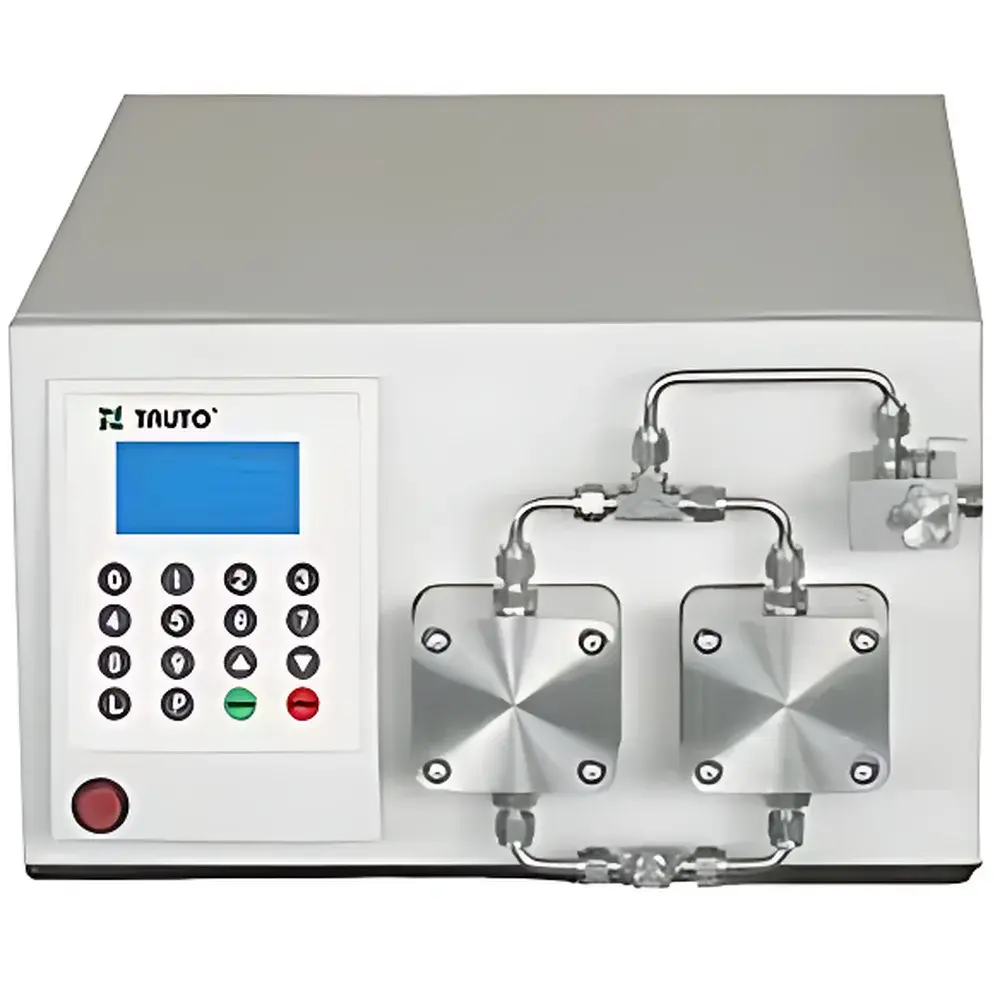
Tongtian TBP-1T02 Dual-Piston Constant Flow Pump
| Brand | Tongtian |
|---|---|
| Origin | Shanghai, China |
| Model | TBP-1T02 |
| Flow Range | 0.1–1000.0 mL/min |
| Pressure Range | 0–2.0 MPa |
| Pressure Pulsation | ≤ 0.20 MPa |
| Flow Accuracy | ≤ 3% (1–100 mL/min), ≤ 1.5% (100–1000 mL/min) |
| Flow Repeatability | ≤ 1.5% (1–100 mL/min), ≤ 1% (100–1000 mL/min) |
| Pressure Accuracy | ≤ 0.05 MPa |
| Wetted Materials | Sapphire, 316L Stainless Steel, Zirconia Ceramic |
| Interface | RS232 |
| Power Supply | 220 V ±10%, 50/60 Hz |
| Power Consumption | 150 W |
| Dimensions | 500 × 380 × 220 mm |
| Weight | 30 kg |
Overview
The Tongtian TBP-1T02 Dual-Piston Constant Flow Pump is an industrial-grade, microprocessor-controlled positive displacement pump engineered for high-precision, continuous liquid delivery under stable pressure and flow conditions. Based on dual-piston reciprocating actuation with active pulse dampening, it operates on the principle of volumetric displacement—where each stroke delivers a fixed volume of fluid, enabling deterministic flow control independent of backpressure within its operational envelope. Designed for mid-pressure applications up to 2.0 MPa (20 bar), the pump maintains exceptional flow stability across its full range of 0.1–1000.0 mL/min, making it suitable for preparative chromatography, solvent delivery in continuous reaction systems, catalyst feeding, and long-duration process validation studies. Its robust architecture integrates mechanical precision with digital control, supporting both standalone operation via front-panel LCD interface and remote orchestration via RS232 serial communication—enabling integration into automated lab workflows and GMP-compliant process trains.
Key Features
- Dual-piston configuration with synchronized phase offset to minimize pressure pulsation (≤ 0.20 MPa), ensuring laminar flow profiles critical for sensitive detection and column integrity.
- Chemically inert wetted path constructed from sapphire (piston balls and seats), 316L stainless steel (manifolds and housings), and zirconia ceramic (seals and guides)—validated for compatibility with organic solvents, dilute acids/bases, and halogenated media.
- Microprocessor-based closed-loop flow regulation with real-time pressure monitoring and automatic flow correction algorithms, delivering ≤ 1.5% repeatability above 100 mL/min.
- Integrated overpressure protection circuitry that triggers immediate shutdown upon exceeding user-defined pressure thresholds, safeguarding downstream instrumentation and personnel.
- Front-panel 4.3-inch monochrome LCD with intuitive menu navigation; displays real-time pressure, setpoint values, elapsed runtime, and error codes.
- Built-in degassing module with adjustable venting cycle timing to eliminate entrained gas prior to delivery—critical for HPLC mobile phase supply and oxygen-sensitive synthesis.
- RS232 serial interface compliant with standard SCPI command syntax, enabling bidirectional communication with LabVIEW, Python-based control scripts, or LIMS-hosted scheduling engines.
Sample Compatibility & Compliance
The TBP-1T02 accommodates a broad spectrum of process liquids—including acetonitrile, methanol, THF, dichloromethane, aqueous buffers (pH 2–12), and low-viscosity polymer solutions—without degradation of flow accuracy or seal integrity. Its wetted materials meet ISO 10993-5 (cytotoxicity) and USP Class VI biocompatibility requirements for non-implantable devices, supporting applications in pharmaceutical formulation development and bioprocess intermediate transfer. While not certified to CE Machinery Directive Annex I or UL 61010-1 out-of-the-box, the unit complies with electromagnetic compatibility (EMC) limits per IEC 61326-1 when installed with shielded cabling and grounded enclosures. For regulated environments, audit trails of flow/pressure setpoints, runtime logs, and calibration events can be exported in CSV format to support FDA 21 CFR Part 11 compliance when paired with validated third-party data acquisition software.
Software & Data Management
The embedded firmware supports two operational modes: manual parameter entry via keypad or host-driven command execution. Standard SCPI commands include :SOURce:FLOW:SET? (query current flow setpoint), :MEASure:PRESSure:ACTual? (read live pressure), and :SYSTem:TIME:SET (configure timed run duration). All parameters—including flow rate, pressure limit, ramp time, and hold duration—are stored in non-volatile memory with battery-backed retention. Data logging occurs at 1 Hz resolution and can be streamed continuously to external storage via RS232; no proprietary drivers are required. Exported CSV files contain timestamped columns for pressure (MPa), flow (mL/min), temperature (°C, if external sensor enabled), and status flags (e.g., “OVERPRESS”, “LOW_FLOW”). The system does not perform onboard statistical analysis but exports raw datasets compatible with JMP, Minitab, or Python pandas for post-hoc SPC charting and trend analysis.
Applications
- Preparative liquid chromatography (prep-LC) and flash chromatography systems requiring stable flow up to 300 mL/min at ≤ 5 MPa—particularly where gradient formation occurs post-pump to avoid solvent miscibility artifacts.
- Continuous-flow chemical synthesis reactors, including photochemical and electrochemical cells, where stoichiometric reagent dosing must remain invariant across multi-hour campaigns.
- Environmental water analysis labs performing automated solid-phase extraction (SPE) cartridge conditioning and elution at precisely controlled flow rates to ensure method reproducibility per EPA Method 500 series protocols.
- Quality control laboratories validating excipient solubility profiles under dynamic dissolution conditions aligned with USP and Ph. Eur. 2.9.3 standards.
- Materials science research involving nanoparticle dispersion delivery into microfluidic mixing junctions, where pulse-free flow prevents aggregation nucleation.
FAQ
What is the maximum allowable viscosity for reliable operation?
The pump is rated for Newtonian fluids up to 200 cP at 25°C. For higher-viscosity media, consult the manufacturer’s derating curve; reduced stroke frequency may be required to maintain volumetric accuracy.
Can the TBP-1T02 be used in explosion-proof environments?
No. It lacks ATEX or IECEx certification. For hazardous area deployment, install within a ventilated purge cabinet meeting NEC Class I, Division 2 requirements.
Is flow calibration traceable to NIST standards?
Yes—factory calibration uses gravimetric measurement against NIST-traceable mass standards (SRM 3160a) with uncertainty < ±0.15% k=2. Certificate of Calibration is provided with each unit.
Does the pump support analog input for external flow modulation?
Not natively. Analog 0–5 V or 4–20 mA input requires optional I/O expansion module (TBP-I/O-01), sold separately.
How often should the sapphire components be inspected?
Visual inspection every 500 operating hours; replacement recommended after 2000 hours or upon observed flow deviation >2% during routine verification.



