
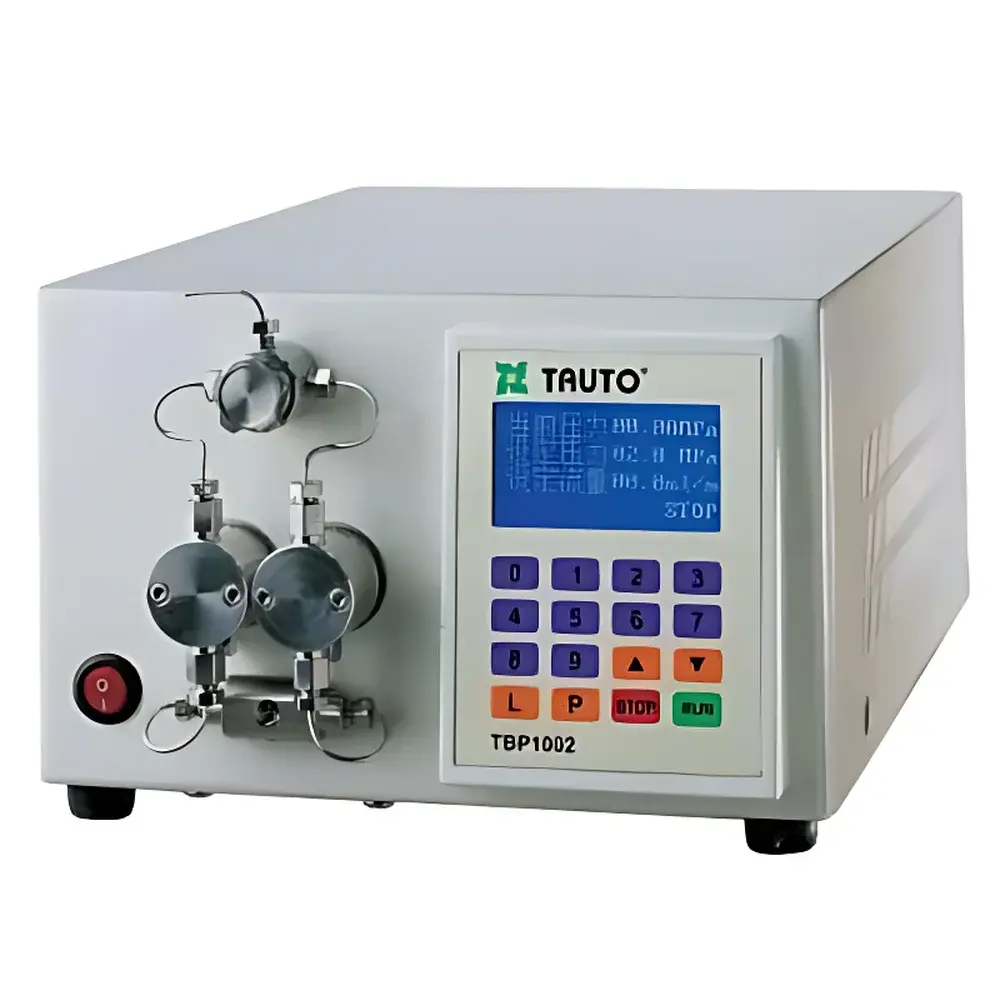
Tongtian TBP-5010 Medium-Pressure Dual-Piston Constant-Flow HPLC Pump
| Brand | Tongtian |
|---|---|
| Origin | Shanghai, China |
| Model | TBP-5010 |
| Pressure Range | 0–10.0 MPa |
| Flow Rate Range | 0.1–50.0 mL/min |
| Pressure Pulsation | ≤0.10 MPa |
| Pressure Accuracy | ≤0.05 MPa |
| Flow Setting Error | ≤1% (0.1–10 mL/min), ≤2% (10–50 mL/min) |
| Flow Precision (RSD) | ≤1% |
| Power Supply | 220 V ±10%, 50/60 Hz |
| Power Consumption | 75 W |
| Dimensions | 360 × 255 × 160 mm |
| Weight | 12 kg |
| Wetted Materials | Sapphire, 316L Stainless Steel, Zirconia Ceramic |
| Communication Interface | RS232 |
Overview
The Tongtian TBP-5010 is a medium-pressure, dual-piston constant-flow pump engineered for precision liquid delivery in analytical and preparative chromatographic applications. It operates on the principle of positive displacement via synchronized dual reciprocating pistons, minimizing flow pulsation and ensuring high volumetric reproducibility under variable backpressure conditions. Designed for use in HPLC, flash chromatography, solvent delivery systems, and continuous-flow reaction setups, the TBP-5010 delivers stable flow rates across its full operating range (0.1–50.0 mL/min) while maintaining pressure stability up to 10.0 MPa (1450 psi). Its microprocessor-based control architecture enables real-time monitoring and closed-loop regulation of both pressure and flow, supporting compliance with method-driven workflows in regulated environments.
Key Features
- Dual-piston design with sapphire pistons and sapphire check valves—ensuring extended service life, chemical inertness, and minimal wear in organic solvent-rich environments.
- Wetted path constructed from chemically resistant materials: 316L stainless steel housing, zirconia ceramic seals, and sapphire components—validated for compatibility with acetonitrile, methanol, THF, chloroform, DMSO, and dilute acids/bases.
- Low-pressure pulsation (≤0.10 MPa) achieved through precision-machined cam profiles and active flow compensation algorithms—critical for baseline stability in UV/VIS detection and mass spectrometry coupling.
- Integrated overpressure protection and automatic flow calibration routines—reducing operator dependency and supporting routine instrument qualification (IQ/OQ).
- Large backlit LCD display with intuitive menu navigation—showing real-time pressure, setpoint values, elapsed runtime, and system status indicators.
- RS232 serial interface compliant with standard SCPI command syntax—enabling seamless integration into LabVIEW, MATLAB, or custom LIMS-controlled automation sequences.
- Patented air-bleed mechanism located at the inlet manifold—facilitating rapid degassing without flow interruption or manual valve manipulation.
Sample Compatibility & Compliance
The TBP-5010 is compatible with a broad spectrum of mobile phases used in reversed-phase, normal-phase, and ion-pair chromatography. Its wetted materials meet ASTM F2029 (biocompatibility of polymeric components) and ISO 10993-5 cytotoxicity screening requirements when configured with PEEK-compatible variants (e.g., TBP-K series). While not certified for GMP manufacturing per FDA 21 CFR Part 11 out-of-the-box, the pump supports audit-trail-capable software extensions and electronic signature-ready firmware updates—making it suitable for GLP-compliant research labs and method development facilities. All pressure and flow data are timestamped and exportable in CSV format for traceability in regulatory submissions.
Software & Data Management
The embedded firmware provides local control via front-panel interface and remote operation via ASCII-based RS232 commands. Key software functions include: real-time pressure curve plotting (with configurable sampling intervals), programmable start/stop timers, user-defined flow/pressure ramps, and persistent storage of up to 10 method profiles. Data logging records pressure deviation, motor current draw, and temperature drift—enabling predictive maintenance analysis. Exported logs conform to ASTM E2500-21 guidelines for raw data integrity and may be imported directly into chromatography data systems (CDS) such as Empower or Chromeleon for cross-instrument correlation studies.
Applications
- Analytical-scale HPLC method development and validation in pharmaceutical QC laboratories.
- Preparative flash chromatography for natural product isolation and synthetic intermediate purification.
- Continuous-flow synthesis systems requiring precise stoichiometric reagent dosing under elevated backpressure.
- Mobile phase delivery in LC-MS interfaces where low pulsation minimizes ion suppression artifacts.
- Environmental testing labs performing EPA Method 8081B (PCBs) and 8270D (semivolatiles) extractions with solvent gradients.
- Academic research in polymer science, where controlled monomer feed rates influence molecular weight distribution in living radical polymerizations.
FAQ
What is the maximum allowable viscosity for stable operation?
The TBP-5010 maintains rated accuracy up to 20 cP at 50 mL/min; above this, flow rate should be reduced proportionally to preserve linearity and avoid motor overload.
Can the pump be operated in gradient mode with external solvent selection valves?
Yes—when paired with TTL-triggered 6-port or 10-port switching valves, the TBP-5010 supports isocratic and step-gradient protocols; however, true continuous binary gradients require the Grad-series dual-pump configuration.
Is calibration traceable to NIST standards?
Factory calibration uses gravimetric flow verification against NIST-traceable balance and stopwatch; users may perform field recalibration using certified flow meters meeting ISO 4064 Class B specifications.
Does the pump support pulseless flow for sensitive detectors?
Its dual-piston architecture achieves ≤0.10 MPa pressure ripple at all flow rates—a performance level validated per ISO 11607-2 Annex C for low-noise detector interfacing.
What maintenance intervals are recommended for sapphire components?
Sapphire pistons and balls require no scheduled replacement under typical usage (≤8 h/day, <5 MPa average pressure); inspection is advised every 6 months or after 5000 hours of cumulative runtime.



